Waszkiewicz Paweł, Lewulis Piotr, Górski Michał, Czarnecki Adam, Feleszko Wojciech
Department of Criminalistics, Faculty of Law and Administration, University of Warsaw, Krakowskie Przedmieście 26/28, 00-927 Warsaw, Poland.
ARC Rynek i Opinia, Market Research Institute, Słowackiego 12, 01-627 Warsaw, Poland.
Vaccines (Basel). 2022 Jul 5;10(7):1081. doi: 10.3390/vaccines10071081.
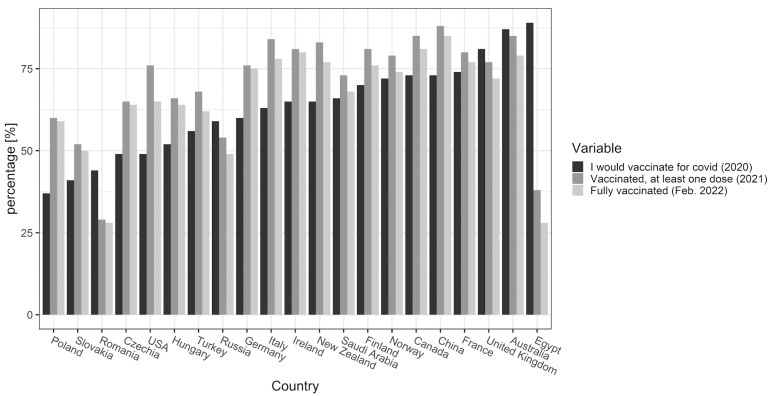
The paper presents a longitudinal cohort survey on the public acceptability of COVID-19 vaccination and real vaccination levels. A survey on a representative sample of adult Polish citizens ( = 1066) was conducted in June 2020 and, one year later, the same group was approached to compare the hypothetical declarations with the real vaccination decisions ( = 438). A significant part of the group that declared reluctance and hesitation toward COVID-19 vaccination before that vaccination was available actually got vaccinated or plans to get vaccinated. Those respondents were asked about the reasons for changing their attitudes. Among the previously vaccine-reluctant individuals, the main reasons included concern about their health and safety (50%) and their desire to travel (26.6%). Vaccine-hesitant individuals also indicated health and safety as their primary concern (69%), as well as the pursuit of herd immunity and a notion of common social safety (12.6%). The main factors helping to increase vaccination acceptance are based on a self-centered pursuit of safety and freedom from restrictions. The survey results may help to prepare a more effective vaccination campaign.
本文介绍了一项关于新冠疫苗接种公众可接受性和实际接种水平的纵向队列调查。2020年6月对波兰成年公民的代表性样本(n = 1066)进行了调查,一年后,对同一组人群进行回访,以比较假设性声明与实际接种决定(n = 438)。在有新冠疫苗之前表示不愿接种和犹豫不决的人群中,很大一部分实际上已经接种或计划接种疫苗。这些受访者被问及改变态度的原因。在之前不愿接种疫苗的个体中,主要原因包括对自身健康和安全的担忧(50%)以及出行愿望(26.6%)。对接种疫苗持犹豫态度的个体也将健康和安全作为首要关注点(69%),以及对群体免疫的追求和共同社会安全的观念(12.6%)。有助于提高疫苗接种接受度的主要因素基于以自我为中心对安全和摆脱限制的追求。调查结果可能有助于开展更有效的疫苗接种运动。