Department of Gastroenterology and Hepatology, Tongji Hospital of Tongji University, Shanghai, China.
PeerJ. 2022 Jul 21;10:e13735. doi: 10.7717/peerj.13735. eCollection 2022.
Nonalcoholic fatty liver disease (NAFLD) is the most common liver disease worldwide that endangers human health. Transcription factors (TFs) have gradually become hot spots for drug development in NAFLD for their impacts on metabolism. However, the specific TFs that regulate immune response in the development of NAFLD is not clear. This study aimed to investigate the TFs involved in the immune response of NAFLD and provide novel targets for drug development.
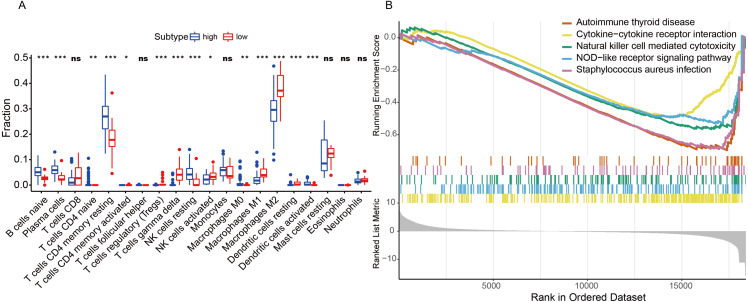
Microarray data were obtained from liver samples from 26 normal volunteers and 109 NAFLD patients using the Gene Expression Omnibus (GEO) database. Differentially expressed genes (DEGs) were analyzed by limma package. Differentially expressed transcription factors (DETFs) were obtained on DEGs combined with Cistrome Cancer database. Immune signatures and pathways hallmark were identified by ssGSSEA and GSVA. The co-regulation network was constructed by the above results. Further, quantitative Real-time Polymerase Chain Reaction (qRT-PCR), Western blot (WB) and Immunohistochemistry (IHC) were used to validate the relationship between and NAFLD. CIBERSORT analysis was performed to identify cell types to explore the relationship between differential expression of and immune cell surface markers.
A total of 617 DEGs and six DETFs (, , , , , ) were obtained by differential analysis. Immune signatures and pathway hallmarks were identified by ssGSSEA and GSVA. and were screened through the co-regulatory networks of DEGs, DETFs, immune signatures and pathway hallmarks. Furthermore, qRT-PCR, WB and IHC indicated that but not was significantly upregulated in NAFLD. Finally, , our data confirmed that GTF2I has a wide impact on the immune profile by negatively regulating the expression of the chemokine receptor family (227/261, count of significance).
plays a role in NAFLD by negatively regulating the chemokine receptor family, which affects the immune profile. This study may provide a potential target for the diagnosis or therapy of NAFLD.
非酒精性脂肪性肝病(NAFLD)是全球最常见的肝脏疾病,危害人类健康。转录因子(TFs)因其对代谢的影响,逐渐成为 NAFLD 药物开发的热点。然而,调节 NAFLD 中免疫反应的特定 TFs 尚不清楚。本研究旨在探讨参与 NAFLD 免疫反应的 TFs,为药物开发提供新的靶点。
从基因表达综合数据库(GEO)中获取 26 名正常志愿者和 109 名 NAFLD 患者的肝脏样本的微阵列数据。使用 limma 包分析差异表达基因(DEGs)。将 DEGs 与 Cistrome Cancer 数据库相结合,获得差异表达转录因子(DETFs)。通过 ssGSSEA 和 GSVA 鉴定免疫特征和途径标志。根据上述结果构建共调控网络。进一步通过定量实时聚合酶链反应(qRT-PCR)、Western blot(WB)和免疫组织化学(IHC)验证与 NAFLD 的关系。通过 CIBERSORT 分析鉴定细胞类型,以探讨差异表达与免疫细胞表面标志物的关系。
通过差异分析共获得 617 个 DEGs 和 6 个 DETFs(、、、、、)。通过 ssGSSEA 和 GSVA 鉴定免疫特征和途径标志。通过 DEGs、DETFs、免疫特征和途径标志的共调控网络筛选出和。此外,qRT-PCR、WB 和 IHC 表明,NAFLD 中显著上调,但不显著上调。最后,我们的数据证实,GTF2I 通过负调控趋化因子受体家族的表达对免疫谱产生广泛影响(227/261,显著计数)。
通过负调控趋化因子受体家族在 NAFLD 中发挥作用,从而影响免疫谱。本研究可为 NAFLD 的诊断或治疗提供潜在靶点。