Gut Liver. 2023 Jan 15;17(1):119-129. doi: 10.5009/gnl210571. Epub 2022 Jul 27.
BACKGROUND/AIMS: The prevalence of nonalcoholic fatty liver disease (NAFLD) has increased rapidly as a consequence of more sedentary lifestyles and a Westernized diet. Fracture is a major clinical problem in older people, but few large-scale cohort studies have evaluated the relationship between NAFLD and fracture. Therefore, we aimed to determine whether the fatty liver index (FLI), which represents the severity of NAFLD, can predict fracture risk.
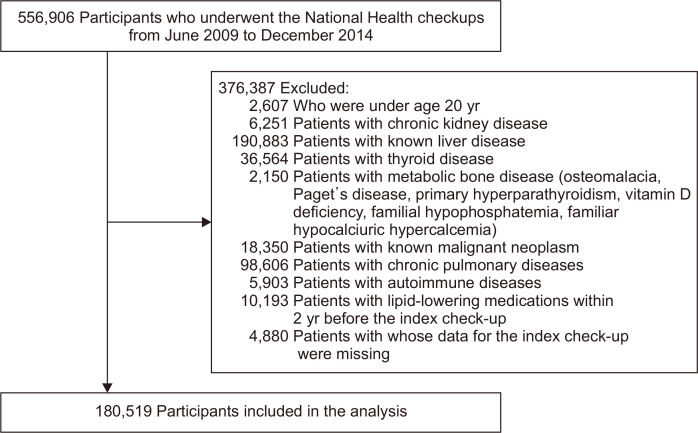
We analyzed the relationship between the FLI and incident fracture using multivariate Cox proportional hazards models and data for 180,519 individuals who underwent National Health check-ups in the Republic of Korea between 2009 and 2014.
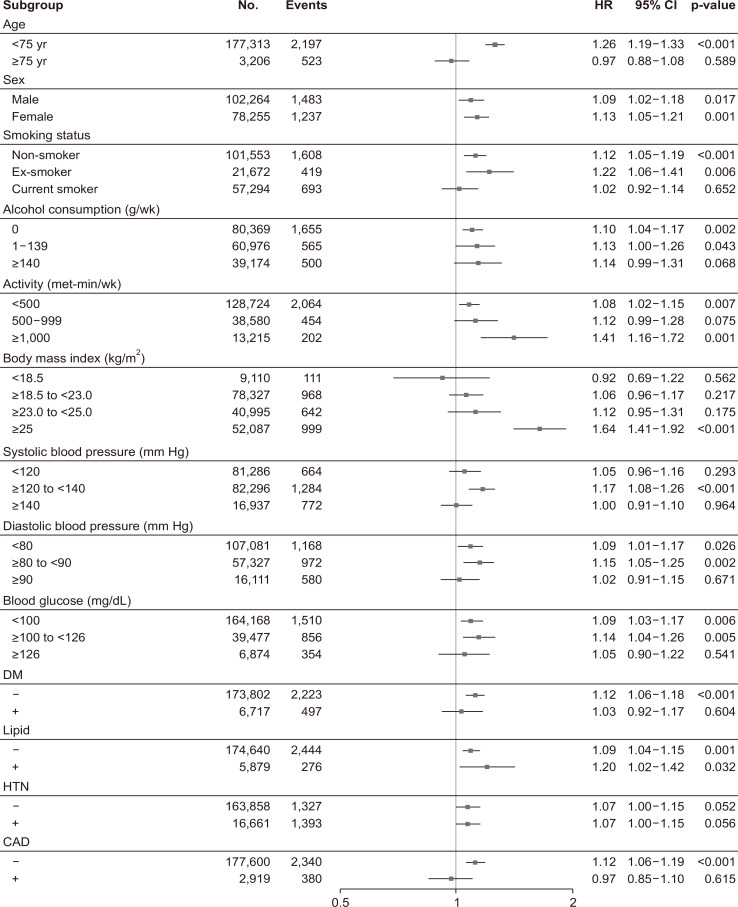
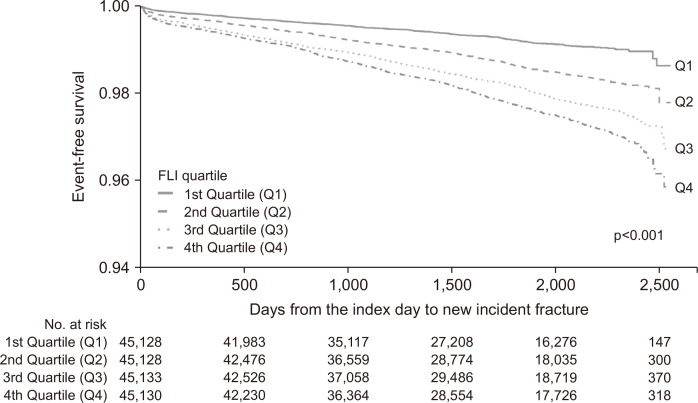
A total of 2,720 participants (1.5%) were newly diagnosed with fracture during the study period (median 4.6 years). The participants were grouped according to FLI quartiles (Q1, 0 to <5.653; Q2, 5.653 to <15.245; Q3, 15.245 to <37.199; and Q4 ≥37.199). The cumulative fracture incidence was significantly higher in the highest FLI group than in the lowest FLI group (Q4, 986 [2.2%] and Q1, 323 [0.7%]; p<0.001). The adjusted hazard ratio indicated that the highest FLI group was independently associated with a higher incidence of fracture (hazard ratio for Q4 vs Q1, 2.956; 95% confidence interval, 2.606 to 3.351; p<0.001). FLI was significantly associated with a higher incidence of fracture, independent of the baseline characteristics of the participants.
Our data imply that the higher the FLI of a Korean patient is, the higher their risk of osteoporotic fracture, independent of key confounding factors. (Gut Liver, Published online July 27, 2022).
背景/目的:由于生活方式更加久坐不动和西化饮食,非酒精性脂肪性肝病(NAFLD)的患病率迅速上升。骨折是老年人的一个主要临床问题,但很少有大规模的队列研究评估 NAFLD 与骨折之间的关系。因此,我们旨在确定代表 NAFLD 严重程度的脂肪肝指数(FLI)是否可以预测骨折风险。
我们使用多变量 Cox 比例风险模型分析了 FLI 与骨折事件之间的关系,并对 2009 年至 2014 年期间在韩国进行国家健康检查的 180519 名个体的数据进行了分析。
在研究期间,共有 2720 名参与者(1.5%)新诊断出骨折(中位数为 4.6 年)。根据 FLI 四分位数(Q1,0 至<5.653;Q2,5.653 至<15.245;Q3,15.245 至<37.199;Q4≥37.199)将参与者分为组。最高 FLI 组的累积骨折发生率明显高于最低 FLI 组(Q4,986[2.2%]和 Q1,323[0.7%];p<0.001)。调整后的危险比表明,最高 FLI 组与骨折发生率升高独立相关(Q4 与 Q1 的危险比为 2.956;95%置信区间为 2.606 至 3.351;p<0.001)。FLI 与骨折发生率升高显著相关,与参与者的基线特征无关。
我们的数据表明,韩国患者的 FLI 越高,其发生骨质疏松性骨折的风险就越高,独立于关键混杂因素。(Gut Liver,在线发表于 2022 年 7 月 27 日)。