Kim Sungmin, Lee Yu-Ran, Lee Eun-Ok, Jin Hao, Choi Yeon-Hee, Joo Hee-Kyoung, Jeon Byeong-Hwa
Research Institute for Medical Sciences, College of Medicine, Chungnam National University, 266 Munhwa-ro, Jung-gu, Daejeon 35015, Korea.
Department of Physiology, College of Medicine, Chungnam National University, 266 Munhwa-ro, Jung-gu, Daejeon 35015, Korea.
Biomedicines. 2022 Jul 23;10(8):1780. doi: 10.3390/biomedicines10081780.
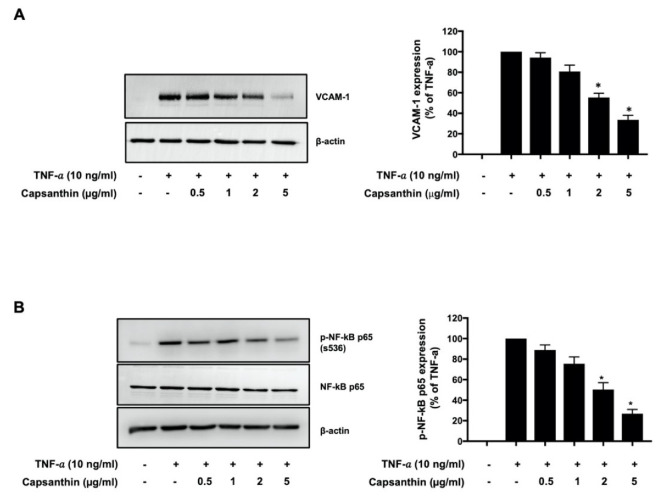
Capsanthin is a red pigment and the major carotenoid component of red paprika ( L.). However, its role in atherosclerosis is yet to be fully elucidated. This study investigated the role of dietary capsanthin in vascular inflammation in atherosclerotic mice. We evaluated the anti-atherosclerotic effects of daily oral administration of capsanthin (0.5 mg/kg of body weight/day) in apolipoprotein E-deficient (ApoE) mice fed a Western-type diet (WD). Capsanthin treatment inhibited vascular cell adhesion molecule 1 expression and nuclear factor-κB ser536 phosphorylation in tumor necrosis factor-α-stimulated cultured endothelial cells. Dietary capsanthin significantly inhibited the WD-induced elevation in the plasma levels of total cholesterol, low-density lipoprotein cholesterol (LDL-C), and triglyceride in mice. Interestingly, capsanthin reduced aortic plaque formation and VCAM-1 expression, which is vascular inflammation, in atherosclerotic mice. In addition, the neutrophil-lymphocyte ratio, a systemic inflammatory marker, was inhibited in capsanthin-treated mice. Furthermore, capsanthin significantly reduced the levels of proinflammatory cytokines, such as TNF-α, interleukin-6, and monocyte chemoattractant protein-1, in the plasma of atherosclerotic mice. Collectively, our data demonstrate that dietary capsanthin plays a protective role against atherosclerosis in hyperlipidemic mice. This protective effect could be attributed to the anti-inflammatory properties of capsanthin.
辣椒红素是一种红色色素,也是红辣椒(L.)中的主要类胡萝卜素成分。然而,其在动脉粥样硬化中的作用尚未完全阐明。本研究调查了饮食中辣椒红素在动脉粥样硬化小鼠血管炎症中的作用。我们评估了每日口服辣椒红素(0.5毫克/千克体重/天)对喂食西式饮食(WD)的载脂蛋白E缺陷(ApoE)小鼠的抗动脉粥样硬化作用。辣椒红素处理抑制了肿瘤坏死因子-α刺激的培养内皮细胞中血管细胞黏附分子1的表达和核因子-κB丝氨酸536的磷酸化。饮食中的辣椒红素显著抑制了WD诱导的小鼠血浆总胆固醇、低密度脂蛋白胆固醇(LDL-C)和甘油三酯水平的升高。有趣的是,辣椒红素减少了动脉粥样硬化小鼠的主动脉斑块形成和血管细胞黏附分子-1的表达,而血管细胞黏附分子-1的表达是血管炎症的表现。此外,辣椒红素处理的小鼠中全身炎症标志物中性粒细胞与淋巴细胞比值受到抑制。此外,辣椒红素显著降低了动脉粥样硬化小鼠血浆中促炎细胞因子如肿瘤坏死因子-α、白细胞介素-6和单核细胞趋化蛋白-1的水平。总体而言,我们的数据表明,饮食中的辣椒红素对高脂血症小鼠的动脉粥样硬化具有保护作用。这种保护作用可能归因于辣椒红素的抗炎特性。