Mancheño-Velasco Cinta, Dacosta-Sánchez Daniel, Blanc-Molina Andrea, Narvaez-Camargo Marta, Lozano-Rojas Óscar Martín
Department of Clinical and Experimental Psychology, University of Huelva, 21004 Huelva, Spain.
Research Center on Natural Resources, Health and the Environment, University of Huelva, 21004 Huelva, Spain.
J Clin Med. 2022 Jul 26;11(15):4341. doi: 10.3390/jcm11154341.
Health care provision during the COVID-19 pandemic and confinement has led to significant changes in the activity of addiction centers. These changes in healthcare activity may have had a greater impact on patients with dual pathology. The aim of this study is to compare the treatment indicators of patients with dual pathology in addiction centers during the pre-confinement, confinement, and post-confinement periods.
A retrospective observational study was conducted for the period between 1 February 2019 and 30 June 2021. A total of 2785 patients treated in specialized addiction services were divided into three periods according to their time of admission: pre-confinement, confinement, and post-confinement.
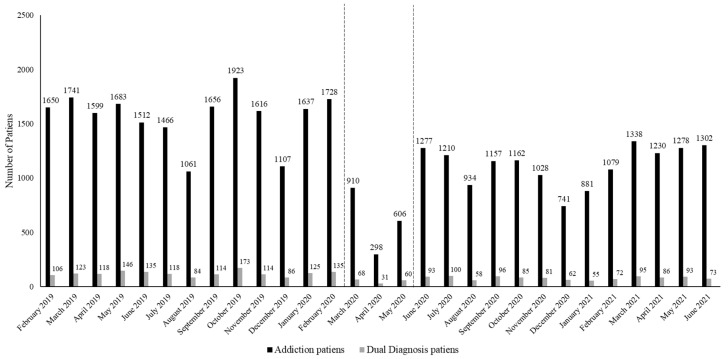
During the pre-pandemic period, the addiction centers attended to an average of 121.3 (SD = 23.58) patients, decreasing to 53 patients during confinement (SD = 19.47), and 80.69 during the post-confinement period (SD = 15.33). The number of appointments scheduled monthly for each patient decreased during the confinement period, although this number increased after confinement. There was a reduction in the number of toxicological tests carried out both during and after confinement (except for alcohol).
The results show a reduction in the number of patients seen and the care activity delivered to dual diagnosis patients. These results, which were caused by the COVID-preventive measures, may affect the progress and recovery of dual patients. A greater investment is needed to bring the care activity up to the standards of the years prior to confinement.
2019冠状病毒病大流行及封锁期间的医疗保健服务导致成瘾治疗中心的活动发生了重大变化。这些医疗保健活动的变化可能对患有双重病理的患者产生了更大的影响。本研究的目的是比较成瘾治疗中心在封锁前、封锁期间和封锁后患有双重病理的患者的治疗指标。
对2019年2月1日至2021年6月30日期间进行了一项回顾性观察研究。在专门的成瘾服务机构接受治疗的2785名患者根据入院时间分为三个时期:封锁前、封锁期间和封锁后。
在疫情前时期,成瘾治疗中心平均接待121.3名(标准差=23.58)患者,在封锁期间降至53名(标准差=19.47),在封锁后时期为80.69名(标准差=15.33)。在封锁期间,为每位患者安排的每月预约次数减少,尽管在封锁后这一数字有所增加。在封锁期间和之后进行的毒理学检测数量有所减少(酒精检测除外)。
结果显示,就诊患者数量以及为双重诊断患者提供的护理活动有所减少。这些由新冠预防措施导致的结果可能会影响双重诊断患者的病情进展和康复。需要加大投资,使护理活动达到封锁前几年的标准。