Department of Computer and Information Technology, Automation and Computers Faculty, "Politehnica" University of Timișoara, Vasile Pârvan Blvd. No. 2, 300223 Timișoara, Romania.
Pulmonology Department, 'Victor Babes' University of Medicine and Pharmacy, Eftimie Murgu Square 2, 300041 Timișoara, Romania.
Tomography. 2022 Jul 27;8(4):1928-1946. doi: 10.3390/tomography8040162.
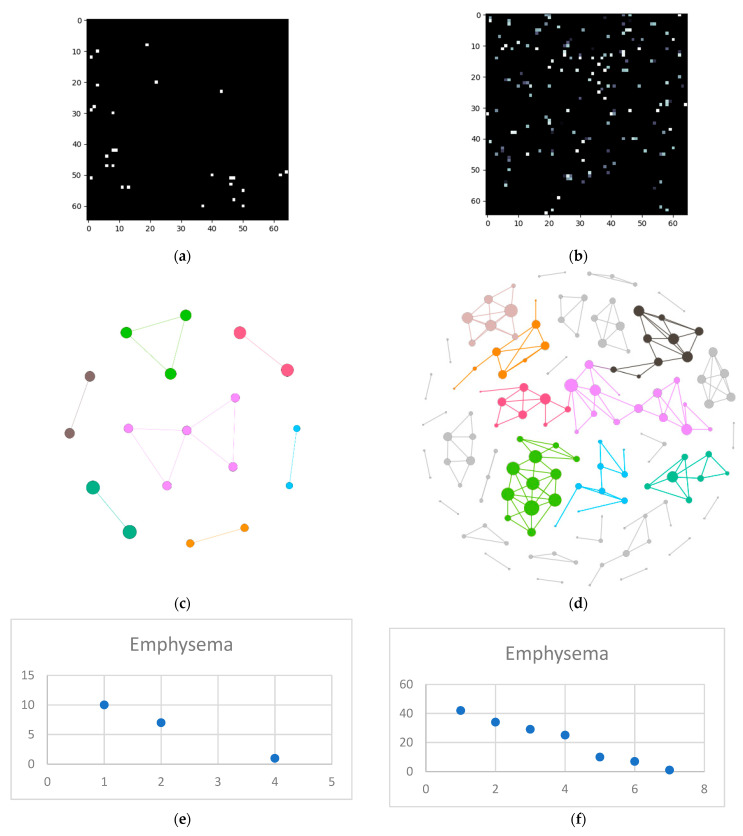
The High-Resolution Computed Tomography (HRCT) detection and diagnosis of diffuse lung disease is primarily based on the recognition of a limited number of specific abnormal findings, pattern combinations or their distributions, as well as anamnesis and clinical information. Since texture recognition has a very high accuracy percentage if a complex network approach is used, this paper aims to implement such a technique customized for diffuse interstitial lung diseases (DILD). The proposed procedure translates HRCT lung imaging into complex networks by taking samples containing a secondary lobule, converting them into complex networks and analyzing them in three dimensions: emphysema, ground glass opacity, and consolidation. This method was evaluated on a 60-patient lot and the results showed a clear, quantifiable difference between healthy and affected lungs. By deconstructing the image on three pathological axes, the method offers an objective way to quantify DILD details which, so far, have only been analyzed subjectively.
高分辨率计算机断层扫描(HRCT)对弥漫性肺疾病的检测和诊断主要基于对有限数量的特定异常发现、模式组合或其分布的识别,以及病史和临床信息。由于纹理识别在使用复杂网络方法时具有非常高的准确率百分比,因此本文旨在为弥漫性间质性肺病(DILD)实现这种技术。所提出的方法通过对包含次级小叶的样本进行处理,将 HRCT 肺部成像转换为复杂网络,并在三个维度上对其进行分析:肺气肿、磨玻璃影和实变。该方法在 60 名患者的样本上进行了评估,结果表明健康和患病肺部之间存在明显的、可量化的差异。通过对三个病理轴进行图像分解,该方法提供了一种客观的方法来量化 DILD 细节,这些细节迄今为止仅进行了主观分析。