Central Department of Microbiology, Tribhuvan University, Kirtipur, Kathmandu, Nepal.
Public Health and Infectious Disease Research Center, New Baneshwor, Kathmandu, Nepal.
Am J Trop Med Hyg. 2022 Jul 5;107(2):349-354. doi: 10.4269/ajtmh.21-0766. Print 2022 Aug 17.
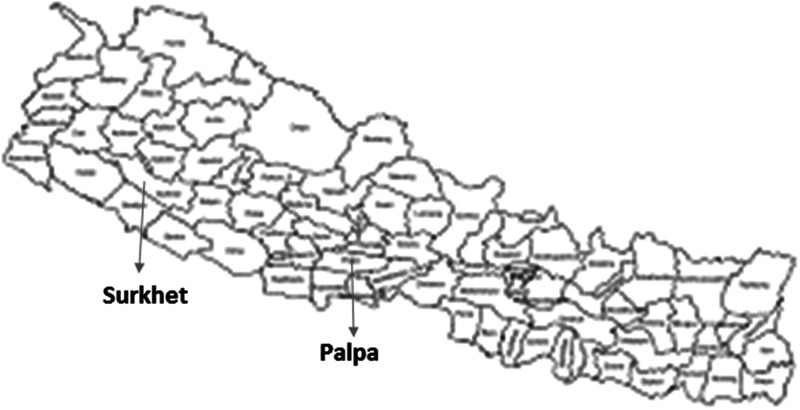
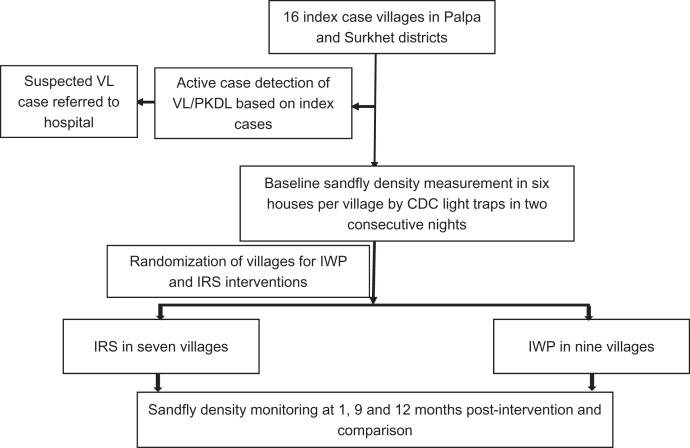
The visceral leishmaniasis (VL) elimination program in Nepal has largely completed the attack phase and is moving toward consolidation and maintenance phases. New VL foci are, however, appearing in Nepal, and therefore new innovative community-centered strategies need to be developed and tested. We conducted early case detection by an index case-based approach and assessed the feasibility, efficacy, and cost of an intervention for sandfly control through indoor residual spraying (IRS) or insecticidal wall painting (IWP) in new and low-endemic districts Palpa and Surkhet. IRS was performed in 236 households and IWP in 178 households. We screened 1,239 and 596 persons in Palpa and Surkhet, respectively, resulting in the detection of one VL case in Palpa. Both IWP and IRS were well accepted, and the percentage reductions in sandfly density after 1, 9, and 12 months of intervention were 90%, 81%, and 75%, respectively, for IWP and 81%, 59%, and 63% respectively for IRS. The cost per household protected per year was USD 10.3 for IRS and 32.8 for IWP, although over a 2-year period, IWP was more cost-effective than IRS. Active case detection combined with sandfly control through IWP or IRS can support to VL elimination in the consolidation and maintenance phase.
尼泊尔内脏利什曼病(VL)消除规划已基本完成攻击阶段,正在向巩固和维持阶段推进。然而,尼泊尔新出现了内脏利什曼病新的疫源地,因此需要制定和测试新的以社区为中心的创新策略。我们采用以索引病例为基础的方法进行早期病例发现,并评估了在新出现的低流行区 Palpa 和 Surkhet 中通过室内滞留喷洒(IRS)或杀虫粉刷(IWP)进行蚊虫控制的干预措施的可行性、效果和成本。在 236 户家庭中进行 IRS,在 178 户家庭中进行 IWP。我们分别对 Palpa 和 Surkhet 的 1,239 人和 596 人进行了筛查,在 Palpa 发现了 1 例 VL 病例。IWP 和 IRS 均被广泛接受,干预后 1、9 和 12 个月的蚊虫密度降低百分比分别为 IWP 90%、81%和 75%,IRS 分别为 81%、59%和 63%。IRS 保护每户每年的费用为 10.3 美元,IWP 为 32.8 美元,但在 2 年期间,IWP 比 IRS 更具成本效益。通过 IWP 或 IRS 进行的主动病例发现与蚊虫控制相结合,可以在巩固和维持阶段支持 VL 的消除。