Department of Public Health, Erasmus MC, University Medical Center Rotterdam, Rotterdam, Netherlands.
Department of Public Health, Erasmus MC, University Medical Center Rotterdam, Rotterdam, Netherlands.
Lancet Infect Dis. 2024 Nov;24(11):1266-1274. doi: 10.1016/S1473-3099(24)00420-1. Epub 2024 Aug 9.
Efforts to eliminate visceral leishmaniasis in India mainly consist of early detection and treatment of cases and indoor residual spraying with insecticides to kill the phlebotomine sandfly Phlebotomus argentipes that transmits the causative Leishmania protozoa. In this modelling study, we aimed to estimate the effect of indoor residual spraying (IRS) on vector abundance and transmission of visceral leishmaniasis in India.
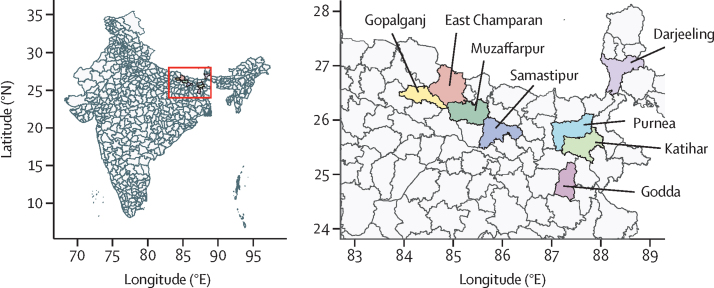
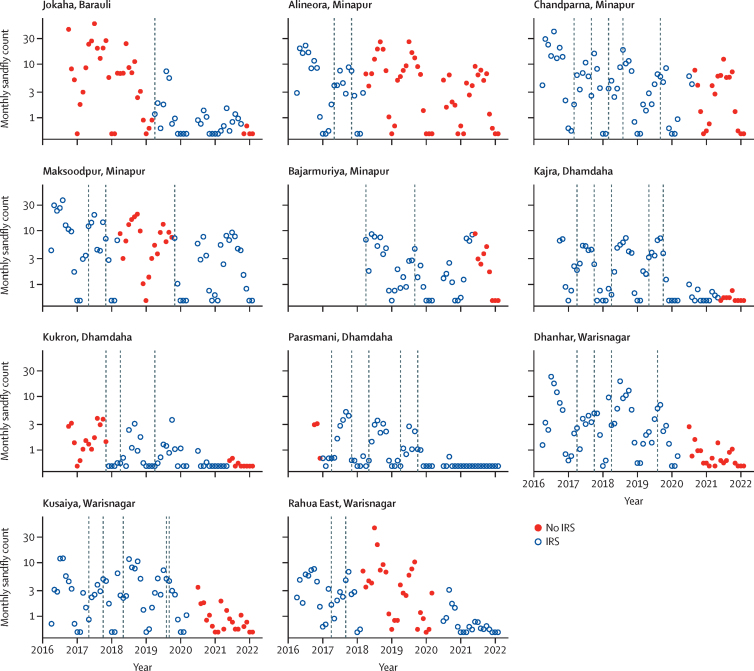
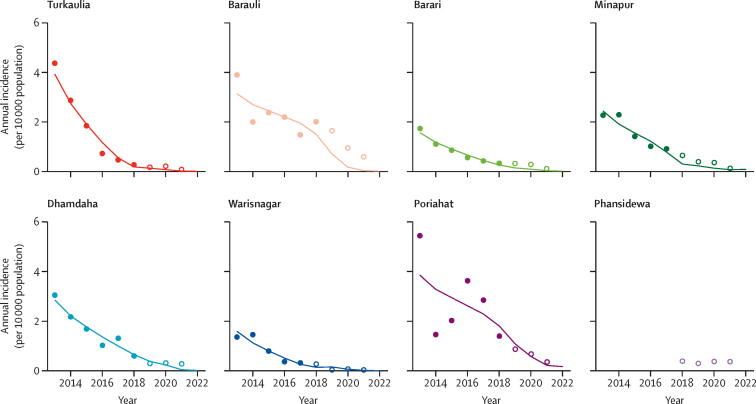
In this time-series analysis and modelling study, we assessed the effect of IRS on vector abundance by using indoor vector-abundance data (from 2016 to 2022) and IRS quality-assurance data (from 2017-20) from 50 villages in eight endemic blocks in India where IRS was implemented programmatically. To assess a potential dose-response relation between insecticide concentrations and changes in sandfly abundance, we examined the correlation between site-level insecticide concentrations and the site-level data for monthly sandfly abundances. We used mathematical modelling to link vector data to visceral leishmaniasis case numbers from the national Kala-Azar Management Information System registry (2013-21), and to predict the effect of IRS on numbers of averted cases and deaths.
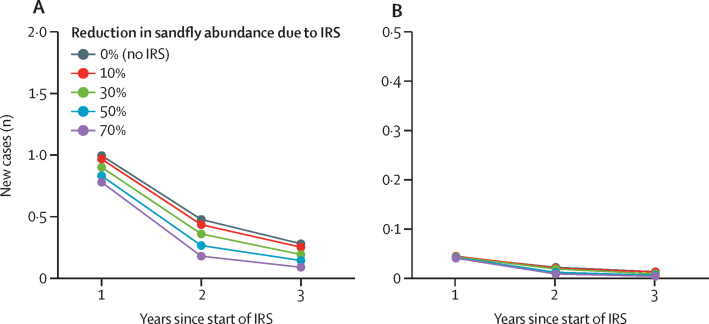
IRS was estimated to reduce indoor sandfly abundance by 27% (95% CI 20-34). Concentrations of insecticides on walls were significantly-but weakly-associated with the degree of reduction in vector abundance, with a reduction of -0·0023 (95% CI -0·0040 to -0·0007) sandflies per mg/m insecticide (p=0·0057). Reported case numbers of visceral leishmaniasis were well explained by trends in vector abundance. Village-wide IRS in response to a newly detected case of visceral leishmaniasis was predicted to reduce disease incidence by 6-40% depending on the presumed reduction in vector abundance modelled.
Indoor residual spraying has substantially reduced sandfly abundance in India, which has contributed to reductions in visceral leishmaniasis and related deaths. To prevent the re-emergence of visceral leishmaniasis as a public health problem, surveillance of transmission and sandfly abundance is warranted.
Bill & Melinda Gates Foundation.
For the Hindi translation of the abstract see Supplementary Materials section.
印度消除内脏利什曼病的努力主要包括早期发现和治疗病例,并使用杀虫剂进行室内滞留喷洒,以杀死传播致病原生动物利什曼原虫的嗜人按蚊。在这项建模研究中,我们旨在估计室内滞留喷洒(IRS)对印度内脏利什曼病传播媒介丰度的影响。
在这项时间序列分析和建模研究中,我们使用室内媒介丰度数据(2016 年至 2022 年)和来自印度八个流行地区的 50 个村庄的 IRS 质量保证数据(2017-20 年)评估 IRS 对媒介丰度的影响。为了评估杀虫剂浓度与沙蝇丰度变化之间的潜在剂量反应关系,我们检查了现场水平杀虫剂浓度与每月沙蝇丰度的现场水平数据之间的相关性。我们使用数学模型将媒介数据与国家黑热病管理信息系统登记处(2013-21 年)的内脏利什曼病病例数联系起来,并预测 IRS 对避免病例和死亡人数的影响。
IRS 估计可使室内沙蝇丰度降低 27%(95%CI 20-34)。墙壁上杀虫剂的浓度与媒介丰度降低程度显著相关,但相关性较弱,每毫克/平方米杀虫剂减少 -0.0023(95%CI -0.0040 至 -0.0007)只沙蝇(p=0.0057)。内脏利什曼病报告病例数与媒介丰度趋势密切相关。根据建模预测的媒介丰度降低程度,针对新发现的内脏利什曼病病例进行的全村范围 IRS 预计将使疾病发病率降低 6-40%。
室内滞留喷洒在印度大大降低了沙蝇的丰度,这有助于减少内脏利什曼病和相关死亡。为了防止内脏利什曼病再次成为公共卫生问题,有必要对传播和沙蝇丰度进行监测。
比尔和梅琳达·盖茨基金会。