Center for the Human-Animal Bond, College of Veterinary Medicine, Purdue University, West Lafayette, Indiana, United States of America.
Human-Animal Bond in Colorado, School of Social Work, Colorado State University, Fort Collins, Colorado, United States of America.
PLoS One. 2022 Jul 27;17(7):e0269186. doi: 10.1371/journal.pone.0269186. eCollection 2022.
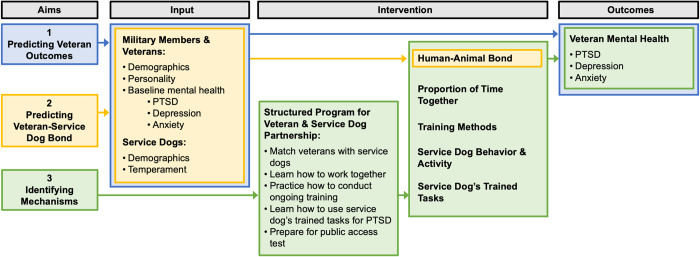
Psychiatric service dogs are an emerging complementary intervention for posttraumatic stress disorder (PTSD). Initial evidence suggests that partnership with a service dog may be related to less PTSD symptom severity. However, it remains unclear how or why this might occur. To address this gap, we conducted a longitudinal investigation of 82 post-9/11 military members or veterans and their PTSD service dogs to (1) evaluate service dog characteristics as potential predictors of efficacy, (2) assess dog and human characteristics as potential predictors of veteran-dog bond, and (3) explore potential mechanisms for mental health outcomes. Aim 1 results demonstrated that most service dog characteristics did not predict veterans' mental health outcomes, but lower service dog excitability was associated with less PTSD symptom severity at follow-up. Aim 2 results showed that closer dog-veteran relationships were associated with less excitable dog temperament. Aim 3 results indicated that worse mental health at follow-up was associated with greater use of the specifically trained PTSD service dog task to initiate a social greeting ("make a friend"), whereas better mental health was related to less use of dominance-based training methods, lower perceived emotional/logistical costs of service dog partnership, and closer veteran-dog relationships. More frequent use of the trained service dog task to signal when someone approaches from behind (cover/watch back) was associated with greater anxiety, but less PTSD symptom severity. Overall, veterans spent an average of 82% of their time with service dogs (assessed via Bluetooth proximity between dog collar and veteran smartphone), and most frequently asked their service dogs to perform the trained task for calming their anxiety (calm/comfort anxiety). The present study provides subjective and objective metrics of the heterogeneity among veteran-service dog dyads while also suggesting which of the assessed metrics might be potential mechanisms involved in the intervention.
精神科服务犬是创伤后应激障碍(PTSD)的一种新兴补充干预措施。初步证据表明,与服务犬合作可能与 PTSD 症状严重程度降低有关。然而,目前尚不清楚这是如何或为什么发生的。为了弥补这一空白,我们对 82 名 9/11 后军人或退伍军人及其 PTSD 服务犬进行了纵向调查,以(1)评估服务犬的特征是否可能成为疗效的预测因素,(2)评估犬和人的特征是否可能成为退伍军人-犬关系的预测因素,(3)探索心理健康结果的潜在机制。目标 1 的结果表明,大多数服务犬的特征并不能预测退伍军人的心理健康结果,但服务犬兴奋性较低与随访时 PTSD 症状严重程度降低有关。目标 2 的结果表明,更密切的犬-人关系与犬的兴奋性气质较低有关。目标 3 的结果表明,随访时心理健康状况较差与更多地使用专门训练的 PTSD 服务犬任务来发起社交问候(“交朋友”)有关,而更好的心理健康状况与较少使用基于支配地位的训练方法、较低的感知服务犬伙伴关系的情感/后勤成本以及更密切的退伍军人-犬关系有关。更频繁地使用受过训练的服务犬任务来指示有人从后面靠近(覆盖/照看后面)与更大的焦虑有关,但与 PTSD 症状严重程度降低有关。总体而言,退伍军人平均 82%的时间与服务犬在一起(通过狗项圈和退伍军人智能手机之间的蓝牙接近度评估),并且最常要求他们的服务犬执行训练任务来缓解他们的焦虑(平静/缓解焦虑)。本研究提供了退伍军人-服务犬对的异质性的主观和客观指标,同时还表明评估的指标中哪些可能是干预中涉及的潜在机制。