Health Personnel Training Institute, University of Medicine and Pharmacy, Hue University, Hue, Vietnam.
School of Health Care Administration, College of Management, Taipei Medical University, Taipei, Taiwan.
PLoS One. 2022 Jul 27;17(7):e0271567. doi: 10.1371/journal.pone.0271567. eCollection 2022.
Adolescents who are willing to perform first aid can help prevent injuries and ultimately death among themselves and others involved in accidents or injuries. This study aims to estimate the prevalence of students' willingness to perform first aid procedures and additionally examine associated factors among high school students in Hue, Vietnam.
A cross-sectional study utilizing multi-stage stratified random sampling was conducted between April to July 2020 by investigating 798 high school students in Hue, Vietnam. Participants were invited to complete a self-reported questionnaire pertaining to individual demographic characteristics, personal perception of self-efficacy, and willingness to perform first aid. To better interpret these findings, both multivariable linear and Poisson regression models were fitted to evaluate the association between individual student characteristics and the willingness to perform first aid.
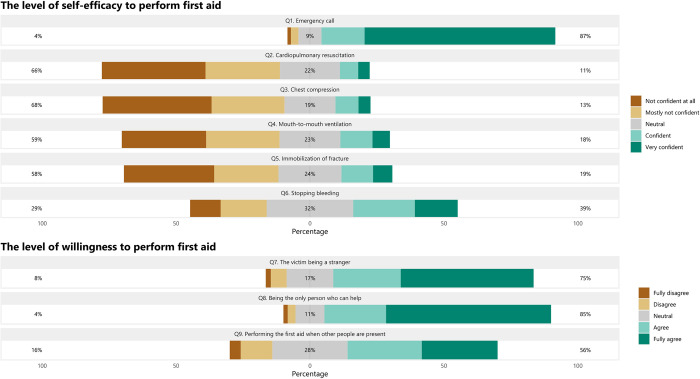
The prevalence of having willingness to perform first aid (defined as ≥4 points out of 5 to all three questions) was 49.9% (95%CI:28.6-71.2%). The major reported barriers in performing first aid were fear of making mistakes and hurting victims (34.4%, 95%CI:31.9-37.0%), no prior first aid training (29.8%, 95%CI:25.9-33.9%), and forgetting first aid steps (23.0%, 95%CI:15.8-32.2%). By employing the multivariable linear regression model, it was identified that students with high (β = 0.614, 95%CI:0.009-1.219) or very high (β = 1.64, 95%CI:0.857-2.422) levels of self-efficacy appeared to be more willing to perform first aid. Similarly, in the Poisson regression models, compared to neutral students, students who reported high (PR = 1.214, 95%CI:1.048-1.407) or very high (PR = 1.871, 95%CI:1.049-3.337) levels of self-efficacy were more willing to perform first aid.
The level of willingness to perform first aid among high school students in this study population was found to be moderate. Therefore, integrating activities to promote self-efficacy in first aid training could be considered a progressive step towards improving a student's willingness to provide such life-saving procedures.
愿意实施急救的青少年可以帮助预防自身和他人在事故或受伤中的伤害,甚至可以预防死亡。本研究旨在估计越南 Hue 高中生实施急救程序的意愿,并进一步研究其相关因素。
2020 年 4 月至 7 月,采用多阶段分层随机抽样方法,对越南 Hue 的 798 名高中生进行了横断面研究。邀请参与者完成一份自我报告的问卷,内容涉及个人人口统计学特征、个人自我效能感感知以及实施急救的意愿。为了更好地解释这些发现,同时使用多变量线性和泊松回归模型评估了学生个体特征与实施急救意愿之间的关联。
愿意实施急救(定义为对所有三个问题的回答均≥4 分)的比例为 49.9%(95%CI:28.6-71.2%)。实施急救的主要报告障碍是害怕犯错误和伤害受害者(34.4%,95%CI:31.9-37.0%),没有接受过急救培训(29.8%,95%CI:25.9-33.9%),以及忘记急救步骤(23.0%,95%CI:15.8-32.2%)。通过使用多变量线性回归模型,发现自我效能感高(β=0.614,95%CI:0.009-1.219)或非常高(β=1.64,95%CI:0.857-2.422)的学生更愿意实施急救。同样,在泊松回归模型中,与中性学生相比,报告自我效能感高(PR=1.214,95%CI:1.048-1.407)或非常高(PR=1.871,95%CI:1.049-3.337)的学生更愿意实施急救。
本研究人群中高中生实施急救的意愿水平中等。因此,在急救培训中整合活动以增强自我效能感可能是提高学生提供这种救生程序意愿的一项进步措施。