Division of Epigenomics, National Cancer Center Research Institute, Tokyo, Japan, 104-0045.
Department of Pathology, Faculty of Medicine, University of Tsukuba, Ibaraki, Japan, 305-8576.
Proc Natl Acad Sci U S A. 2022 Aug 2;119(31):e2123241119. doi: 10.1073/pnas.2123241119. Epub 2022 Jul 27.
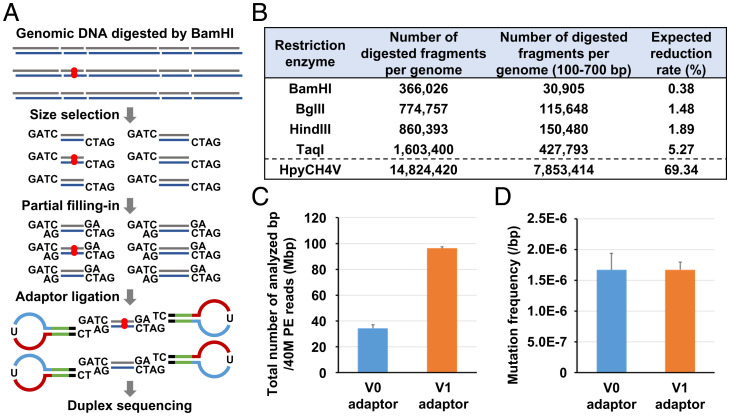
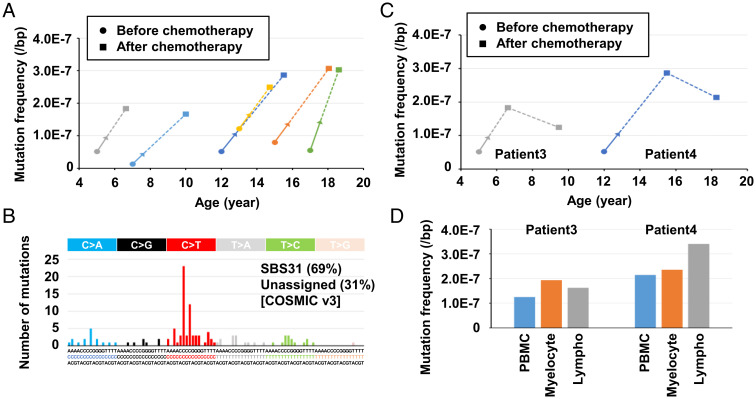
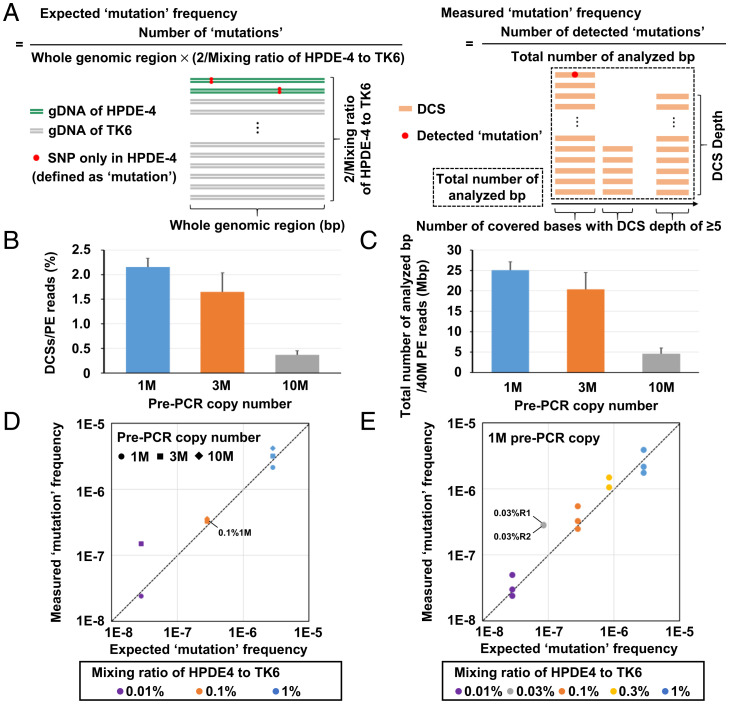
Somatic mutations are accumulated in normal human tissues with aging and exposure to carcinogens. If we can accurately count any passenger mutations in any single DNA molecule, since their quantity is much larger than driver mutations, we can sensitively detect mutation accumulation in polyclonal normal tissues. Duplex sequencing, which tags both DNA strands in one DNA molecule, enables accurate count of such mutations, but requires a very large number of sequencing reads for each single sample of human-genome size. Here, we reduced the genome size to 1/90 using the HI restriction enzyme and established a cost-effective pipeline. The enzymatically cleaved and optimal sequencing (EcoSeq) method was able to count somatic mutations in a single DNA molecule with a sensitivity of as low as 3 × 10 per base pair (bp), as assessed by measuring artificially prepared mutations. Taking advantages of EcoSeq, we analyzed normal peripheral blood cells of pediatric sarcoma patients who received chemotherapy ( = 10) and those who did not ( = 10). The former had a mutation frequency of 31.2 ± 13.4 × 10 per base pair while the latter had 9.0 ± 4.5 × 10 per base pair ( < 0.001). The increase in mutation frequency was confirmed by analysis of the same patients before and after chemotherapy, and increased mutation frequencies persisted 46 to 64 mo after chemotherapy, indicating that the mutation accumulation constitutes a risk of secondary leukemia. EcoSeq has the potential to reveal accumulation of somatic mutations and exposure to environmental factors in any DNA samples and will contribute to cancer risk estimation.
体细胞突变是随着人类组织的衰老和接触致癌物质而积累的。如果我们能够准确地计算任何单个 DNA 分子中的任何乘客突变,由于它们的数量远远大于驱动突变,我们就可以敏感地检测到多克隆正常组织中的突变积累。双链测序(Duplex sequencing)可以标记一个 DNA 分子中的两条 DNA 链,从而能够准确地计算这些突变,但每个人类基因组大小的样本都需要非常大量的测序读长。在这里,我们使用 HI 限制性内切酶将基因组大小缩小到 1/90,并建立了一个具有成本效益的管道。酶切和优化测序(EcoSeq)方法能够以低至每碱基对 3×10 的灵敏度(通过测量人工制备的突变来评估),在单个 DNA 分子中计数体细胞突变。利用 EcoSeq,我们分析了接受化疗(n = 10)和未接受化疗(n = 10)的儿科肉瘤患者的正常外周血单个核细胞。前者的突变频率为 31.2 ± 13.4×10 每碱基对,而后者为 9.0 ± 4.5×10 每碱基对(<0.001)。通过对化疗前后相同患者的分析证实了突变频率的增加,并且在化疗后 46 至 64 个月时,突变频率持续增加,表明突变积累构成了继发性白血病的风险。EcoSeq 有可能揭示任何 DNA 样本中的体细胞突变积累和环境因素暴露,并将有助于癌症风险评估。