Mendonça Michelle Mendanha, da Cruz Kellen Rosa, Dos Santos Silva Fernanda Cacilda, Fontes Marco Antônio Peliky, Xavier Carlos Henrique
Laboratório de Neurobiologia de Sistemas, Departamento de Ciências Fisiológicas, Instituto de Ciências Biológicas, Universidade Federal de Goiás, Goiânia, GO, Brazil.
Laboratório de Fisiologia Cardiovascular, Departamento de Ciências Biológicas, Instituto de Ciências Biológicas, Universidade Federal de Ouro Preto, Ouro Preto, MG, Brazil.
Braz J Psychiatry. 2022 Jul 27;44(4):434-40. doi: 10.47626/1516-4446-2021-2339.
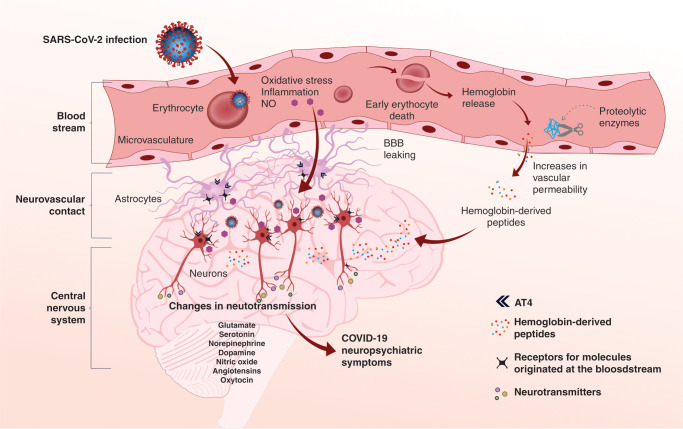
Follow-up of patients affected by COVID-19 has unveiled remarkable findings. Among the several sequelae caused by SARS-CoV-2 viral infection, it is particularly noteworthy that patients are prone to developing depression, anxiety, cognitive disorders, and dementia as part of the post-COVID-19 syndrome. The multisystem aspects of this disease suggest that multiple mechanisms may converge towards post-infection clinical manifestations. The literature provides mechanistic hypotheses related to changes in classical neurotransmission evoked by SARS-CoV-2 infection; nonetheless, the interaction of peripherally originated classical and non-canonic peptidergic systems may play a putative role in this neuropathology. A wealth of robust findings shows that hemoglobin-derived peptides are able to control cognition, memory, anxiety, and depression through different mechanisms. Early erythrocytic death is found during COVID-19, which would cause excess production of hemoglobin-derived peptides. Following from this premise, the present review sheds light on a possible involvement of hemoglobin-derived molecules in the COVID-19 pathophysiology by fostering neuroscientific evidence that supports the contribution of this non-canonic peptidergic pathway. This rationale may broaden knowledge beyond the currently available data, motivating further studies in the field and paving ways for novel laboratory tests and clinical approaches.
对新冠病毒感染者的随访揭示了一些显著的发现。在严重急性呼吸综合征冠状病毒2(SARS-CoV-2)病毒感染引起的多种后遗症中,特别值得注意的是,患者容易出现抑郁、焦虑、认知障碍和痴呆等,这些都是新冠后综合征的一部分。这种疾病的多系统特征表明,多种机制可能共同导致感染后的临床表现。文献提供了与SARS-CoV-2感染引起的经典神经传递变化相关的机制假说;尽管如此,外周起源的经典和非经典肽能系统的相互作用可能在这种神经病理学中发挥假定作用。大量确凿的研究结果表明,血红蛋白衍生肽能够通过不同机制控制认知、记忆、焦虑和抑郁。在新冠病毒感染期间发现早期红细胞死亡,这会导致血红蛋白衍生肽的过量产生。基于这一前提,本综述通过提供神经科学证据,阐明了血红蛋白衍生分子可能参与新冠病毒感染病理生理学的情况,这些证据支持了这种非经典肽能途径的作用。这一基本原理可能会拓展目前已有数据之外的知识,推动该领域的进一步研究,并为新的实验室检测和临床方法铺平道路。