Sarubbo Fiorella, El Haji Khaoulah, Vidal-Balle Aina, Bargay Lleonart Joan
Research Unit, University Hospital Son Llàtzer, Health Research Institute of the Balearic Islands (IdISBa), Crta, Manacor Km 4, 07198, Palma, Spain.
University of the Balearic Islands (UIB), Biology Department, Mallorca, Spain.
Brain Behav Immun Health. 2022 Feb;19:100399. doi: 10.1016/j.bbih.2021.100399. Epub 2021 Nov 30.
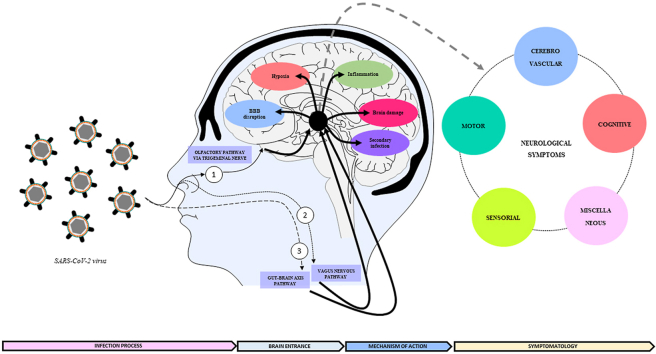
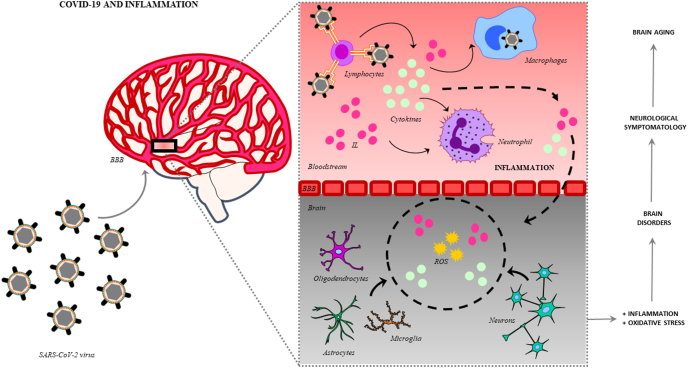
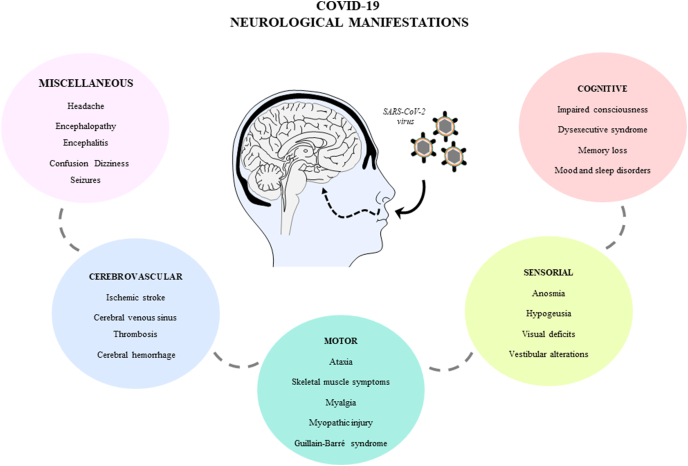
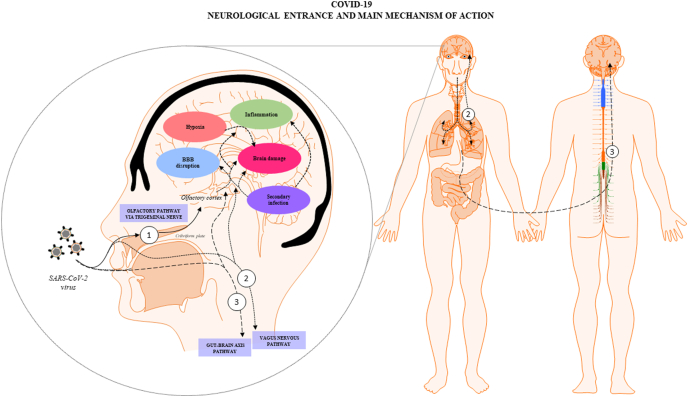
Due to the infection by the SARS-CoV-2 virus (COVID-19) there were also reported neurological symptoms, being the most frequent and best cited those that affect the cerebrovascular, sensorial, cognitive and motor functions, together with the neurological diffuse symptoms as for examples headache or dizziness. Besides, some of them behave high risk of mortality. Consequently, it is crucial to elucidate the mechanisms of action in brain of SARS-CoV-2 virus in order to create new therapeutic targets to fight against this new disease. Since now the mechanisms of arrival to the brain seems to be related with the following processes: blood brain barrier (BBB) disruption together with nervous or axonal transport of the virus by the trigeminal nerve, the vagus nerve, or the brain-gut-axis. Being two the mechanisms of brain affectation most cited: a direct affectation of the virus in the brain through neuroinvasion and an indirect mechanism of action due to the effects of the systemic infection. Both processes include the triggering of inflammation, hypoxia and the increased likelihood of secondary infections. This topic supposes a major novel challenge for neuroscience. Therefore, the aim of this review is to provide summarized information about the neurological symptomatology and the brain pathogenic mechanisms involved and reported in COVID-19.
由于感染严重急性呼吸综合征冠状病毒2(SARS-CoV-2,即新冠病毒),也有报告出现神经症状,其中最常见且被引用最多的是影响脑血管、感觉、认知和运动功能的症状,以及如头痛或头晕等神经弥漫性症状。此外,其中一些症状具有高死亡风险。因此,阐明SARS-CoV-2病毒在大脑中的作用机制,以创建对抗这种新疾病的新治疗靶点至关重要。目前看来,病毒进入大脑的机制似乎与以下过程有关:血脑屏障(BBB)破坏以及病毒通过三叉神经、迷走神经或脑-肠轴进行的神经或轴突运输。最常被提及的两种大脑受影响机制是:病毒通过神经侵袭直接影响大脑,以及由于全身感染的影响而产生的间接作用机制。这两个过程都包括炎症的触发、缺氧以及继发感染可能性的增加。这个主题对神经科学来说是一个重大的新挑战。因此,本综述的目的是提供关于新冠病毒感染中所涉及和报告的神经症状学及大脑致病机制的总结信息。