Solheim Anne Marit, Lorentzen Åslaug Rudjord, Dahlberg Audun Olav, Flemmen Heidi Øyen, Brune Synne, Forselv Kristine Johanne Nordstrøm, Pripp Are Hugo, Bø Margrete Halvorsen, Eikeland Randi, Reiso Harald, Mygland Åse, Ljøstad Unn
Department of Neurology, Sørlandet sykehus HF Kristiansand, Kristiansand, Norway
Institute of Clinical Medicine, University of Bergen, Bergen, Norway.
J Neurol Neurosurg Psychiatry. 2022 Jul 27;93(11):1222-8. doi: 10.1136/jnnp-2022-329724.
There is limited evidence regarding optimal duration of antibiotic treatment in neuroborreliosis. We aimed to compare efficacy and safety of oral doxycycline for 2 and 6 weeks in European Lyme neuroborreliosis (LNB).
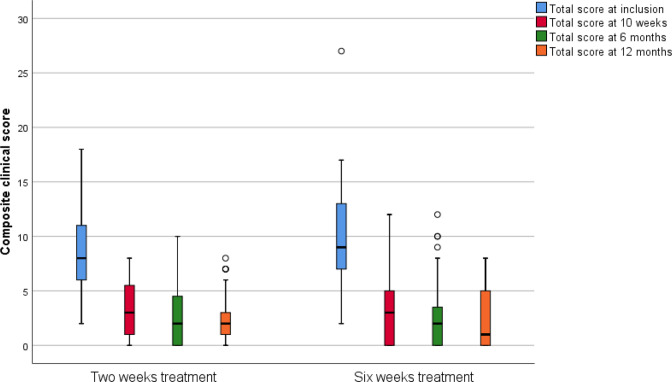
The trial had a randomised, double-blinded, placebo-controlled, non-inferiority design. Patients with LNB were recruited from eight Norwegian hospitals and randomised to doxycycline 200 mg once daily for 2 weeks, followed by 4 weeks of placebo, or doxycycline 200 mg once daily for 6 weeks. The primary endpoint was clinical improvement as measured by difference in a Composite Clinical Score (0-64 points) from baseline to 6 months. The non-inferiority margin was predetermined to 0.5 points.
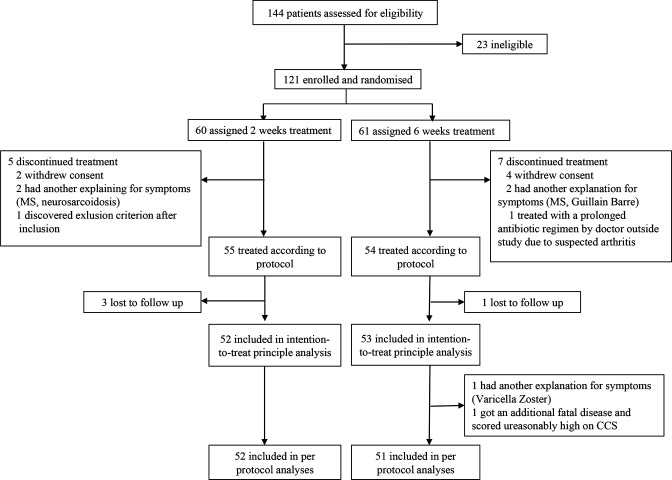
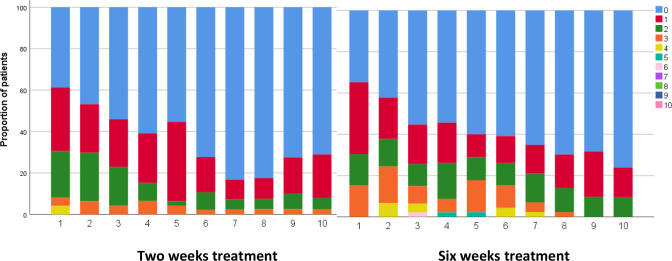
One hundred and twenty-one patients were included. Fifty-two treated for 2 weeks and 53 for 6 weeks were included in the intention-to-treat analyses, and 52 and 51 in per-protocol analysis. Mean difference in clinical improvement between the groups was 0.06, 95% CI -1.2 to 1.2, p=0.99 in the intention-to-treat population, and -0.4, 95% CI -1.4 to 0.7, p=0.51 in the per-protocol population and non-inferiority could not be established. There were no treatment failures and no serious adverse events. The groups did not differ in secondary outcomes including clinical scores at 10 weeks and 12 months, cerebrospinal fluid data and patient-reported outcome measures. Patients receiving 6 weeks doxycycline reported slightly more side effects in week 5.
Our results strongly indicate that there are no benefits of doxycycline treatment beyond 2 weeks in European LNB.
2015-001481-25.
关于神经型莱姆病抗生素治疗的最佳疗程,证据有限。我们旨在比较口服多西环素2周和6周治疗欧洲莱姆病神经病变(LNB)的疗效和安全性。
该试验采用随机、双盲、安慰剂对照、非劣效性设计。LNB患者从挪威的八家医院招募,随机分为两组,一组每天一次口服200mg多西环素,共2周,随后4周服用安慰剂;另一组每天一次口服200mg多西环素,共6周。主要终点是通过综合临床评分(0 - 64分)从基线到6个月的差值来衡量的临床改善情况。非劣效性界值预先设定为0.5分。
共纳入121例患者。意向性分析中,52例接受2周治疗,53例接受6周治疗;符合方案分析中,分别为52例和51例。意向性分析人群中,两组临床改善的平均差值为0.06,95%置信区间为 -1.2至1.2,p = 0.99;符合方案分析人群中,平均差值为 -0.4,95%置信区间为 -1.4至0.7,p = 0.51,未确立非劣效性。未出现治疗失败情况,也未发生严重不良事件。两组在次要结局方面无差异,包括10周和12个月时的临床评分、脑脊液数据以及患者报告的结局指标。接受6周多西环素治疗的患者在第5周报告的副作用略多。
我们的结果强烈表明,在欧洲LNB中,多西环素治疗超过2周并无益处。
2015 - 001481 - 25