Center for Healthcare Innovation & Delivery Science, Department of Population Health, NYU Grossman School of Medicine, New York, New York, United States.
Department of Medicine, NYU Grossman School of Medicine, New York, New York, United States.
Appl Clin Inform. 2022 May;13(3):632-640. doi: 10.1055/s-0042-1750416. Epub 2022 Jul 27.
We previously developed and validated a predictive model to help clinicians identify hospitalized adults with coronavirus disease 2019 (COVID-19) who may be ready for discharge given their low risk of adverse events. Whether this algorithm can prompt more timely discharge for stable patients in practice is unknown.
The aim of the study is to estimate the effect of displaying risk scores on length of stay (LOS).
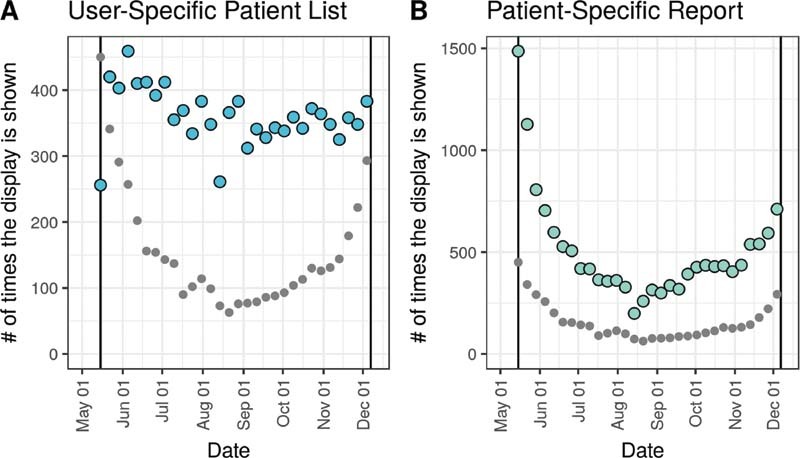
We integrated model output into the electronic health record (EHR) at four hospitals in one health system by displaying a green/orange/red score indicating low/moderate/high-risk in a patient list column and a larger COVID-19 summary report visible for each patient. Display of the score was pseudo-randomized 1:1 into intervention and control arms using a patient identifier passed to the model execution code. Intervention effect was assessed by comparing LOS between intervention and control groups. Adverse safety outcomes of death, hospice, and re-presentation were tested separately and as a composite indicator. We tracked adoption and sustained use through daily counts of score displays.
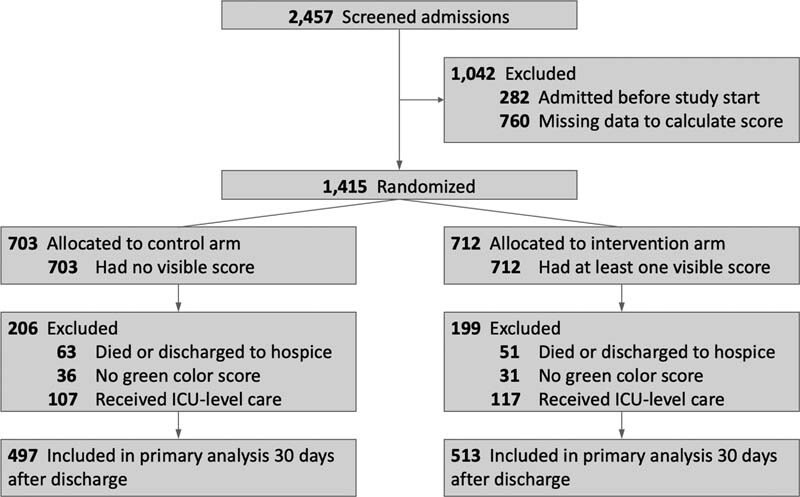
Enrolling 1,010 patients from May 15, 2020 to December 7, 2020, the trial found no detectable difference in LOS. The intervention had no impact on safety indicators of death, hospice or re-presentation after discharge. The scores were displayed consistently throughout the study period but the study lacks a causally linked process measure of provider actions based on the score. Secondary analysis revealed complex dynamics in LOS temporally, by primary symptom, and hospital location.
An AI-based COVID-19 risk score displayed passively to clinicians during routine care of hospitalized adults with COVID-19 was safe but had no detectable impact on LOS. Health technology challenges such as insufficient adoption, nonuniform use, and provider trust compounded with temporal factors of the COVID-19 pandemic may have contributed to the null result.
ClinicalTrials.gov identifier: NCT04570488.
我们之前开发并验证了一种预测模型,以帮助临床医生识别患有 2019 年冠状病毒病(COVID-19)的住院成年人,这些患者的不良事件风险较低,可能已经准备好出院。该算法是否能在实践中促使病情稳定的患者更及时地出院尚不清楚。
本研究旨在评估显示风险评分对住院时间(LOS)的影响。
我们通过在一个医疗系统中的 4 家医院的电子健康记录(EHR)中整合模型输出,在患者列表列中显示绿色/橙色/红色分数,以指示低/中/高风险,并为每位患者显示更大的 COVID-19 摘要报告。通过将传递给模型执行代码的患者标识符进行 1:1 伪随机分组,将分数显示分为干预组和对照组。通过比较干预组和对照组之间的 LOS 来评估干预效果。分别测试了死亡、临终关怀和再入院的不良安全结果,并作为综合指标进行测试。我们通过每日分数显示次数来跟踪采用情况和持续使用情况。
该试验于 2020 年 5 月 15 日至 12 月 7 日期间纳入了 1010 名患者,发现 LOS 没有明显差异。干预措施对出院后死亡、临终关怀或再入院的安全指标没有影响。在整个研究期间,分数一直持续显示,但研究缺乏基于分数的临床医生行为的因果相关过程测量。二次分析显示,LOS 随时间、主要症状和医院位置呈现出复杂的动态变化。
在对 COVID-19 住院成年人进行常规护理期间,被动向临床医生显示基于人工智能的 COVID-19 风险评分是安全的,但对 LOS 没有明显影响。健康技术挑战,如采用不足、使用不统一以及提供者信任,加上 COVID-19 大流行的时间因素,可能导致了该结果的无效。
ClinicalTrials.gov 标识符:NCT04570488。