School of Public Health, Imperial College London, Norfolk Place, London, W2 1PG, UK.
MRC Centre for Global Infectious Disease Analysis and Jameel Institute, Imperial College London, London, UK.
BMC Infect Dis. 2022 Jul 27;22(1):647. doi: 10.1186/s12879-022-07628-4.
Since the emergence of SARS-CoV-2, evolutionary pressure has driven large increases in the transmissibility of the virus. However, with increasing levels of immunity through vaccination and natural infection the evolutionary pressure will switch towards immune escape. Genomic surveillance in regions of high immunity is crucial in detecting emerging variants that can more successfully navigate the immune landscape.
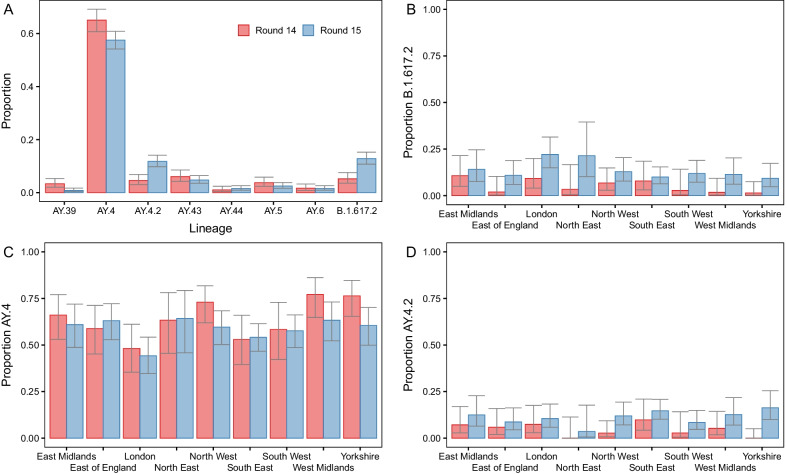
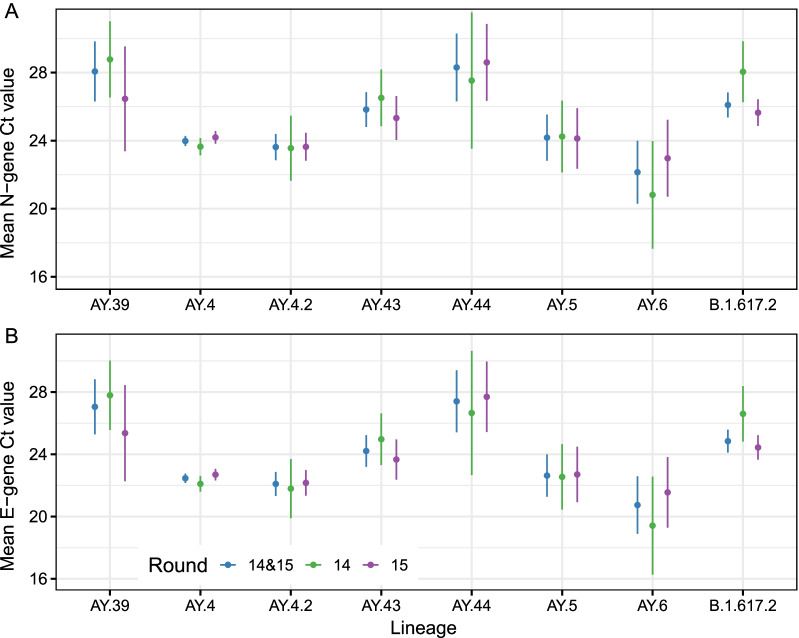
We present phylogenetic relationships and lineage dynamics within England (a country with high levels of immunity), as inferred from a random community sample of individuals who provided a self-administered throat and nose swab for rt-PCR testing as part of the REal-time Assessment of Community Transmission-1 (REACT-1) study. During round 14 (9 September-27 September 2021) and 15 (19 October-5 November 2021) lineages were determined for 1322 positive individuals, with 27.1% of those which reported their symptom status reporting no symptoms in the previous month.
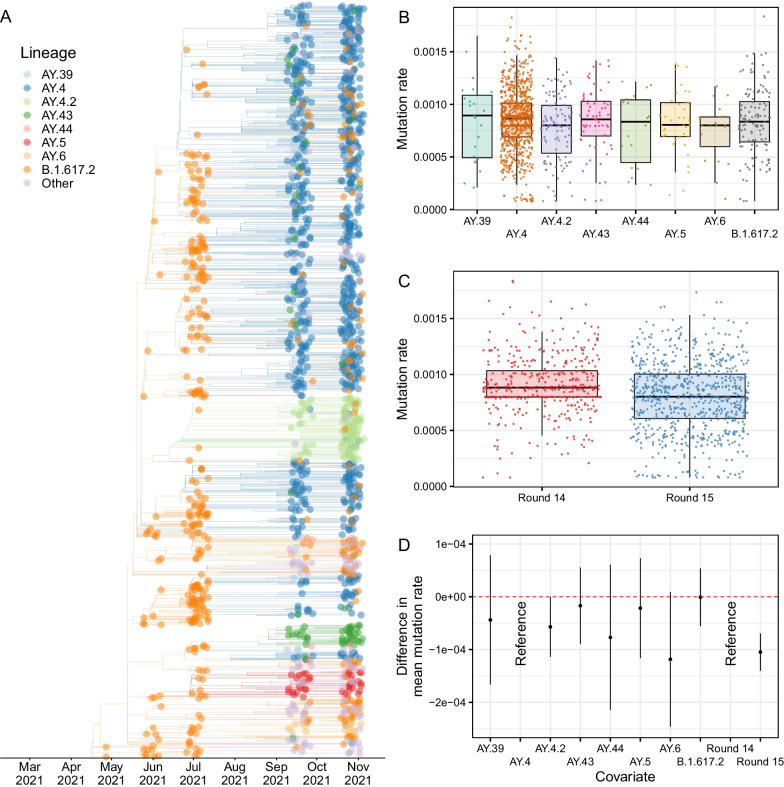
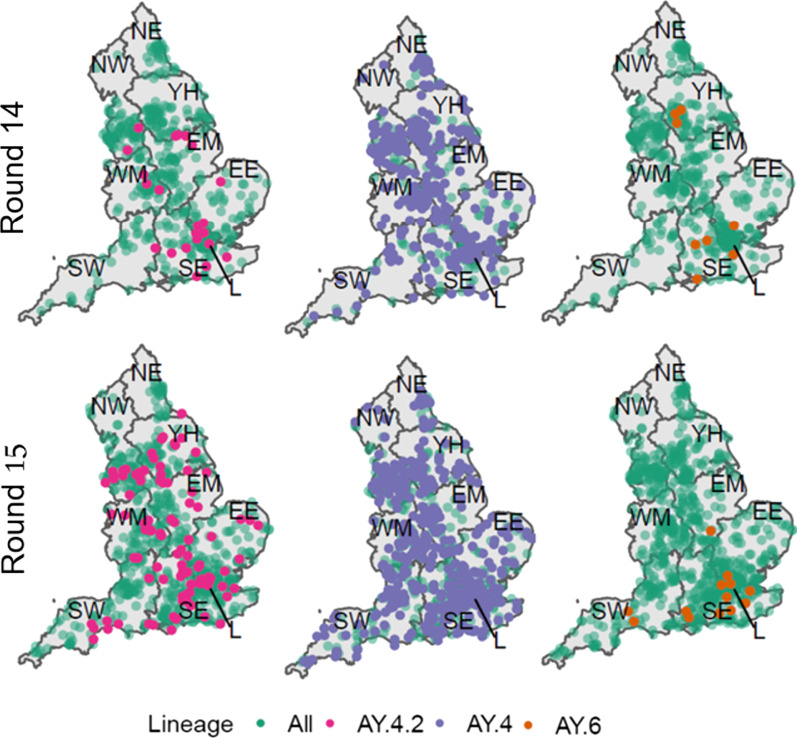
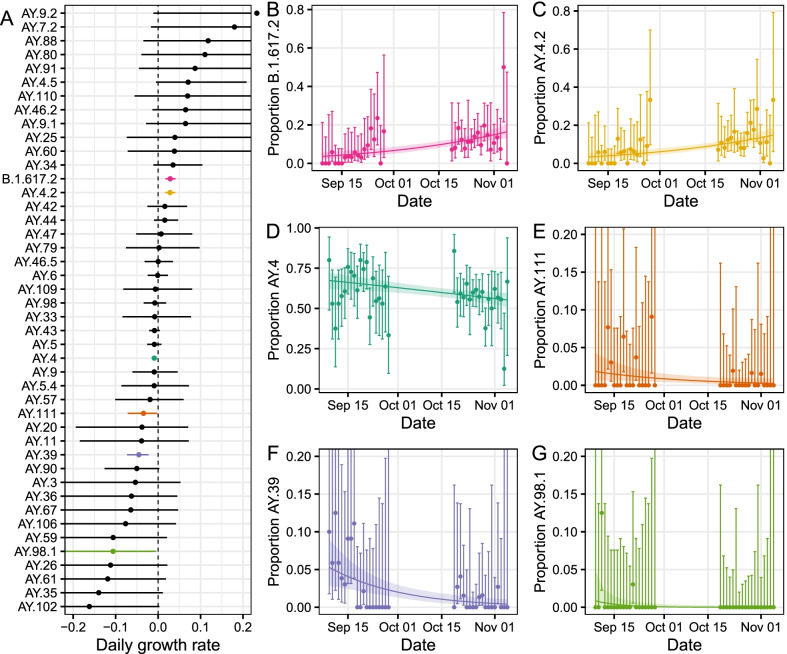
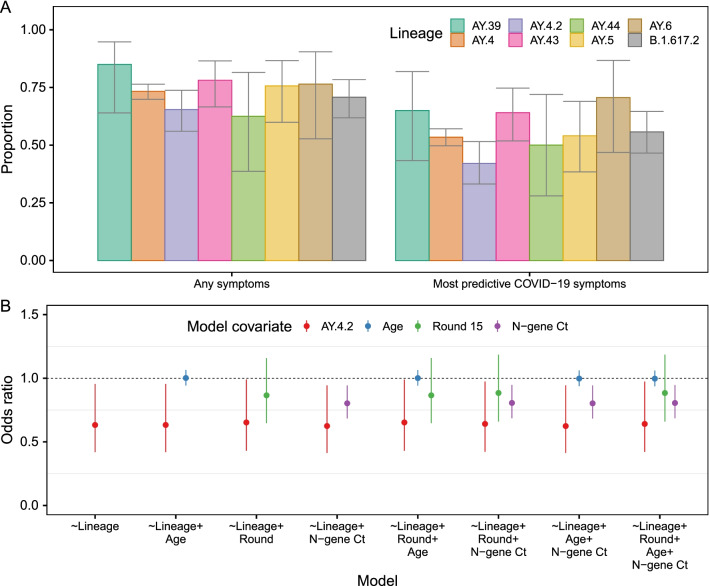
We identified 44 unique lineages, all of which were Delta or Delta sub-lineages, and found a reduction in their mutation rate over the study period. The proportion of the Delta sub-lineage AY.4.2 was increasing, with a reproduction number 15% (95% CI 8-23%) greater than the most prevalent lineage, AY.4. Further, AY.4.2 was less associated with the most predictive COVID-19 symptoms (p = 0.029) and had a reduced mutation rate (p = 0.050). Both AY.4.2 and AY.4 were found to be geographically clustered in September but this was no longer the case by late October/early November, with only the lineage AY.6 exhibiting clustering towards the South of England.
As SARS-CoV-2 moves towards endemicity and new variants emerge, genomic data obtained from random community samples can augment routine surveillance data without the potential biases introduced due to higher sampling rates of symptomatic individuals.
自 SARS-CoV-2 出现以来,病毒的传播能力因进化压力而大幅提高。然而,随着疫苗接种和自然感染带来的免疫水平不断提高,进化压力将转向免疫逃逸。在高免疫地区进行基因组监测对于检测能够更成功地穿越免疫景观的新兴变体至关重要。
我们展示了英格兰(一个免疫水平较高的国家)的个体随机社区样本中个体的系统发育关系和谱系动态,这些个体提供了自我管理的喉咙和鼻子拭子进行 rt-PCR 检测,作为实时社区传播评估-1(REACT-1)研究的一部分。在第 14 轮(2021 年 9 月 9 日至 9 月 27 日)和第 15 轮(2021 年 10 月 19 日至 11 月 5 日)中,对 1322 名阳性个体的谱系进行了确定,其中 27.1%的个体报告在过去一个月内没有症状。
我们确定了 44 个独特的谱系,均为 Delta 或 Delta 亚谱系,并且在研究期间发现其突变率降低。AY.4.2 亚谱系的比例在增加,其繁殖数比最流行的谱系 AY.4 高 15%(95%CI 8-23%)。此外,AY.4.2 与最具预测性的 COVID-19 症状的关联性较低(p=0.029),且突变率降低(p=0.050)。AY.4.2 和 AY.4 都在 9 月被发现呈地理聚类,但到 10 月底/11 月初这种情况不再存在,只有谱系 AY.6 表现出向英格兰南部的聚类。
随着 SARS-CoV-2 向地方病转变和新变体的出现,从随机社区样本中获得的基因组数据可以增强常规监测数据,而不会因对症状个体的更高采样率而引入潜在偏差。