School of Public Health, Imperial College London, London, UK.
MRC Centre for Global infectious Disease Analysis and Abdul Latif Jameel Institute for Disease and Emergency Analytics, Imperial College London, London, UK.
Microb Genom. 2023 Feb;9(2). doi: 10.1099/mgen.0.000887.
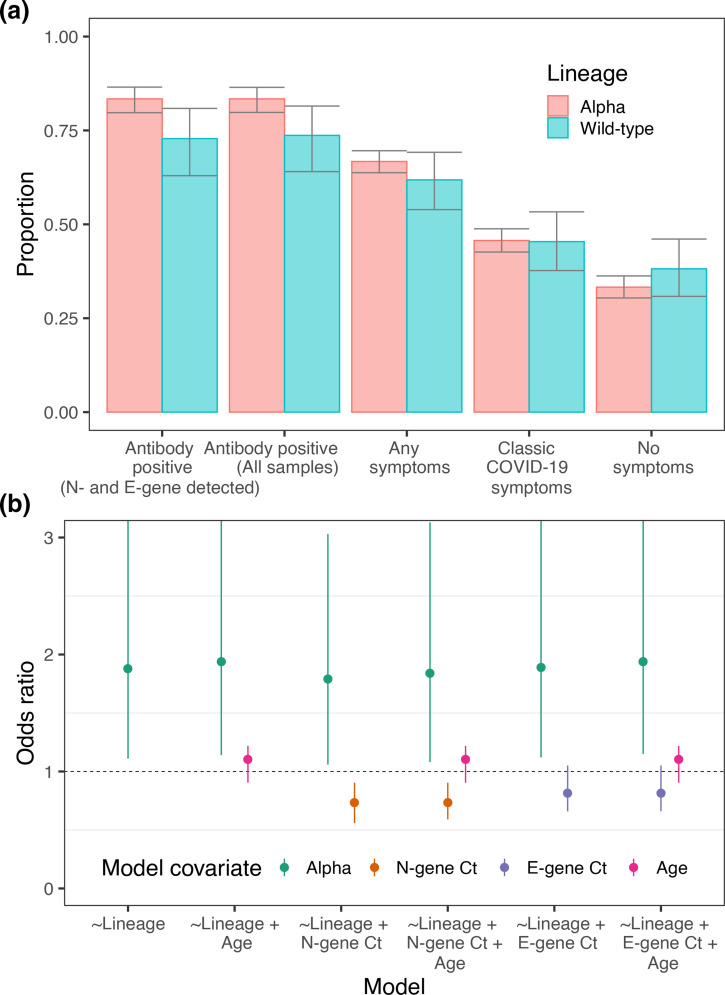
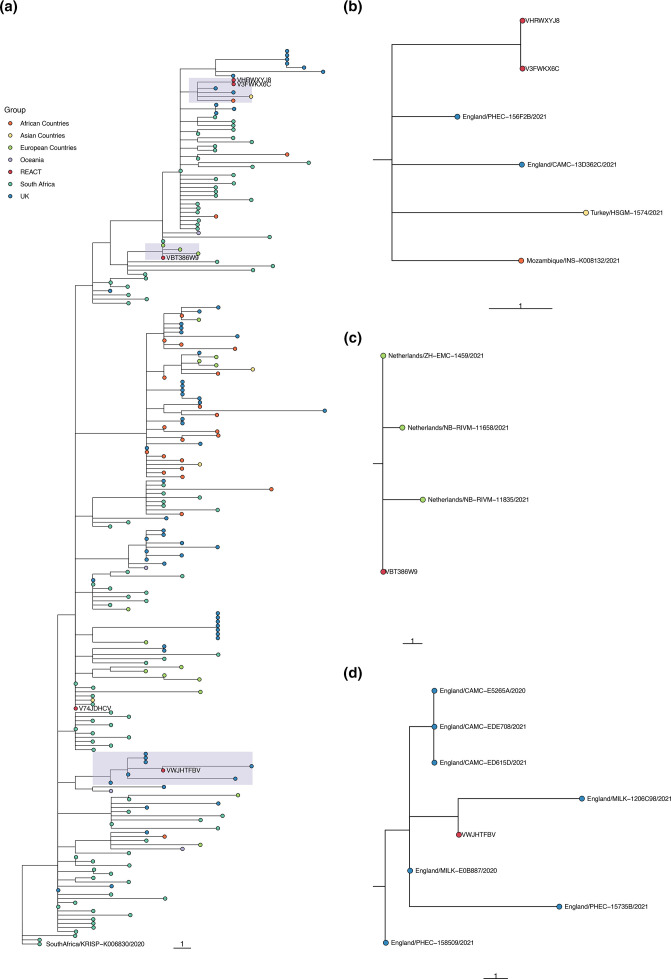
Genomic surveillance for SARS-CoV-2 lineages informs our understanding of possible future changes in transmissibility and vaccine efficacy and will be a high priority for public health for the foreseeable future. However, small changes in the frequency of one lineage over another are often difficult to interpret because surveillance samples are obtained using a variety of methods all of which are known to contain biases. As a case study, using an approach which is largely free of biases, we here describe lineage dynamics and phylogenetic relationships of the Alpha and Beta variant in England during the first 3 months of 2021 using sequences obtained from a random community sample who provided a throat and nose swab for rt-PCR as part of the REal-time Assessment of Community Transmission-1 (REACT-1) study. Overall, diversity decreased during the first quarter of 2021, with the Alpha variant (first identified in Kent) becoming predominant, driven by a reproduction number 0.3 higher than for the prior wild-type. During January, positive samples were more likely to be Alpha in those aged 18 to 54 years old. Although individuals infected with the Alpha variant were no more likely to report one or more classic COVID-19 symptoms compared to those infected with wild-type, they were more likely to be antibody-positive 6 weeks after infection. Further, viral load was higher in those infected with the Alpha variant as measured by cycle threshold (Ct) values. The presence of infections with non-imported Beta variant (first identified in South Africa) during January, but not during February or March, suggests initial establishment in the community followed by fade-out. However, this occurred during a period of stringent social distancing. These results highlight how sequence data from representative community surveys such as REACT-1 can augment routine genomic surveillance during periods of lineage diversity.
对 SARS-CoV-2 谱系的基因组监测有助于我们了解其传染性和疫苗效力可能发生的未来变化,这将是可预见的未来公共卫生的首要任务。然而,由于监测样本是通过各种方法获得的,这些方法都存在偏倚,因此通常很难解释一个谱系的频率相对于另一个谱系的微小变化。作为一个案例研究,我们使用一种基本上没有偏倚的方法,在这里描述了 2021 年 3 月前三个月在英国的 Alpha 和 Beta 变体的谱系动态和系统发育关系,使用的序列来自作为 REal-time Assessment of Community Transmission-1 (REACT-1) 研究的一部分,为 rt-PCR 提供喉咙和鼻子拭子的随机社区样本中获得。总的来说,2021 年第一季度多样性下降,首先在肯特发现的 Alpha 变体占主导地位,其繁殖数比先前的野生型高 0.3。1 月期间,18 至 54 岁年龄组中阳性样本更有可能是 Alpha。虽然与感染野生型的人相比,感染 Alpha 变体的人报告一种或多种典型 COVID-19 症状的可能性没有增加,但他们在感染后 6 周更有可能呈抗体阳性。此外,与感染野生型的人相比,感染 Alpha 变体的人病毒载量更高,这一点可以通过循环阈值 (Ct) 值来衡量。1 月期间存在非输入性 Beta 变体(首先在南非发现)的感染,但 2 月和 3 月没有,这表明在社区中初步建立后逐渐消失。然而,这是在严格的社会隔离期间发生的。这些结果强调了在谱系多样性时期,来自代表性社区调查(如 REACT-1)的序列数据如何增强常规基因组监测。