Département des Sciences de la Santé, Université du Québec à Rimouski (UQAR), Campus de Lévis, 1595 Boulevard Alphonse-Desjardins, Lévis, QC G6V 0A6, Canada.
Centre de Recherche du CISSS de Chaudière-Appalaches, 143 rue Wolfe, Lévis, QC G6V 3Z1, Canada.
Int J Environ Res Public Health. 2022 Jul 25;19(15):9019. doi: 10.3390/ijerph19159019.
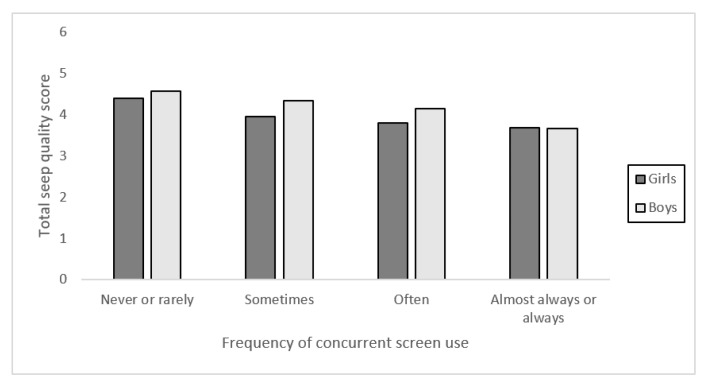
The study objective was to verify whether recreational screen time was associated with sleep quality among adolescents during the third wave of the COVID-19 pandemic in Canada. Data collection took place in four high schools in the region of Chaudière-Appalaches (Quebec, Canada) from the end of April to mid-May 2021. Recreational screen time and sleep quality were measured using the French versions of validated questionnaires specifically designed for adolescents. A total of 258 adolescents (14−18 years; 66.3% girls) answered the online survey. Adolescent boys had a higher total mean recreational screen time (454.3 ± 197.5 vs. 300.5 ± 129.3 min/day, p < 0.0001) and a higher total mean sleep quality score (4.2 ± 0.9 vs. 3.9 ± 0.8, p = 0.0364) compared to girls. Recreational screen time (β = −0.0012, p = 0.0005) and frequency of concurrent screen use (sometimes: β = −0.3141, p = 0.0269; often: β = −0.4147, p = 0.0048; almost always or always: β = −0.6155, p = 0.0002) were negatively associated with sleep quality while being a boy (β = 0.4276, p = 0.0004) was positively associated with sleep quality and age (p = 0.6321) was not. This model explained 16% of the variance in adolescents’ sleep quality. Public health interventions during and after the COVID-19 pandemic should target recreational screen time, concurrent screen use and especially girls to possibly improve sleep quality and promote adolescents’ physical and mental health.
本研究旨在验证在加拿大 COVID-19 疫情第三波期间,休闲屏幕时间是否与青少年的睡眠质量有关。数据收集于 2021 年 4 月底至 5 月中旬在魁北克沙迪尔-阿帕拉什地区的四所高中进行。休闲屏幕时间和睡眠质量使用专为青少年设计的经过验证的法语问卷进行测量。共有 258 名青少年(14-18 岁;66.3%为女孩)回答了在线调查。与女孩相比,青少年男孩的总平均休闲屏幕时间更高(454.3 ± 197.5 分钟/天比 300.5 ± 129.3 分钟/天,p < 0.0001),总平均睡眠质量评分也更高(4.2 ± 0.9 比 3.9 ± 0.8,p = 0.0364)。休闲屏幕时间(β = -0.0012,p = 0.0005)和同时使用屏幕的频率(有时:β = -0.3141,p = 0.0269;经常:β = -0.4147,p = 0.0048;几乎总是或总是:β = -0.6155,p = 0.0002)与睡眠质量呈负相关,而男孩(β = 0.4276,p = 0.0004)与睡眠质量呈正相关,年龄(p = 0.6321)则没有相关性。该模型解释了青少年睡眠质量变化的 16%。在 COVID-19 大流行期间和之后,公共卫生干预措施应针对休闲屏幕时间、同时使用屏幕的行为,特别是针对女孩,以可能改善睡眠质量,促进青少年身心健康。