State Key Laboratory of Biogeology and Environmental Geology, School of Environmental Studies, China University of Geosciences, Wuhan 430074, China.
Department of Zoology, College of Science, King Saud University, P.O. Box 2455, Riyadh 11451, Saudi Arabia.
Int J Environ Res Public Health. 2022 Jul 25;19(15):9071. doi: 10.3390/ijerph19159071.
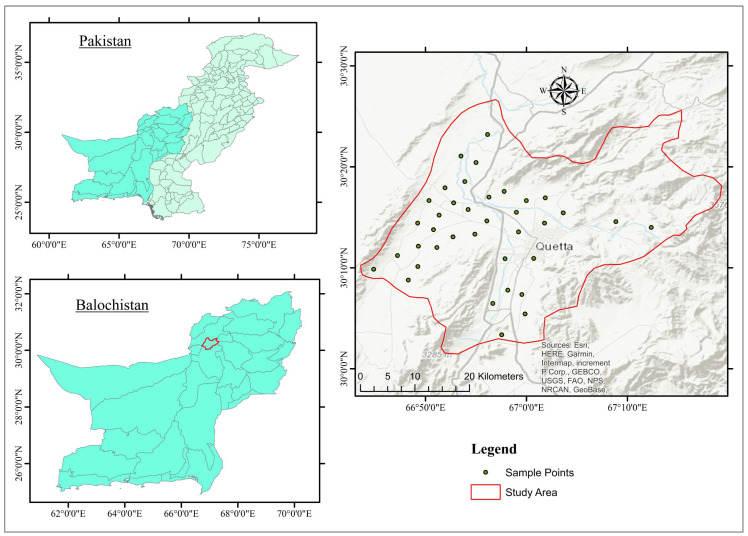
Fluoride (F) contamination in drinking groundwater is a significant human health risk in Pakistan. Moreover, high fluoride pollution in drinking water causes a variety of disorders, including dental, neurological, and skeletal fluorosis. The aim of this research was to evaluate the health risk of elevated fluoride in groundwater and its suitability assessment for drinking purposes. The total of ( = 37) samples were collected from community tube wells of Quetta Valley, Balochistan, Pakistan. The results show a mean pH value of 7.7, TDS of 404.6 mg/L, EC of 500 µs/cm, depth of 96.8 feet, and turbidity of 1.7 nephelometric turbidity units. The mean values of HCO, Ca, Mg, and Na, were 289.5, 47.5, 30.6, and 283.3 mg/L, respectively. The mean values of SO, NO, K, Cl, and Fe, were 34.9, 1.0, 1.6, 25.6, and 0.01 mg/L, respectively. The F concentration in the groundwater varied between 0.19 and 6.21, with a mean value of 1.8 mg/L, and 18 samples out of 37 were beyond the WHO recommended limit of 1.5 mg/L. The hydrochemical analysis results indicated that among the groundwater samples of the study area, 54% samples were Na-HCO type and 46% were mixed CaNaHCO type. The saturation indices of the mineral phases reveal that the groundwater sources of the study area were saturated with CaCO and halide minerals due to their positive (SI) values. Such minerals include calcite, dolomite, gypsum, and fluorite. The principal component analysis results reveal that the groundwater sources of the study area are contaminated due to geological and anthropogenic actions. The health risk assessment results of the F concentrations show the ranges of ADD for children, females, and males in the Quetta Valley, and their mean values were observed to be 0.093052, 0.068825, and 0.065071, respectively. The HQ mean values were 1.55086, 1.147089, and 1.084521 for children, females, and males, respectively. It was noticed that children had the highest maximum and average values of ADD and HQ in the research area, indicating that groundwater fluoride intake poses the greatest health risk to children. The water quality index (WQI) analyses show that 44% of the samples belong to the poor-quality category, 49% were of good quality, and 8% of the samples of the study area belong to the excellent category.
巴基斯坦饮用地下水氟污染是一个严重的人类健康风险。此外,饮用水中高氟污染会导致多种疾病,包括牙齿、神经和骨骼氟中毒。本研究旨在评估地下水高氟的健康风险及其饮用适宜性评估。从巴基斯坦俾路支省奎达谷的社区管井中采集了总共 37 个样本。结果表明,pH 值平均值为 7.7,总溶解固体(TDS)为 404.6 毫克/升,电导率(EC)为 500 微西门子/厘米,深度为 96.8 英尺,浊度为 1.7 度。HCO、Ca、Mg 和 Na 的平均值分别为 289.5、47.5、30.6 和 283.3 毫克/升。SO、NO、K、Cl 和 Fe 的平均值分别为 34.9、1.0、1.6、25.6 和 0.01 毫克/升。地下水中的 F 浓度在 0.19 至 6.21 之间,平均值为 1.8 毫克/升,37 个样本中有 18 个超过世界卫生组织(WHO)推荐的 1.5 毫克/升限值。水化学分析结果表明,在所研究地区的地下水样本中,54%的样本属于 Na-HCO 型,46%的样本属于混合 CaNaHCO 型。矿物相的饱和度指数表明,由于正(SI)值,研究区地下水来源与 CaCO 和卤化物矿物饱和。这些矿物包括方解石、白云石、石膏和萤石。主成分分析结果表明,由于地质和人为因素,研究区地下水来源受到污染。F 浓度的健康风险评估结果显示,奎达谷儿童、女性和男性的 ADD 范围及其平均值分别为 0.093052、0.068825 和 0.065071。HQ 的平均值分别为儿童、女性和男性的 1.55086、1.147089 和 1.084521。研究区儿童的 ADD 和 HQ 最高值和平均值最高,表明地下水氟摄入对儿童健康的风险最大。水质指数(WQI)分析表明,44%的样本属于劣质类别,49%的样本属于优质类别,8%的样本属于优秀类别。