Department of Infectious Disease, Faculty of Medicine, Vasile Goldis Western University of Arad, 310414 Arad, Romania.
Doctoral School of Biology, Vasile Goldis Western University of Arad, 310414 Arad, Romania.
Int J Mol Sci. 2022 Jul 26;23(15):8210. doi: 10.3390/ijms23158210.
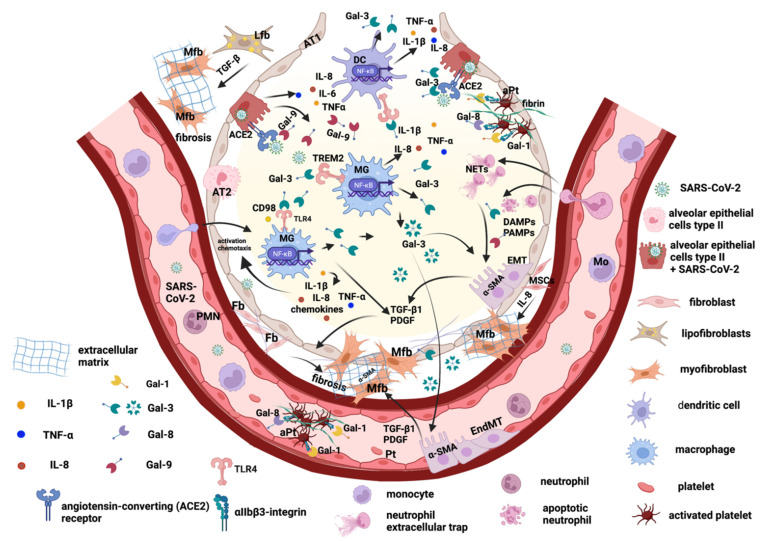
Pulmonary fibrosis is a consequence of the pathological accumulation of extracellular matrix (ECM), which finally leads to lung scarring. Although the pulmonary fibrogenesis is almost known, the last two years of the COVID-19 pandemic caused by severe acute respiratory syndrome coronavirus 2 (SARS-CoV-2) and its post effects added new particularities which need to be explored. Many questions remain about how pulmonary fibrotic changes occur within the lungs of COVID-19 patients, and whether the changes will persist long term or are capable of resolving. This review brings together existing knowledge on both COVID-19 and pulmonary fibrosis, starting with the main key players in promoting pulmonary fibrosis, such as alveolar and endothelial cells, fibroblasts, lipofibroblasts, and macrophages. Further, we provide an overview of the main molecular mechanisms driving the fibrotic process in connection with Galactin-1, -3, -8, and -9, together with the currently approved and newly proposed clinical therapeutic solutions given for the treatment of fibrosis, based on their inhibition. The work underlines the particular pathways and processes that may be implicated in pulmonary fibrosis pathogenesis post-SARS-CoV-2 viral infection. The recent data suggest that galectin-1, -3, -8, and -9 could become valuable biomarkers for the diagnosis and prognosis of lung fibrosis post-COVID-19 and promising molecular targets for the development of new and original therapeutic tools to treat the disease.
肺纤维化是细胞外基质(ECM)病理性积累的结果,最终导致肺部瘢痕形成。尽管肺纤维化的发生机制已基本明确,但 2019 年冠状病毒病(COVID-19)大流行的最后两年,由严重急性呼吸综合征冠状病毒 2(SARS-CoV-2)引起及其后续影响带来了新的特点,需要进一步探索。关于 COVID-19 患者肺部发生肺纤维化改变的机制,以及这些改变是否会长期持续或能够自行消退,仍有许多问题尚未明确。本综述综合了 COVID-19 和肺纤维化两方面的现有知识,首先介绍了促进肺纤维化的主要关键因素,如肺泡和内皮细胞、成纤维细胞、脂肪成纤维细胞和巨噬细胞。此外,我们概述了主要的分子机制,这些机制与半乳糖凝集素-1、-3、-8 和 -9 一起,驱动着纤维化过程,同时还基于这些分子的抑制作用,介绍了目前批准的和新提出的治疗纤维化的临床治疗方案。该研究强调了可能与 SARS-CoV-2 病毒感染后肺纤维化发病机制有关的特定途径和过程。最近的数据表明,半乳糖凝集素-1、-3、-8 和 -9 可能成为 COVID-19 后肺纤维化诊断和预后的有价值的生物标志物,也是开发治疗该疾病的新的、原创性治疗工具的有前途的分子靶点。