Department of Information Technology, College of Computer and Information Sciences, Princess Nourah Bint Abdulrahman University, P.O. Box 84428, Riyadh 11671, Saudi Arabia.
Department of Computer Sciences, College of Computer and Information Sciences, Princess Nourah Bint Abdulrahman University, P.O. Box 84428, Riyadh 11671, Saudi Arabia.
Sensors (Basel). 2022 Jul 24;22(15):5520. doi: 10.3390/s22155520.
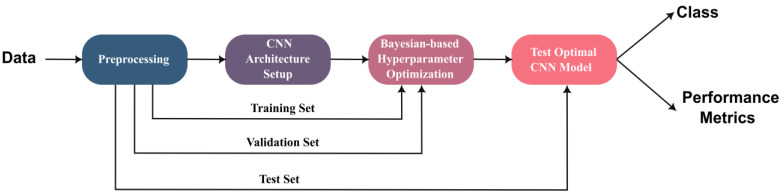
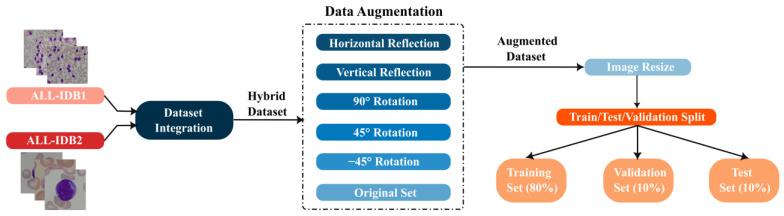
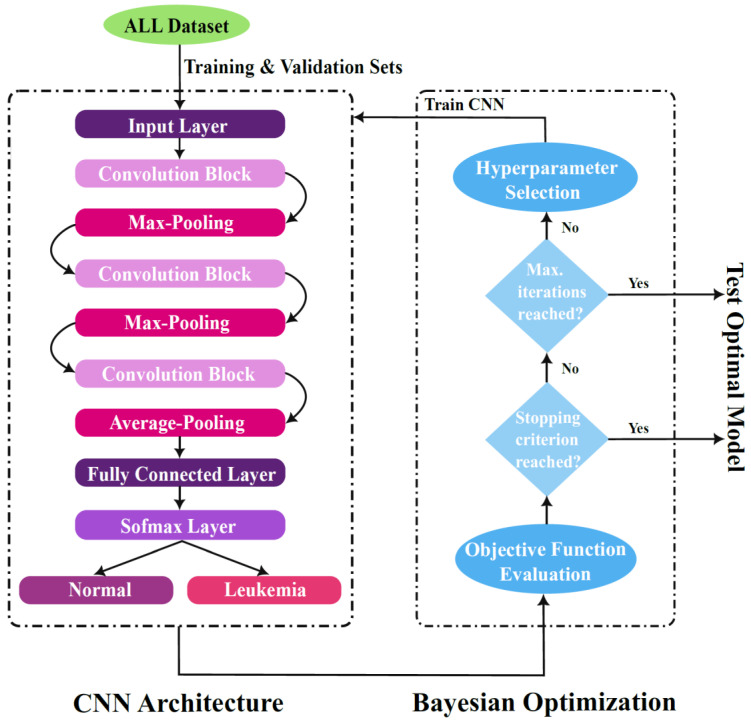
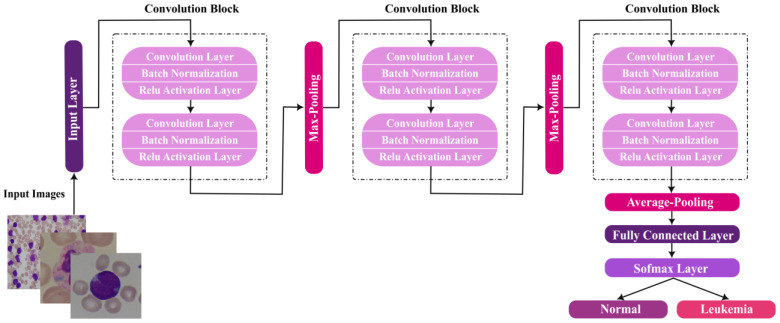
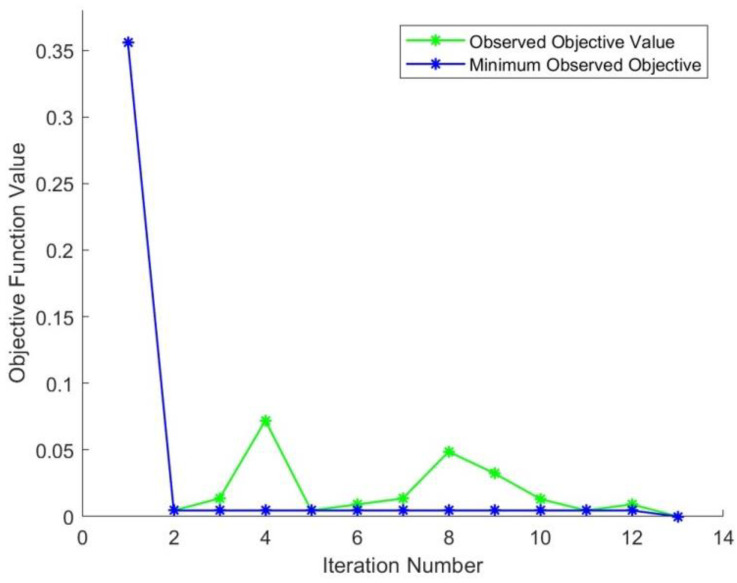
Acute lymphoblastic leukemia (ALL) is a deadly cancer characterized by aberrant accumulation of immature lymphocytes in the blood or bone marrow. Effective treatment of ALL is strongly associated with the early diagnosis of the disease. Current practice for initial ALL diagnosis is performed through manual evaluation of stained blood smear microscopy images, which is a time-consuming and error-prone process. Deep learning-based human-centric biomedical diagnosis has recently emerged as a powerful tool for assisting physicians in making medical decisions. Therefore, numerous computer-aided diagnostic systems have been developed to autonomously identify ALL in blood images. In this study, a new Bayesian-based optimized convolutional neural network (CNN) is introduced for the detection of ALL in microscopic smear images. To promote classification performance, the architecture of the proposed CNN and its hyperparameters are customized to input data through the Bayesian optimization approach. The Bayesian optimization technique adopts an informed iterative procedure to search the hyperparameter space for the optimal set of network hyperparameters that minimizes an objective error function. The proposed CNN is trained and validated using a hybrid dataset which is formed by integrating two public ALL datasets. Data augmentation has been adopted to further supplement the hybrid image set to boost classification performance. The Bayesian search-derived optimal CNN model recorded an improved performance of image-based ALL classification on test set. The findings of this study reveal the superiority of the proposed Bayesian-optimized CNN over other optimized deep learning ALL classification models.
急性淋巴细胞白血病 (ALL) 是一种致命的癌症,其特征是血液或骨髓中不成熟淋巴细胞的异常积聚。ALL 的有效治疗与疾病的早期诊断密切相关。目前,ALL 的初始诊断是通过人工评估染色血涂片显微镜图像来进行的,这是一个耗时且容易出错的过程。基于深度学习的以人为中心的生物医学诊断最近已成为协助医生做出医疗决策的强大工具。因此,已经开发了许多计算机辅助诊断系统来自动识别血液图像中的 ALL。在这项研究中,引入了一种新的基于贝叶斯的优化卷积神经网络 (CNN) 来检测显微镜涂片图像中的 ALL。为了提高分类性能,通过贝叶斯优化方法对所提出的 CNN 架构及其超参数进行定制,以适应输入数据。贝叶斯优化技术采用一种知情的迭代过程来搜索超参数空间,以找到最小化目标误差函数的最佳网络超参数集。所提出的 CNN 使用混合数据集进行训练和验证,该数据集通过整合两个公共 ALL 数据集形成。采用数据增强进一步补充混合图像集以提高分类性能。贝叶斯搜索得出的最优 CNN 模型在测试集上记录了基于图像的 ALL 分类的改进性能。这项研究的结果表明,所提出的基于贝叶斯优化的 CNN 优于其他优化的深度学习 ALL 分类模型。