van de Kruis Nienke, van der Ploeg Phyllis, Wilting Jody H C, Caroline Vos M, Thijs Anna M J, de Hullu Joanne, Ottevanger Petronella B, Lok Christianne, Piek Jurgen M J
Department of Obstetrics and Gynecology, Catharina Hospital, Michelangelolaan 2, 5623 EJ Eindhoven, The Netherlands.
GROW School for Oncology and Developmental Biology, Maastricht University, Universiteitssingel 40, 6229 ER Maastricht, The Netherlands.
Gynecol Oncol Rep. 2022 Jun 28;42:101035. doi: 10.1016/j.gore.2022.101035. eCollection 2022 Aug.
Clinical efficacy of cytostatic anticancer agents can be determined with the progression-free survival (PFS) ratio. This outcome measure compares PFS achieved by a new treatment (PFS2) to the PFS of the most recent treatment on which the patient has experienced progression (PFS1). Clinical benefit has been defined as a PFS-ratio (PFS2/PFS1) > 1.3. However, in order to demonstrate significant benefit, trial designs require an assumption on the proportion of patients who reach this ratio during palliative options. For ovarian carcinoma, data is lacking to support this assumption. Therefore in this study, we assess the PFS-ratio in recurrent ovarian carcinoma patients treated with current palliative options.
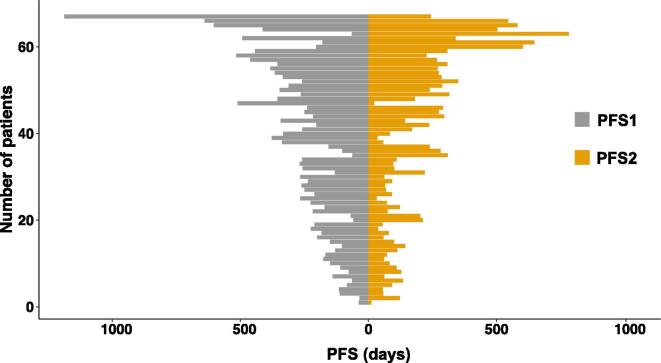
We included 67 patients with recurrent high-grade serous (HGSC, 73.1%) or low-grade (LGOC, 26.9%) ovarian carcinoma. We determined the median PFS-ratio and investigated the association with clinicopathological characteristics.
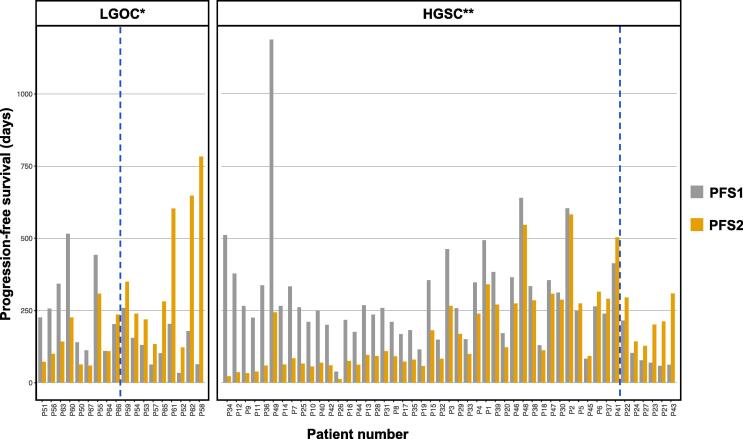
Overall, we observed a median PFS-ratio of 0.69. The proportion of patients with a PFS-ratio > 1.3 was 22.4%. For HGSC patients, the median PFS-ratio was significantly lower than for LGOC patients (respectively, 0.58 and 1.26, = 0.007). Multivariate logistic regression analysis revealed that the LGOC subtype and CA125 tumor marker concentration were independent factors related to a PFS-ratio > 1.3.
Although the PFS-ratio represents a meaningful outcome measure in studies investigating cytostatic anticancer agents, we conclude that it is influenced by tumor histology and biological behavior. In future research, these factors should be taken into account when determining thresholds for clinical benefit in trial designs.
细胞毒性抗癌药物的临床疗效可用无进展生存期(PFS)比值来确定。该结局指标将新治疗方案所达到的PFS(PFS2)与患者经历疾病进展的最新治疗方案的PFS(PFS1)进行比较。临床获益定义为PFS比值(PFS2/PFS1)>1.3。然而,为了证明显著获益,试验设计需要对姑息治疗方案中达到该比值的患者比例做出假设。对于卵巢癌,缺乏支持该假设的数据。因此,在本研究中,我们评估了接受当前姑息治疗方案的复发性卵巢癌患者的PFS比值。
我们纳入了67例复发性高级别浆液性(HGSC,73.1%)或低级别(LGOC,26.9%)卵巢癌患者。我们确定了PFS比值的中位数,并研究了其与临床病理特征的相关性。
总体而言,我们观察到PFS比值的中位数为0.69。PFS比值>1.3的患者比例为22.4%。对于HGSC患者,PFS比值的中位数显著低于LGOC患者(分别为0.58和1.26,P=0.007)。多因素逻辑回归分析显示,LGOC亚型和CA125肿瘤标志物浓度是与PFS比值>1.3相关的独立因素。
尽管PFS比值在研究细胞毒性抗癌药物的研究中是一个有意义的结局指标,但我们得出结论,它受肿瘤组织学和生物学行为的影响。在未来的研究中,在确定试验设计中的临床获益阈值时应考虑这些因素。