Primm Kristin M, Zhao Hui, Hernandez Daphne C, Chang Shine
Department of Epidemiology, The University of Texas MD Anderson Cancer Center, Houston, Texas.
Department of Health Services Research, The University of Texas MD Anderson Cancer Center, Houston, Texas.
JTO Clin Res Rep. 2022 Jul 2;3(8):100374. doi: 10.1016/j.jtocrr.2022.100374. eCollection 2022 Aug.
Detailed evaluations of racial and ethnic trends and disparities in NSCLC outcomes are lacking, and it remains unclear whether recent advances in screening and targeted therapies for NSCLC have benefited all population groups equally.
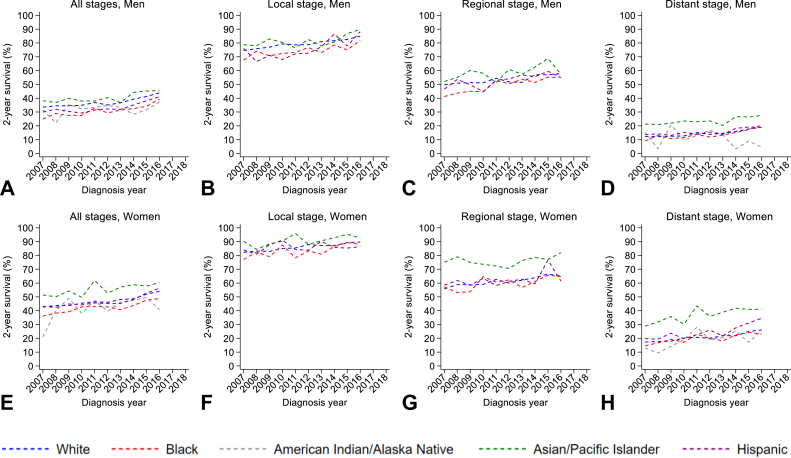
Using the Surveillance, Epidemiology, and End Results 18-registry data, we evaluated trends in overall and stage-specific NSCLC incidence (2007-2018) among patients aged 55 to 79 years by sex and race and ethnicity. Overall and stage-specific 2-year cause-specific survival rates were calculated by sex and race and ethnicity. Health Disparities software calculated absolute (difference) and relative (ratio) disparity measures comparing racial and ethnic groups with the highest and lowest rates (range measures) and comparing white patients (reference group) with other groups (pairwise rate measures). Joinpoint software assessed changes in rates and disparities.
Both men and women experienced substantial declines in NSCLC incidence from 2007 to 2018, largely due to significant declines in the incidence of distant-stage NSCLC over the study period ( < 0.05). During the same time period, the incidence of local-stage NSCLC significantly increased among black and Hispanic women ( < 0.05) and remained stable among all other groups. Overall, 2-year cause-specific survival rates improved across most racial and ethnic groups, especially among those diagnosed in regional and distant stages. For both sexes, absolute disparities in overall and stage-specific incidence of NSCLC significantly decreased over time ( < 0.05), whereas relative disparities remained unchanged. Pairwise comparison revealed persistent disparities in NSCLC burden between black and white men.
We found evidence of narrowing racial and ethnic disparities in NSCLC incidence over time; however, important disparities persist. More work is needed to ensure consistent and equitable access to high-quality screening, diagnosis, and treatment to reduce and eliminate cancer disparities.
目前缺乏对非小细胞肺癌(NSCLC)结局的种族和民族趋势及差异的详细评估,NSCLC筛查和靶向治疗的最新进展是否使所有人群同等受益仍不清楚。
利用监测、流行病学和最终结果(SEER)18登记处的数据,我们按性别、种族和民族评估了55至79岁患者中NSCLC总体发病率和特定分期发病率的趋势(2007 - 2018年)。按性别、种族和民族计算总体和特定分期的2年病因特异性生存率。健康差异软件计算了绝对(差值)和相对(比值)差异指标,用于比较发病率最高和最低的种族和民族群体(范围指标),以及比较白人患者(参照组)与其他群体(成对率指标)。Joinpoint软件评估发病率和差异的变化。
2007年至2018年,男性和女性的NSCLC发病率均大幅下降,这主要归因于研究期间远处分期NSCLC发病率的显著下降(<0.05)。在同一时期,局部分期NSCLC的发病率在黑人和西班牙裔女性中显著增加(<0.05),在所有其他群体中保持稳定。总体而言,大多数种族和民族群体的2年病因特异性生存率有所提高,尤其是那些诊断为区域和远处分期的患者。对于男性和女性,NSCLC总体发病率和特定分期发病率的绝对差异随时间显著降低(<0.05),而相对差异保持不变。成对比较显示黑人和白人男性在NSCLC负担方面存在持续差异。
我们发现有证据表明随着时间推移NSCLC发病率的种族和民族差异在缩小;然而,重要的差异仍然存在。需要开展更多工作以确保一致且公平地获得高质量的筛查、诊断和治疗,以减少和消除癌症差异。