Moore Jeff M, Vinoskey Cameron, Salmons Hannah, Hooshmand Shirin, Kressler Jochen
School of Exercise and Nutritional Sciences, San Diego State University, San Diego, CA, 92182, USA.
The Lundquist Institute for Biomedical Innovation at Harbor-UCLA Medical Center, Torrance, CA, 90502, USA.
Metabol Open. 2022 Jul 14;15:100200. doi: 10.1016/j.metop.2022.100200. eCollection 2022 Sep.
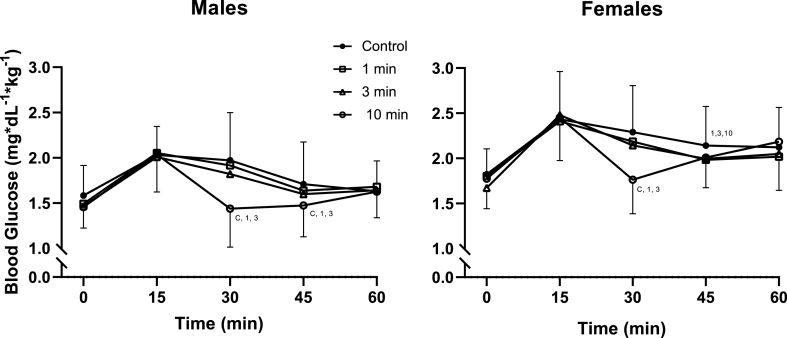
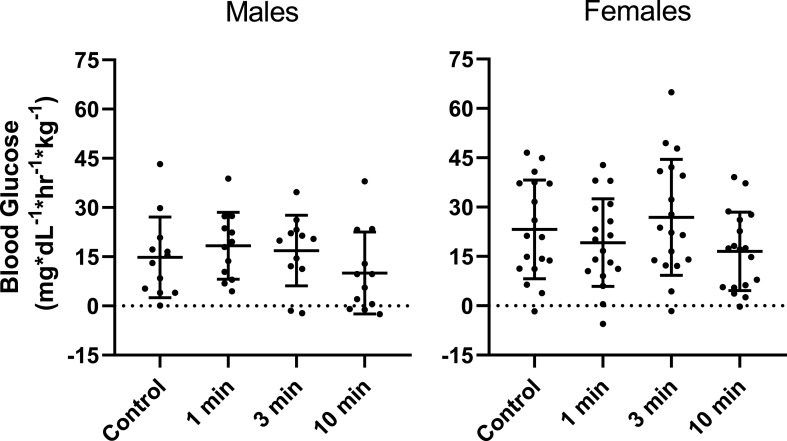
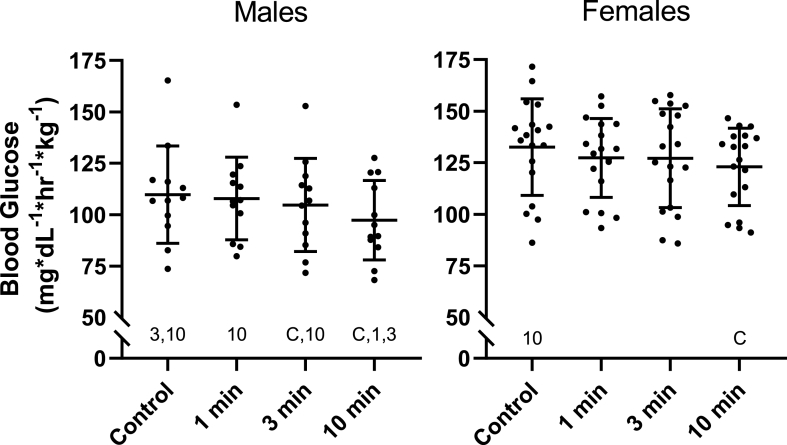
Single, short stair climbing and descending (SCD) bouts of low to moderate intensity effectively lower postprandial blood glucose but previous reports have found conflicting results on interactions by sex during exercise. We hypothesize that SCD at a self-selected intensity will be equally effective at lowering postprandial blood glucose in males and females. Methods and Results: Thirty subjects (age: 23.8 (3.0) years) performed 0, 1, 3, and 10 min of SCD following consumption of a mixed meal. SCD was performed at a self-selected comfortable pace and all bouts ended at minute 28. Postprandial blood glucose was measured every 15 min for 1 h and analyzed as glucose over time, area under the curve (AUC), and incremental AUC (iAUC) using mixed-design ANOVAs with repeated measures. Although there was no interaction between sex and condition or time (p = .129 to .541) for glucose over time, AUC, or iAUC, there was a main effect for sex for glucose over time (p = .004) and AUC (p = .006), but not iAUC (p = .125). Females had higher blood glucose throughout each trial (22% (13 to 31%), p = .004) but both males' and females' postprandial blood glucose was lowered following 10 min of SCD relative to the seated control condition. Conclusions: Males and females benefited equally from single, short SCD bouts of low to moderate intensity despite females having higher blood glucose at all time points. Previous findings of sex differences in the attenuating effect of exercise on postprandial blood glucose are likely due to the use of absolute workloads leading to varying relative intensities.
单次进行低至中等强度的短时间爬楼梯和下楼梯(SCD)活动能有效降低餐后血糖,但此前的报告在运动期间性别间的相互作用方面得出了相互矛盾的结果。我们假设,以自我选择的强度进行SCD对降低男性和女性的餐后血糖同样有效。方法与结果:30名受试者(年龄:23.8(3.0)岁)在食用混合餐后进行了0、1、3和10分钟的SCD。SCD以自我选择的舒适节奏进行,所有时间段均在第28分钟结束。在1小时内每隔15分钟测量一次餐后血糖,并使用重复测量的混合设计方差分析将其作为随时间变化的血糖、曲线下面积(AUC)和增量AUC(iAUC)进行分析。尽管在随时间变化的血糖、AUC或iAUC方面,性别与条件或时间之间没有相互作用(p = 0.129至0.541),但在随时间变化的血糖(p = 0.004)和AUC(p = 0.006)方面存在性别主效应,而在iAUC方面不存在(p = 0.125)。在每个试验中,女性的血糖始终较高(22%(13%至31%),p = 0.004),但与坐着的对照条件相比,男性和女性在进行10分钟的SCD后餐后血糖均有所降低。结论:尽管女性在所有时间点的血糖都较高,但男性和女性从单次、短时间的低至中等强度SCD活动中获得的益处是相同的。先前关于运动对餐后血糖的衰减作用存在性别差异的研究结果,可能是由于使用了绝对工作量导致相对强度不同所致。