Bhowmik Khokon Kanti, Barek Md Abdul, Aziz Md Abdul, Islam Mohammad Safiqul
Department of Pharmacy Faculty of Science, Noakhali Science and Technology University Noakhali Bangladesh.
Laboratory of Pharmacogenomics and Molecular Biology, Department of Pharmacy Noakhali Science and Technology University Noakhali Bangladesh.
Health Sci Rep. 2022 Jul 25;5(4):e728. doi: 10.1002/hsr2.728. eCollection 2022 Jul.
Abnormalities in hematological and biochemical markers are assumed to be associated with the progression of COVID-19 disease. This meta-analysis was performed to assess the consequences of abnormalities of biomarkers (D-dimers, C-reactive protein [CRP], serum ferritin, lactate dehydrogenase [LDH], random blood sugar [RBS], absolute neutrophil count [ANC], neutrophil to lymphocyte ratio (NLR), serum creatinine, and hemoglobin) in the Bangladeshi COVID-19 patients.
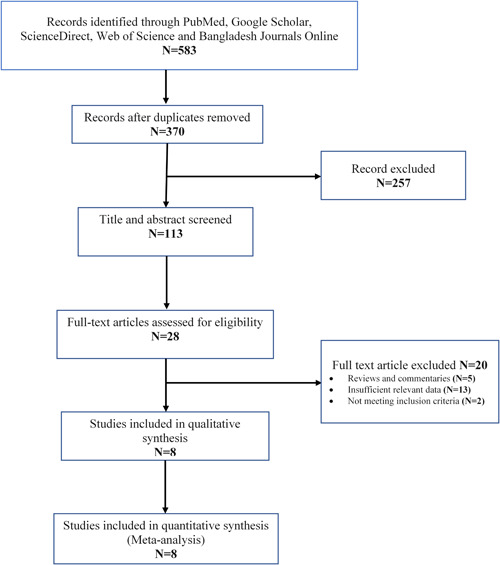
The data of biomarker levels in Bangladeshi COVID-19 patients were gathered from five databases: PubMed, ScienceDirect, Web of Science, Google Scholar and Bangladesh Journals Online between January 2020 to March 2022. Review Manager 5.4 was used for the meta-analysis, and Egger's test and Begg-Mazumdar's rank correlation were used to investigate publication bias.
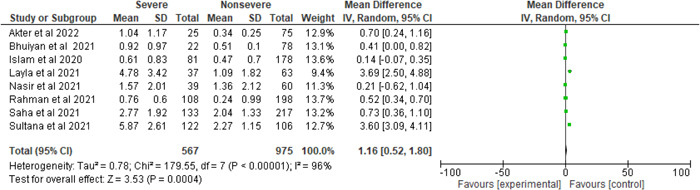
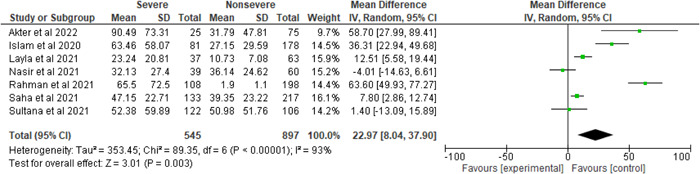
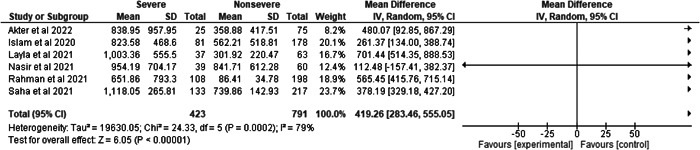
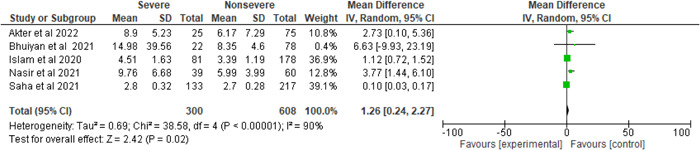
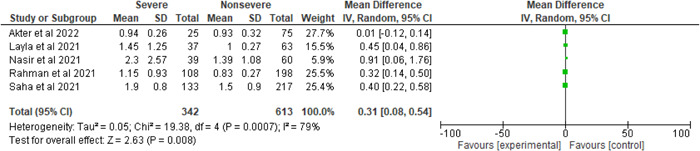
This study included 1542 patients with 567 severe and 975 nonsevere statuses. Based on the accumulated data synthesis, there is a strong correlation between disease severity and different biomarkers, including D-dimer, CRP, ferritin, LDH, RBS, NLR, and serum creatinine (MD = 1.16, = 0.0004; MD = 22.97, = 0.003; MD = 419.26, < 0.00001; MD = 118.37, = 0.004; MD = 1.96, = 0.02; MD = 1.26, = 0.02; and MD = 0.31, = 0.008, respectively). A significantly decreased correlation was observed for hemoglobin levels in severe COVID-19 patients (MD = -0.73, = 0.10).
The elevated biomarkers level was noticed in severe cases compared to nonsevere patients, revealing that D-dimer, CRP, ferritin, LDH, RBS, NLR, and serum creatinine are significantly correlated to COVID-19 severity. Only lower hemoglobin level was found to be associated with COVID-19 severity.
血液学和生化指标异常被认为与2019冠状病毒病(COVID-19)的病情进展有关。本荟萃分析旨在评估孟加拉国COVID-19患者生物标志物(D-二聚体、C反应蛋白[CRP]、血清铁蛋白、乳酸脱氢酶[LDH]、随机血糖[RBS]、绝对中性粒细胞计数[ANC]、中性粒细胞与淋巴细胞比值[NLR]、血清肌酐和血红蛋白)异常的后果。
2020年1月至2022年3月期间,从五个数据库收集孟加拉国COVID-19患者生物标志物水平的数据,这五个数据库分别是:PubMed、ScienceDirect、科学网、谷歌学术和孟加拉国在线期刊。使用Review Manager 5.4进行荟萃分析,采用Egger检验和Begg-Mazumdar秩相关分析来研究发表偏倚。
本研究纳入了1542例患者,其中567例为重症,975例为非重症。基于累积的数据综合分析,疾病严重程度与不同生物标志物之间存在强相关性,这些生物标志物包括D-二聚体、CRP、铁蛋白、LDH、RBS、NLR和血清肌酐(MD = 1.16,P = 0.0004;MD = 22.97,P = 0.003;MD = 419.26,P < 0.00001;MD = 118.37,P = 0.004;MD = 1.96,P = 0.02;MD = 1.26,P = 0.02;MD = 0.31,P = 0.008)。重症COVID-19患者的血红蛋白水平相关性显著降低(MD = -0.73,P = 0.10)。
与非重症患者相比,重症病例中生物标志物水平升高,表明D-二聚体、CRP、铁蛋白LDH、RBS、NLR和血清肌酐与COVID-19严重程度显著相关。仅发现较低的血红蛋白水平与COVID-19严重程度相关。