Montalvo-Martínez Larisa, Cruz-Carrillo Gabriela, Maldonado-Ruiz Roger, Trujillo-Villarreal Luis A, Garza-Villarreal Eduardo A, Camacho-Morales Alberto
Universidad Autónoma de Nuevo León, Department of Biochemistry, College of Medicine; Universidad Autónoma de Nuevo León, Neurometabolism Unit, Center for Research and Development in Health Sciences, Monterrey, México.
Universidad Nacional Autónoma de México, Campus Juriquilla Instituto de Neurobiología, Queretaro, México.
Neural Regen Res. 2023 Feb;18(2):280-283. doi: 10.4103/1673-5374.346475.
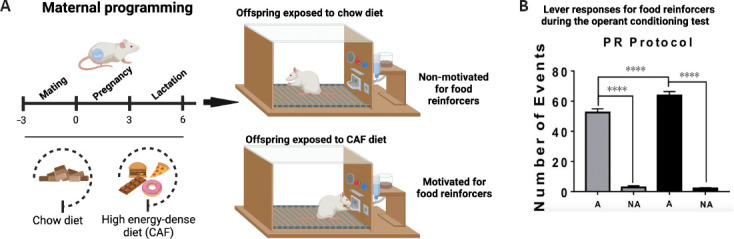
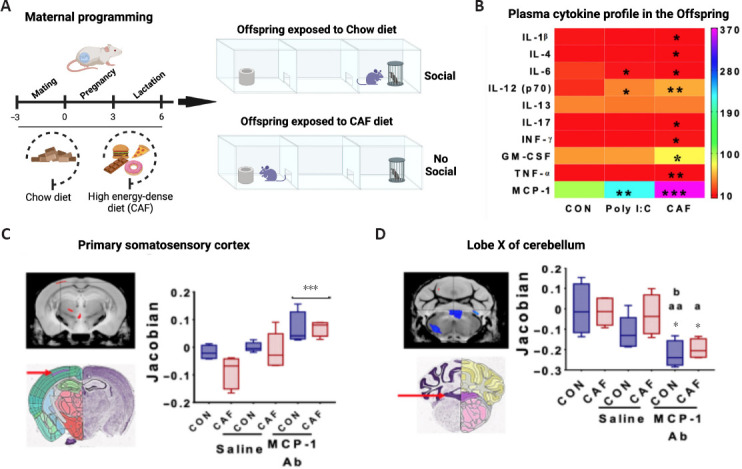
Prenatal programming during pregnancy sets physiological outcomes in the offspring by integrating external or internal stimuli. Accordingly, pregnancy is an important stage of physiological adaptations to the environment where the fetus becomes exposed and adapted to the maternal milieu. Maternal exposure to high-energy dense diets can affect motivated behavior in the offspring leading to addiction and impaired sociability. A high-energy dense exposure also increases the pro-inflammatory cytokines profile in plasma and brain and favors microglia activation in the offspring. While still under investigation, prenatal exposure to high-energy dense diets promotes structural abnormalities in selective brain regions regulating motivation and social behavior in the offspring. The current review addresses the role of energy-dense foods programming central and peripheral inflammatory profiles during embryonic development and its effect on motivated behavior in the offspring. We provide preclinical and clinical evidence that supports the contribution of prenatal programming in shaping immune profiles that favor structural and brain circuit disruption leading to aberrant motivated behaviors after birth. We hope this minireview encourages future research on novel insights into the mechanisms underlying maternal programming of motivated behavior by central immune networks.
孕期的产前编程通过整合外部或内部刺激来设定后代的生理结果。因此,怀孕是生理适应环境的重要阶段,在此期间胎儿会接触并适应母体环境。母体暴露于高能量密度饮食会影响后代的动机行为,导致成瘾和社交能力受损。高能量密度暴露还会增加血浆和大脑中的促炎细胞因子水平,并促进后代小胶质细胞的激活。虽然仍在研究中,但产前暴露于高能量密度饮食会导致后代中调节动机和社会行为的选择性脑区出现结构异常。本综述探讨了高能量密度食物在胚胎发育过程中对中枢和外周炎症特征进行编程的作用及其对后代动机行为的影响。我们提供了临床前和临床证据,支持产前编程在塑造免疫特征方面的作用,这些免疫特征有利于结构和脑回路破坏,导致出生后出现异常的动机行为。我们希望这篇小型综述能鼓励未来对中枢免疫网络在母体动机行为编程潜在机制方面的新见解进行研究。