Laboratory of Macromolecular Engineering, Department of Pharmaceutical Chemistry, Faculty of Pharmacy, Universitas Gadjah Mada Sekip Utara II, 55281 Yogyakarta, Indonesia.
Cancer Chemoprevention Research Center, Faculty of Pharmacy, Universitas Gadjah Mada Sekip Utara II, 55281 Yogyakarta, Indonesia.
Asian Pac J Cancer Prev. 2022 Jul 1;23(7):2341-2350. doi: 10.31557/APJCP.2022.23.7.2341.
Tamoxifen is the drug of choice for treating breast cancer, particularly the estrogen receptor-positive luminal A subtype. However, the increased occurrence of Tamoxifen resistance highlights the need to develop an agent to enhance the effectiveness of this drug.
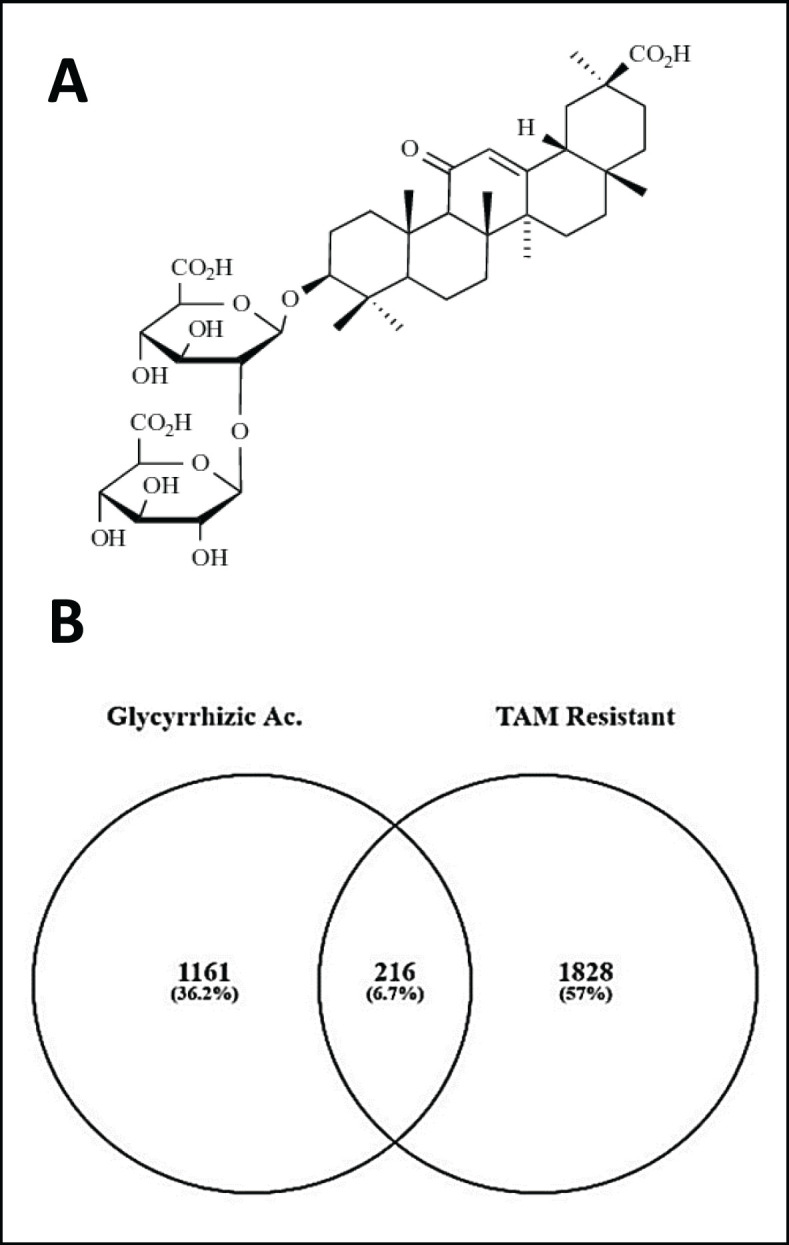
Although glycyrrhizic acid (GA) is known to exhibit cytotoxic effects on Michigan Cancer Foundation-7 cells, the specific gene targets and pathways it employs to overcome Tamoxifen resistance are incompletely understood. Therefore, the goal of the present research is to discover the potential targets and pathways of GA by using a bioinformatics approach.
Differentially expressed genes (DEGs) were identified in the Gene Expression Omnibus NCBI database using microarray data from GSE67916 and GSE85871. Further analyses were performed on these DEGs by using DAVID v6.8, STRING-DB v11.0, and Cytoscape v3.8.0. Analysis of gene alterations was performed using cBioPortal for target validation, and the relevant interaction process was examined via the molecular docking method.
Gene Ontology and Kyoto Encyclopedia of Genes and Genomes pathway enrichment analyses identified the PI3K-AKT signaling as the potential target mechanism. Construction of the protein-protein interaction network and analysis of hub genes identified the top 25 hub genes. Genetic alterations were observed in six potential target genes, such as CDK2, MDM2, NF1, SMAD3, PTPN11, and CALM1. Molecular docking analysis demonstrated that the docking score of GA is lower than that of the native ligand of p53. More importantly, 3n the PI3K-AKT signaling pathway is a potential target for overcoming Tamoxifen resistance in breast cancer.
MDM2 may be a potential gene target of GA and the PI3K-AKT signaling may be a prospective mechanism for overcoming Tamoxifen resistance in breast cancer cells. Additional research is required to validate the findings of this study.
他莫昔芬是治疗乳腺癌的首选药物,特别是雌激素受体阳性的腔 A 型。然而,他莫昔芬耐药性的发生率增加表明需要开发一种药物来增强这种药物的疗效。
虽然甘草酸(GA)已知对密歇根癌症基金会-7 细胞具有细胞毒性作用,但它克服他莫昔芬耐药性所采用的特定基因靶点和途径尚不完全清楚。因此,本研究的目的是通过生物信息学方法发现 GA 的潜在靶点和途径。
从 GSE67916 和 GSE85871 的微阵列数据中,在 NCBI 基因表达综合数据库中使用基因表达谱芯片技术识别差异表达基因(DEGs)。然后使用 DAVID v6.8、STRING-DB v11.0 和 Cytoscape v3.8.0 对这些 DEGs 进行进一步分析。使用 cBioPortal 进行靶基因验证分析基因改变,通过分子对接方法研究相关的相互作用过程。
基因本体论和京都基因与基因组百科全书通路富集分析鉴定出 PI3K-AKT 信号通路是潜在的靶点机制。构建蛋白质-蛋白质相互作用网络并分析枢纽基因,确定了前 25 个枢纽基因。在六个潜在靶基因(如 CDK2、MDM2、NF1、SMAD3、PTPN11 和 CALM1)中观察到遗传改变。分子对接分析表明,GA 的对接评分低于 p53 的天然配体。更重要的是,PI3K-AKT 信号通路是克服乳腺癌他莫昔芬耐药的潜在靶点。
MDM2 可能是 GA 的潜在基因靶点,PI3K-AKT 信号通路可能是克服乳腺癌细胞他莫昔芬耐药的潜在机制。需要进一步的研究来验证本研究的结果。