School of Life Course and Population Sciences, King's College London, Faculty of Life Sciences and Medicine, London, London, UK
School of Life Course and Population Sciences, King's College London, Faculty of Life Sciences and Medicine, London, London, UK.
BMJ Open. 2022 Jul 28;12(7):e062893. doi: 10.1136/bmjopen-2022-062893.
Both low and high body mass index (BMI) have been associated with greater mortality in older adults. This study aimed to evaluate the trajectory of BMI in the final years of life.
A population-based cohort study was conducted including community-dwelling adults in the English Longitudinal Study of Ageing between 1998 and 2012. BMI was evaluated in relation to age and years before death. Number of long-term conditions, cigarette smoking and socioeconomic position were evaluated as effect modifiers.
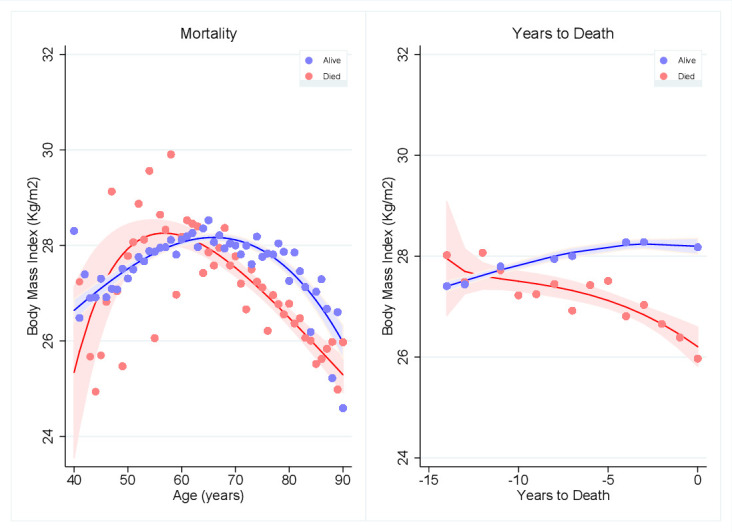
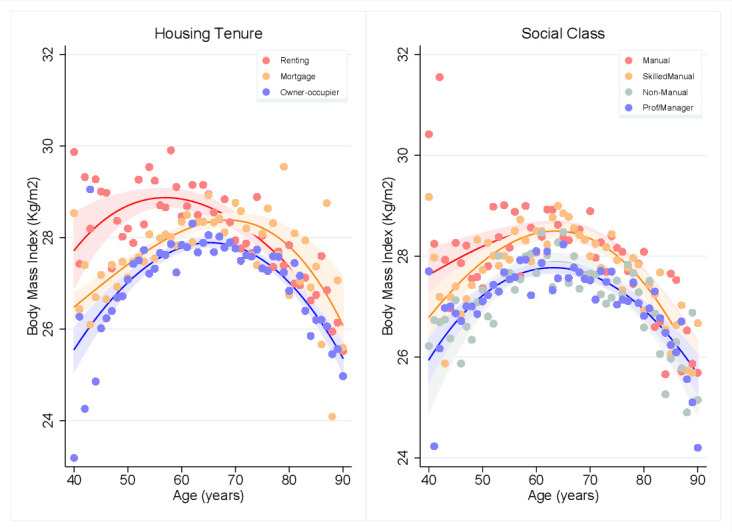
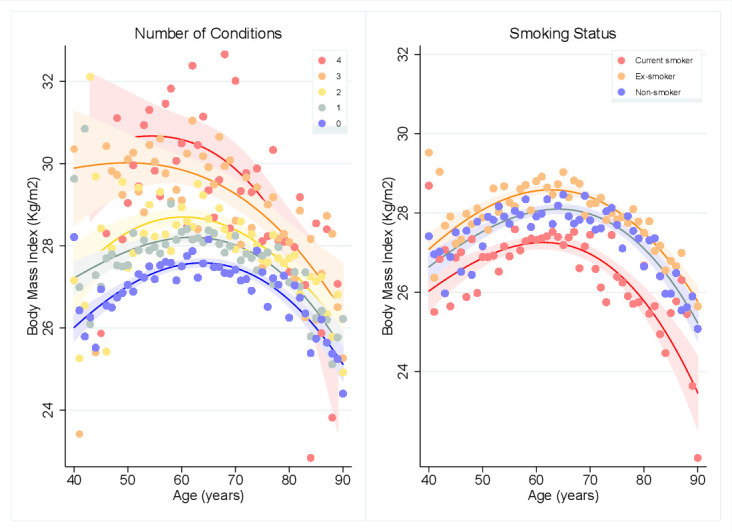
Data were analysed for 16 924 participants with 31 857 BMI records; mean age at study starts, 61.6 (SD 10.9) years; mean BMI, 27.5 (4.7) Kg/m. There were 3686 participants (4794 BMI records) who died and 13 238 participants (27 063 BMI records) who were alive at last follow-up. Mean BMI increased with age to 60-69 years but then declined, but the age-related decline was more rapid in decedents. From 4 to 7 years before death or end of study, adjusted mean BMI was 0.87 (95% CI 0.50 to 1.24) Kg/m lower for male decedents than survivors and 1.02 (0.56 to 1.47) lower in women; and from 3 to 0 years before death, BMI was 1.39 (0.98 to 1.80) Kg/m lower in male decedents and 2.12 (1.60 to 2.64) lower in female decedents. Multiple long-term conditions and lower socioeconomic position were associated with higher peak BMI and greater BMI decline; current smoking was associated with lower BMI and greater BMI decline.
In community-dwelling older adults, mean BMI enters an accelerating decline from up to 8 years before death. Multiple long-term conditions, smoking and lower socioeconomic position are associated with BMI decline.
低体重指数(BMI)和高体重指数(BMI)与老年人死亡率增加均相关。本研究旨在评估生命终末期 BMI 的变化轨迹。
进行了一项基于人群的队列研究,纳入了 1998 年至 2012 年间参加英国老龄化纵向研究的社区居住成年人。评估了 BMI 与年龄和死亡前年限的关系。评估了多种慢性疾病、吸烟和社会经济地位作为效应修饰剂。
共分析了 16924 名参与者的 31857 条 BMI 记录,研究开始时的平均年龄为 61.6(10.9)岁,平均 BMI 为 27.5(4.7)kg/m²。共有 3686 名参与者(4794 条 BMI 记录)死亡,13238 名参与者(27063 条 BMI 记录)在最后一次随访时仍然存活。平均 BMI 随年龄增长至 60-69 岁后开始下降,但死亡者的下降速度更快。在死亡或研究结束前 4-7 年,与存活者相比,男性死亡者的调整后平均 BMI 低 0.87(95%CI 0.50 至 1.24)kg/m²,女性低 1.02(0.56 至 1.47)kg/m²;在死亡前 3-0 年,男性死亡者的 BMI 低 1.39(0.98 至 1.80)kg/m²,女性死亡者的 BMI 低 2.12(1.60 至 2.64)kg/m²。多种慢性疾病和较低的社会经济地位与较高的峰值 BMI 和更大的 BMI 下降有关;当前吸烟与 BMI 较低和 BMI 下降更大有关。
在社区居住的老年人中,平均 BMI 从死亡前 8 年开始进入加速下降阶段。多种慢性疾病、吸烟和较低的社会经济地位与 BMI 下降有关。