Department of Biomedical Sciences, Seoul National University College of Medicine, Seoul, South Korea.
Department of Biomedical Informatics, CHA University School of Medicine, CHA University, Seongnam, South Korea.
Arthritis Res Ther. 2022 Jul 28;24(1):180. doi: 10.1186/s13075-022-02871-1.
There is limited information regarding disease-modifying antirheumatic drug (DMARD)-dependent risks of overall, incident, and recurrent herpes zoster (HZ) during first-line biologic DMARD (bDMARD) or targeted synthetic DMARD (tsDMARD) treatment among patients with seropositive rheumatoid arthritis (RA) in terms of HZ risk.
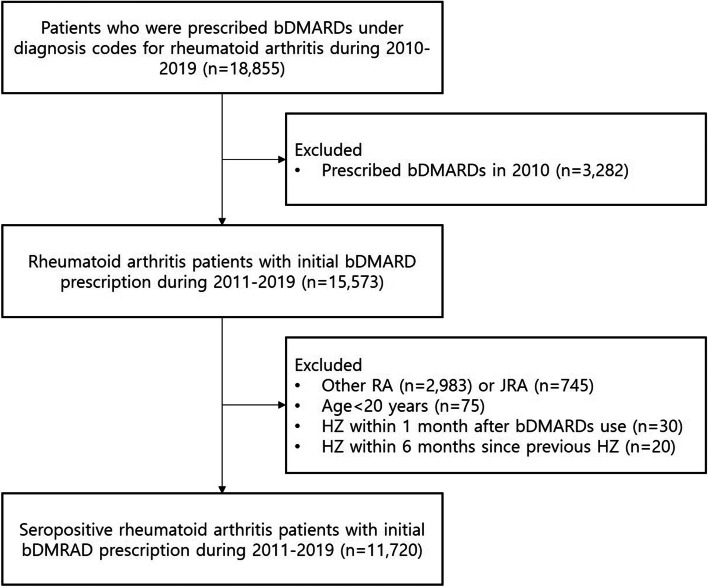
A total of 11,720 patients with seropositive RA who were prescribed bDMARD or tofacitinib between January 2011 and January 2019 from the Korean Health Insurance Review & Assessment Service database were studied. A multivariate Cox proportional hazards regression model was adopted to evaluate the adjusted hazard ratio (aHR) with 95% confidence interval (CI) for the risk of HZ dependent on the choice of first-line bDMARDs or tsDMARD, including etanercept, infliximab, adalimumab, golimumab, tocilizumab, rituximab, tofacitinib, and abatacept.
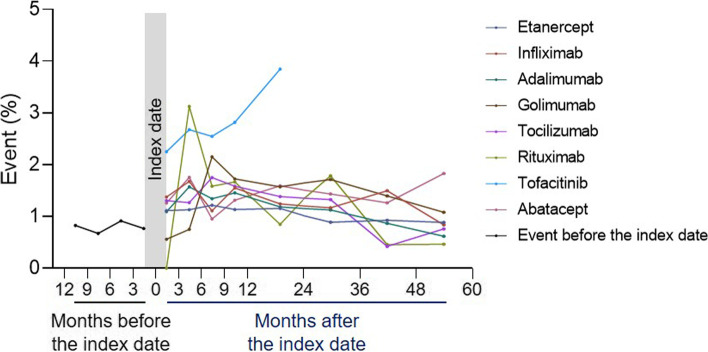
During the 34,702 person-years of follow-up, 1686 cases (14.4%) of HZ were identified, including 1372 (11.7%) incident and 314 (2.7%) recurrent HZs. Compared with that of the abatacept group, tofacitinib increased the overall risk (aHR, 2.46; 95% CI, 1.61-3.76; P<0.001), incidence (aHR, 1.99; 95% CI, 1.18-3.37; P=0.011), and recurrence (aHR, 3.69; 95% CI, 1.77-7.69; P<0.001) of HZ. Infliximab (aHR, 1.36; 95% CI, 1.06-1.74; P=0.017) and adalimumab (aHR, 1.29; 95% CI, 1.02-1.64; P=0.032) also increased the overall HZ risk. Moreover, a history of HZ was found to be an independent risk factor for HZ (aHR, 1.54; 95% CI, 1.33-1.78; P<0.001).
HZ risk is significantly increased in RA patients with a history of HZ after the initiation of bDMARDs or tsDMARD. The risk of incident and recurrent HZ was higher after tofacitinib treatment in patients with RA than that after treatment with bDMARDs. Individualized characteristics and history of HZ should be considered when selecting bDMARDs or tsDMARD for RA patients considering HZ risks.
在血清阳性类风湿关节炎(RA)患者中,关于一线生物 DMARD(bDMARD)或靶向合成 DMARD(tsDMARD)治疗期间,疾病修饰抗风湿药物(DMARD)依赖性总体、新发和复发性带状疱疹(HZ)风险,有关 HZ 风险的信息有限。
本研究共纳入了 11720 名自 2011 年 1 月至 2019 年 1 月期间在韩国健康保险审查与评估服务数据库中接受 bDMARD 或托法替布治疗的血清阳性 RA 患者。采用多变量 Cox 比例风险回归模型,评估了基于一线 bDMARD 或 tsDMARD 选择的 HZ 依赖性风险的调整后危险比(aHR)及其 95%置信区间(CI),包括依那西普、英夫利昔单抗、阿达木单抗、戈利木单抗、托珠单抗、利妥昔单抗、托法替布和阿巴西普。
在 34702 人年的随访期间,共确定了 1686 例(14.4%)HZ 病例,包括 1372 例(11.7%)新发 HZ 和 314 例(2.7%)复发性 HZ。与阿巴西普组相比,托法替布增加了总体风险(aHR,2.46;95%CI,1.61-3.76;P<0.001)、新发 HZ 风险(aHR,1.99;95%CI,1.18-3.37;P=0.011)和复发性 HZ 风险(aHR,3.69;95%CI,1.77-7.69;P<0.001)。英夫利昔单抗(aHR,1.36;95%CI,1.06-1.74;P=0.017)和阿达木单抗(aHR,1.29;95%CI,1.02-1.64;P=0.032)也增加了总体 HZ 风险。此外,HZ 病史被发现是 HZ 的独立危险因素(aHR,1.54;95%CI,1.33-1.78;P<0.001)。
在开始使用 bDMARD 或 tsDMARD 后,有 HZ 病史的 RA 患者的 HZ 风险显著增加。与 bDMARD 治疗相比,RA 患者使用托法替布治疗后新发和复发性 HZ 的风险更高。在考虑 RA 患者的 HZ 风险时,应考虑 bDMARD 或 tsDMARD 的个体化特征和 HZ 病史。