Ma Yue, Qiu Shui, Zhou Renyi
Department of Pulmonary and Critical Care Medicine, Shengjing Hospital of China Medical University, Shenyang, China.
Department of Orthopedics, First Hospital of China Medical University, Shenyang, China.
Front Physiol. 2022 Jul 12;13:939253. doi: 10.3389/fphys.2022.939253. eCollection 2022.
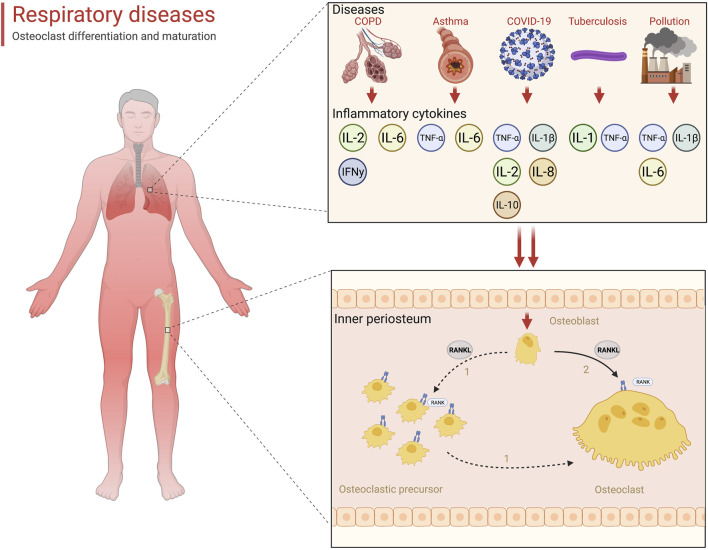
Climate change, environmental pollution, and virus epidemics have sharply increased the number of patients suffering from respiratory diseases in recent years. Prolonged periods of illness and drug use increase the occurrence of complications in these patients. Osteoporosis is the common bone metabolism disease with respiratory disturbance, which affects prognosis and increases mortality of patients. The problem of osteoporosis in patients with respiratory diseases needs more attention. In this review, we concluded the characteristics of osteoporosis in some respiratory diseases including COPD, asthma, COVID-19, tuberculosis, and lung cancer. We revealed that hypoxia was the common pathogenesis of osteoporosis secondary to respiratory diseases, with malnutrition and corticosteroid abuse driving the progression of osteoporosis. Hypoxia-induced ROS accumulation and activated HIF-1α lead to attenuated osteogenesis and enhanced osteoclastogenesis in patients with respiratory diseases. Tuberculosis and cancer also invaded bone tissue and reduced bone strength by direct infiltration. For the treatment of osteoporosis in respiratory patients, oral-optimized bisphosphonates were the best treatment modality. Vitamin D was a necessary supplement, both for calcium absorption in osteogenesis and for improvement of respiratory lesions. Reasonable adjustment of the dose and course of corticosteroids according to the etiology and condition of patients is beneficial to prevent the occurrence and development of osteoporosis. Additionally, HIF-1α was a potential target for the treatment of osteoporosis in respiratory patients, which could be activated under hypoxia condition and involved in the process of bone remodeling.
近年来,气候变化、环境污染和病毒流行使呼吸系统疾病患者数量急剧增加。疾病和药物使用时间的延长增加了这些患者并发症的发生率。骨质疏松症是伴有呼吸功能障碍的常见骨代谢疾病,影响患者的预后并增加死亡率。呼吸系统疾病患者的骨质疏松问题需要更多关注。在本综述中,我们总结了慢性阻塞性肺疾病(COPD)、哮喘、新型冠状病毒肺炎(COVID-19)、肺结核和肺癌等一些呼吸系统疾病中骨质疏松症的特点。我们发现,缺氧是呼吸系统疾病继发骨质疏松症的常见发病机制,营养不良和皮质类固醇滥用推动了骨质疏松症的进展。缺氧诱导的活性氧(ROS)积累和缺氧诱导因子-1α(HIF-1α)激活导致呼吸系统疾病患者成骨作用减弱和破骨细胞生成增强。肺结核和癌症也会侵袭骨组织并通过直接浸润降低骨强度。对于呼吸系统疾病患者骨质疏松症的治疗,口服优化的双膦酸盐是最佳治疗方式。维生素D是一种必要的补充剂,既有助于成骨过程中钙的吸收,也有助于改善肺部病变。根据患者的病因和病情合理调整皮质类固醇的剂量和疗程,有利于预防骨质疏松症的发生和发展。此外,HIF-1α是呼吸系统疾病患者骨质疏松症治疗的潜在靶点,其可在缺氧条件下被激活并参与骨重塑过程。