Department of Clinical Pharmacy, Hanoi University of Pharmacy, Hanoi, Vietnam.
School of Biomedical Sciences and Pharmacy, College of Health, Medicine and Wellbeing, University of Newcastle, Callaghan, NSW, Australia.
Clin Interv Aging. 2022 Jul 21;17:1127-1138. doi: 10.2147/CIA.S368871. eCollection 2022.
Geriatric inpatients generally have a high risk of drug-related problems (DRP) in prescribing following hospital admission, which are likely to cause negative clinical consequences. This is particularly evident in developing countries such as Vietnam. Therefore, clinical pharmacy service (CPS) aims to identify and resolve these DRPs to improve the quality use of medicines in the older population following hospital admission.
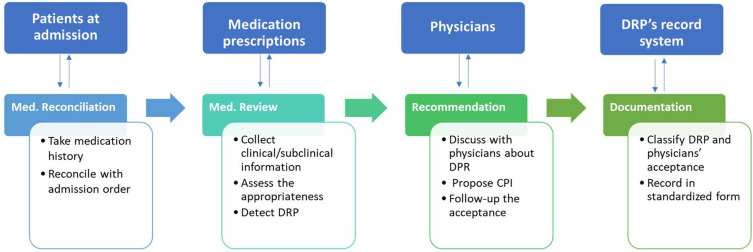
The study was conducted as a prospective, single-center study implemented at a general public hospital in Hanoi. Patients aged ≥60 years with at least three chronic diseases admitted to the Internal Medicine Department between August 2020 and December 2020 were eligible to be enrolled. A well-trained clinical pharmacist provided a structured CPS to identify any DRP in prescribing for each patient in the study. Clinical pharmacist interventions were then proposed to the attending physicians and documented in the DRP reporting system.
A total of 255 DRP were identified in 185 patients during the study period. The most frequent types of DRP were underuse (21.2%), dose too high (12.2%), and contraindication (11.8%). There was a very high rate of approval and uptake by the physicians regarding the interventions proposed by the clinical pharmacist (82.4% fully accepted and 12.5% partially accepted). Of the interventions, 73.4% were clinically relevant (pADE score ≥0.1). In general, 9 out of 10 physicians agreed that CPS has significant benefits for both patients and physicians.
Improving clinical pharmacy services can potentially have a positive impact on the quality of prescribing in elderly inpatients. These services should officially be implemented to optimize the quality use of medicines in this population group in Vietnam.
老年住院患者在入院后接受药物治疗时通常存在较高的药物相关问题(DRP)风险,这些问题可能会导致负面的临床后果。在越南等发展中国家,这种情况尤为明显。因此,临床药学服务(CPS)旨在识别和解决这些 DRP,以改善老年住院患者的药物使用质量。
本研究为前瞻性、单中心研究,在河内的一家公立医院进行。符合条件的患者为年龄≥60 岁、患有至少三种慢性病且于 2020 年 8 月至 2020 年 12 月期间入住内科的患者。一位经过培训的临床药师为每位研究患者提供了结构化的 CPS,以识别处方中的任何 DRP。然后向主治医生提出临床药师干预措施,并记录在 DRP 报告系统中。
在研究期间,185 名患者共发现 255 例 DRP。最常见的 DRP 类型是用药不足(21.2%)、剂量过高(12.2%)和禁忌证(11.8%)。医生对临床药师提出的干预措施非常认可并采纳(82.4%完全接受,12.5%部分接受)。在提出的干预措施中,73.4%具有临床相关性(pADE 评分≥0.1)。总的来说,90%的医生认为 CPS 对患者和医生都有显著的益处。
改善临床药学服务有可能对老年住院患者的处方质量产生积极影响。这些服务应该在越南正式实施,以优化该人群的药物使用质量。