Shallcross Amanda J, Duberstein Zoe T, Sperber Sarah H, Visvanathan Pallavi D, Lutfeali Samina, Lu Nathaniel, Carmody James, Spruill Tanya M
New York University, School of Medicine.
Manhattan Center for Mindfulness-Based Cognitive Therapy.
Cogn Behav Pract. 2022 May;29(2):280-291. doi: 10.1016/j.cbpra.2020.12.004. Epub 2021 Feb 10.
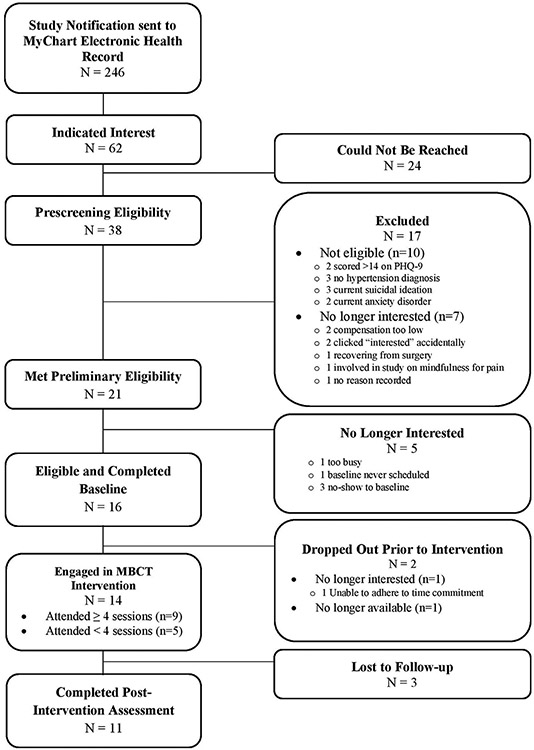
Mindfulness-based cognitive therapy (MBCT) is a promising intervention for reducing depressive symptoms in individuals with comorbid chronic disease, but the program's attendance demands make it inaccessible to many who might benefit. We tested the feasibility, acceptability, safety, and preliminary efficacy of an abbreviated, telephone-delivered adaptation of the in-person mindfulness-based cognitive therapy (MBCT-T) program in a sample of patients with depressive symptoms and hypertension. Participants (n = 14; 78.6% female, mean age = 60.6) with mild to moderate depressive symptoms and hypertension participated in the 8-week MBCT-T program. Feasibility was indexed via session attendance and home-based practice completion. Acceptability was indexed via self-reported satisfaction scores. Safety was assessed via reports of symptomatic decline or need for additional mental health treatment. Depressive symptoms (Quick Inventory of Depressive Symptomatology-Self-Report [QIDS-SR]) and anxiety (Hospital Anxiety and Depression Scale-Anxiety subscale; HADS-A) were assessed at baseline and immediately following the intervention. Sixty-four percent of participants (n = 9) attended ≥4 intervention sessions. Seventy-one percent (n = 6) of participants reported completing all assigned formal home practice and 89.2% (n = 8) reported completing all assigned informal practice. Participants were either very satisfied (75%; n = 6) or mostly satisfied (25%; n = 2) with the intervention. There were no adverse events or additional need for mental health treatment. Depressive symptom scores were 4.09 points lower postintervention (p = .004). Anxiety scores were 3.18 points lower postintervention (p = .039). Results support the feasibility, acceptability, safety, and preliminary efficacy of an abbreviated, telephone-delivered version of MBCT for reducing depressive and anxiety symptoms in individuals with co-occurring chronic disease.
基于正念的认知疗法(MBCT)是一种很有前景的干预方法,可减少患有慢性合并症个体的抑郁症状,但该项目的出勤要求使许多可能受益的人无法参与。我们在一组有抑郁症状和高血压的患者样本中,测试了一种简化的、通过电话提供的面对面基于正念的认知疗法(MBCT-T)项目的可行性、可接受性、安全性和初步疗效。有轻度至中度抑郁症状和高血压的参与者(n = 14;78.6%为女性,平均年龄 = 60.6岁)参加了为期8周的MBCT-T项目。通过课程出勤和家庭练习完成情况来衡量可行性。通过自我报告的满意度得分来衡量可接受性。通过症状恶化报告或额外心理健康治疗需求来评估安全性。在基线和干预结束后立即评估抑郁症状(抑郁症状快速自评量表[QIDS-SR])和焦虑(医院焦虑抑郁量表-焦虑分量表;HADS-A)。64%的参与者(n = 9)参加了≥4次干预课程。71%(n = 6)的参与者报告完成了所有指定的正式家庭练习,89.2%(n = 8)的参与者报告完成了所有指定的非正式练习。参与者对干预要么非常满意(75%;n = 6),要么大多满意(25%;n = 2)。没有不良事件或额外的心理健康治疗需求。干预后抑郁症状得分降低了4.09分(p = .004)。干预后焦虑得分降低了3.18分(p = .039)。结果支持了一种简化的、通过电话提供的MBCT版本在减少患有慢性合并症个体的抑郁和焦虑症状方面的可行性、可接受性、安全性和初步疗效。