Spruill Tanya M, Park Chorong, Kalinowski Jolaade, Arabadjian Milla E, Xia Yuhe, Shallcross Amanda J, Visvanathan Pallavi, Smilowitz Nathaniel R, Hausvater Anaïs, Bangalore Sripal, Zhong Hua, Park Ki, Mehta Puja K, Thomas Dwithiya K, Trost Jeffrey, Bainey Kevin R, Heydari Bobak, Wei Janet, Dickson Victoria Vaughan, Ogedegbe Gbenga, Berger Jeffrey S, Hochman Judith S, Reynolds Harmony R
Institute for Excellence in Health Equity, NYU Langone Health, New York, New York, USA.
Department of Population Health, NYU Grossman School of Medicine, New York, New York, USA.
JACC Adv. 2025 Jan 16;4(2):101530. doi: 10.1016/j.jacadv.2024.101530. eCollection 2025 Feb.
Elevated perceived stress is associated with adverse outcomes following myocardial infarction (MI) and may account for poorer recovery among women vs men.
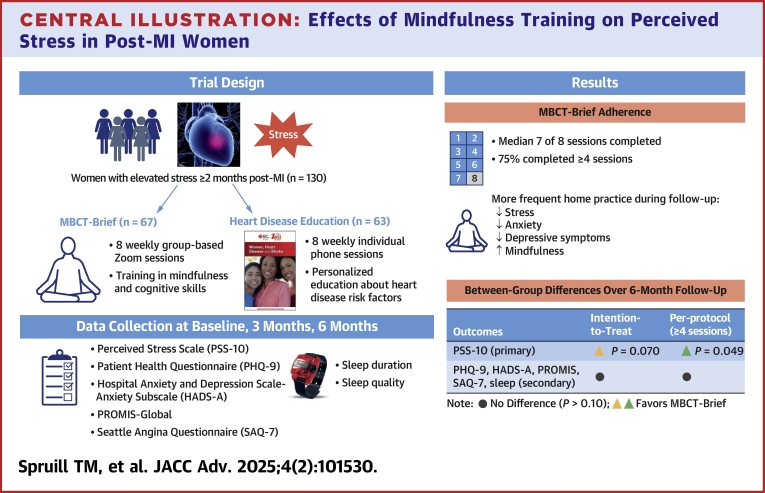
This randomized controlled trial tested effects of a mindfulness-based intervention on stress levels among women with MI.
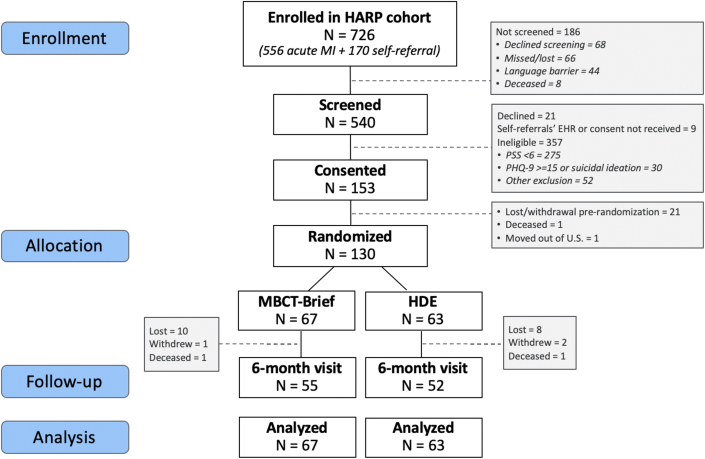
Women with elevated stress (Perceived Stress Scale [PSS-4]≥6) at least 2 months after MI were enrolled from 12 hospitals in the United States and Canada and via community advertising. Participants were randomized to a remotely delivered mindfulness intervention (MBCT-Brief) or heart disease education, both 8 weeks long. Follow-up was 6 months. Changes in stress (PSS-10; primary outcome) and secondary outcomes (depressive symptoms, anxiety, quality of life, disease-specific health status, actigraphy-assessed sleep) were compared between groups.
The sample included 130 women with MI (mean age 59.8 ± 12.8 years, 34% racial/ethnic minorities). In intention-to-treat analysis, PSS-10 scores declined in the MBCT-Brief arm (-0.52 [95% CI: -0.77 to -0.28]) but not the heart disease education arm (-0.19 [95% CI: -0.45 to 0.06]; group×time interaction = 0.070). The effect was stronger in per-protocol analysis of participants who completed ≥4 intervention sessions ( = 0.049). There were no significant differences in secondary outcomes in intention-to-treat or per-protocol analyses. Within the MBCT-Brief arm, more frequent mindfulness practice was associated with greater reductions in stress ( = 0.007), depressive symptoms ( = 0.017), and anxiety ( = 0.036).
MBCT-Brief was associated with greater 6-month reductions in stress than an active control among adherent participants. More frequent mindfulness practice was associated with greater improvements in psychological outcomes. Strategies to engage women with MI in mindfulness training and support regular home practice may enhance these effects.
感知压力升高与心肌梗死(MI)后的不良后果相关,且可能是女性比男性恢复较差的原因。
这项随机对照试验测试了基于正念的干预对心肌梗死女性压力水平的影响。
在美国和加拿大的12家医院以及通过社区广告招募心肌梗死后至少2个月压力升高(感知压力量表[PSS-4]≥6)的女性。参与者被随机分配到远程提供的正念干预(MBCT-Brief)或心脏病教育组,两者均为期8周。随访6个月。比较两组之间压力(PSS-10;主要结局)和次要结局(抑郁症状、焦虑、生活质量、疾病特异性健康状况、活动记录仪评估的睡眠)的变化。
样本包括130名心肌梗死女性(平均年龄59.8±12.8岁,34%为种族/族裔少数群体)。在意向性分析中,MBCT-Brief组的PSS-10评分下降(-0.52[95%CI:-0.77至-0.28]),而心脏病教育组未下降(-0.19[95%CI:-0.45至0.06];组×时间交互作用=0.070)。在完成≥4次干预课程的参与者的符合方案分析中,效果更强(=0.049)。在意向性分析或符合方案分析中,次要结局没有显著差异。在MBCT-Brief组中,更频繁的正念练习与压力(=0.007)、抑郁症状(=0.017)和焦虑(=0.036)的更大降低相关。
在坚持参与的参与者中,MBCT-Brief与比积极对照更大程度地降低6个月压力相关。更频繁的正念练习与心理结局的更大改善相关。使心肌梗死女性参与正念训练并支持定期在家练习的策略可能会增强这些效果。