Wu Ming, Li Huanrong, Yu Hongfei, Yan Ye, Wang Chen, Teng Fei, Fan Aiping, Xue Fengxia
Department of Gynecology and Obstetrics, Tianjin Medical University General Hospital, Tianjin, China.
Tianjin Key Laboratory of Female Reproductive Health and Eugenic, Department of Gynecology and Obstetrics, Tianjin Medical University General Hospital, Tianjin, China.
Front Oncol. 2022 Jul 12;12:941741. doi: 10.3389/fonc.2022.941741. eCollection 2022.
Emerging evidence has demonstrated a close association between perturbations in vaginal microbiota composition in women and human papillomavirus (HPV) infection, cervical lesions, and cervical cancer (Ca); however, these findings are highly heterogeneous and inconclusive.
To perform a comprehensive systematic review of the global disturbance in the vaginal microbiota, specifically in women with HPV-associated cervical diseases, and to further conduct within- and across-disease comparisons.
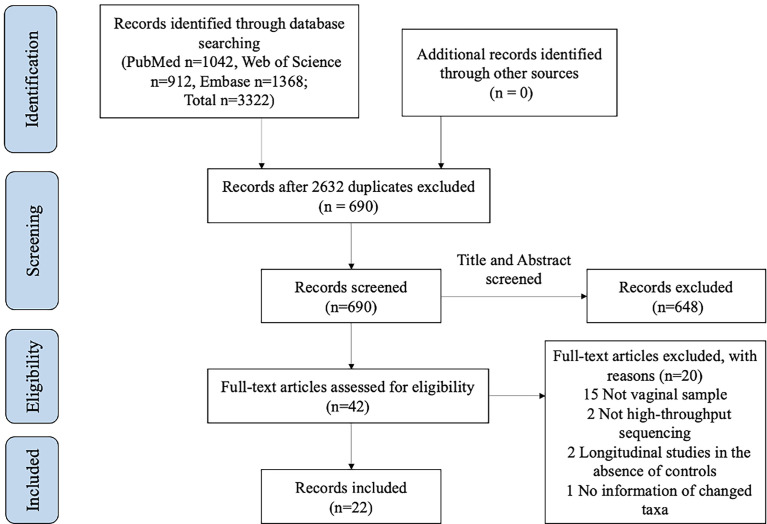
Twenty-two records were identified in a systematic literature search of PubMed, Web of Science, and Embase up to February 28, 2022. We extracted microbial changes at the community (alpha and beta diversity) and taxonomic (relative abundance) levels. Within- and across-disease findings on the relative abundance of taxonomic assignments were qualitatively synthesized.
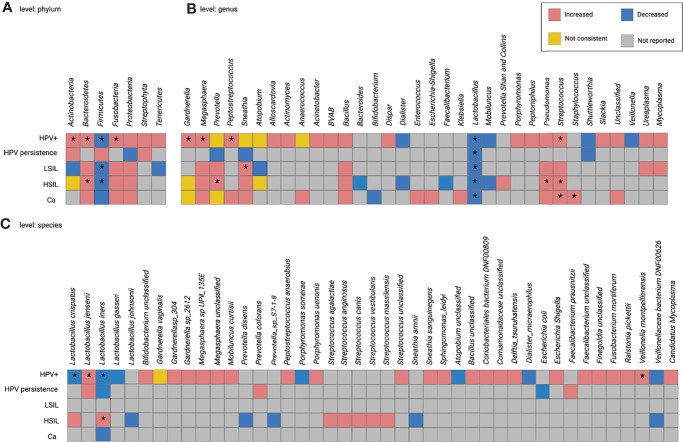
Generally, significantly higher alpha diversity was observed for HPV infection, cervical lesions, and/or cancer patients than in controls, and significant differences within beta diversity were observed for the overall microbial composition across samples. In within-disease comparisons, the genera , , , , and showed the greatest abundances with HPV infection; and showed inconsistent abundance with HPV infection, and was observed in Ca. Across diseases, we find increased levels of and varying levels of were shared across HPV infections, high-grade squamous intraepithelial lesions, and Ca, whereas varied depending on the HPV-related disease subtype.
This systematic review reports that vaginal microbiome disturbances are correlated to the depletion of , enrichment of anaerobes, and increased abundance of aerobic bacteria in HPV infection and related cervical diseases. Moreover, may exert either protective or pathogenic effects on different HPV-related diseases.
新出现的证据表明,女性阴道微生物群组成的扰动与人类乳头瘤病毒(HPV)感染、宫颈病变和宫颈癌(Ca)之间存在密切关联;然而,这些发现高度异质且尚无定论。
对阴道微生物群的全球紊乱情况进行全面系统的综述,特别是在与HPV相关的宫颈疾病女性中,并进一步进行疾病内和疾病间的比较。
截至2022年2月28日,在对PubMed、科学网和Embase进行的系统文献检索中确定了22条记录。我们提取了群落水平(α和β多样性)和分类水平(相对丰度)的微生物变化。对分类学分类相对丰度的疾病内和疾病间发现进行了定性综合。
一般来说,与对照组相比,HPV感染、宫颈病变和/或癌症患者的α多样性显著更高,并且在样本的整体微生物组成中观察到β多样性存在显著差异。在疾病内比较中,属、、、、和在HPV感染中丰度最高;和在HPV感染中的丰度不一致,而在Ca中观察到。在不同疾病中,我们发现HPV感染、高级别鳞状上皮内病变和Ca中均有和水平升高以及不同水平的,而根据HPV相关疾病亚型的不同而有所变化。
本系统综述报告称,阴道微生物群紊乱与HPV感染及相关宫颈疾病中的、厌氧菌富集和需氧菌丰度增加有关。此外,可能对不同的HPV相关疾病发挥保护或致病作用。