Zhou Jiamin, Feng Longhai, Li Xinxiang, Wang Miao, Zhao Yiming, Zhang Ning, Wang Longrong, Zhang Ti, Mao Anrong, Xu Ye, Wang Lu
Department of Hepatic Surgery, Shanghai Cancer Center, Fudan University, Shanghai, China.
Department of Oncology, Shanghai Medical College, Fudan University, Shanghai, China.
Front Oncol. 2022 Jul 12;12:916455. doi: 10.3389/fonc.2022.916455. eCollection 2022.
The aim of this study is to investigate the value of total laparoscopic simultaneous colorectal and hepatic resection in patients with synchronous colorectal cancer liver metastases (sCRLMs).
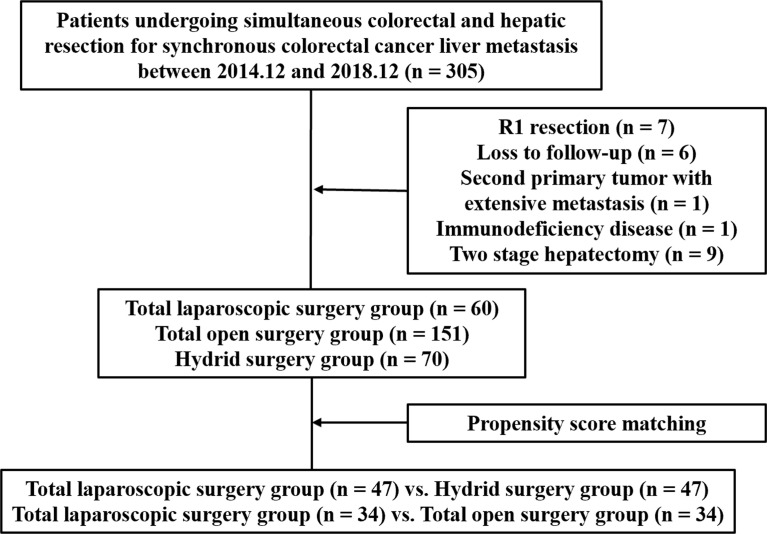
sCRLM patients who underwent simultaneous resection from December 2014 to December 2018 in Shanghai Cancer Center, Fudan University were recruited and analyzed retrospectively. The patients were divided into laparoscopic, open, and hybrid surgery groups. The intraoperative information, postoperative short-term outcome, and long-term survival were compared among the three groups. Propensity score matching (PSM) was performed to balance baselines.
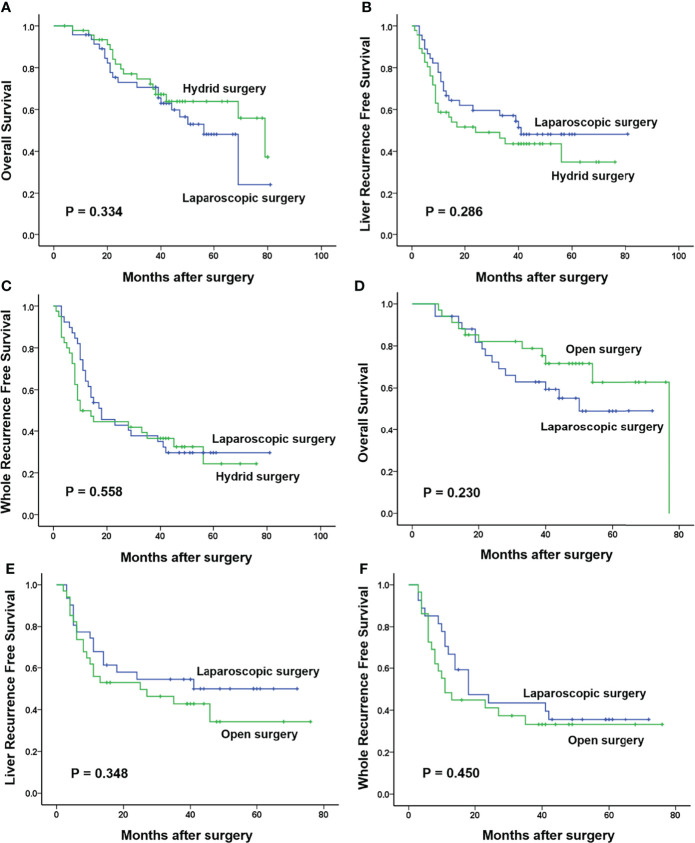
A total of 281 patients were recruited. After PSM, 34 patients were selected from both the laparoscopic and the open surgery group. Forty-seven patients were also selected from both the laparoscopic and the hybrid surgery group. The clinicopathologic baselines between the laparoscopic surgery group and the other two groups were well matched. All the operation-related indicators between laparoscopic surgery and hybrid surgery were similar. However, compared with open surgery, laparoscopic surgery showed significantly longer operation time (229.09 ± 10.94 min vs. 192.24 ± 9.49 min, = 0.013) and less intraoperative blood loss [100.00 (50.00-300.00) ml vs. 200.00 (150.00-400.00) ml, = 0.021]. For postoperative morbidity, there was no significant difference between the laparoscopic surgery group and the hybrid or the open surgery group (23.40% vs. 31.91% and 17.65% vs. 26.47%, = 0.356 and = 0.380). Long-term survival analysis showed that there were no significant differences in all 1-, 3-, and 5-year overall survival, liver recurrence-free survival (RFS), and whole RFS between laparoscopic surgery and hybrid surgery ( = 0.334, = 0.286, and = 0.558) or open surgery ( = 0.230, = 0.348, and = 0.450).
Laparoscopic simultaneous resection for sCRLM shows slight advantages in surgical safety and short-term outcome, and does not compromise long-term survival.
本研究旨在探讨全腹腔镜同期结直肠癌和肝切除在同期结直肠癌肝转移(sCRLMs)患者中的价值。
回顾性纳入2014年12月至2018年12月在复旦大学附属上海肿瘤中心接受同期切除的sCRLM患者并进行分析。将患者分为腹腔镜手术组、开放手术组和杂交手术组。比较三组患者的术中情况、术后短期结局和长期生存情况。采用倾向评分匹配(PSM)来平衡基线。
共纳入281例患者。PSM后,从腹腔镜手术组和开放手术组各选取34例患者。从腹腔镜手术组和杂交手术组也各选取47例患者。腹腔镜手术组与其他两组之间的临床病理基线匹配良好。腹腔镜手术和杂交手术之间的所有手术相关指标相似。然而,与开放手术相比,腹腔镜手术的手术时间明显更长(229.09±10.94分钟对192.24±9.49分钟,P = 0.013),术中出血量更少[100.00(50.00 - 300.00)毫升对200.00(150.00 - 400.00)毫升,P = 0.021]。术后并发症方面,腹腔镜手术组与杂交手术组或开放手术组之间无显著差异(23.40%对31.91%以及17.65%对26.47%,P = 0.356和P = 0.380)。长期生存分析显示,腹腔镜手术与杂交手术(P = 0.334、P = 0.286和P = 0.558)或开放手术(P = 0.230、P = 0.348和P = 0.450)在1年、3年和5年总生存率、肝无复发生存率(RFS)以及全RFS方面均无显著差异。
腹腔镜同期切除sCRLM在手术安全性和短期结局方面显示出轻微优势,且不影响长期生存。