Zhang Yan-Yu, Zhang Xian, Bu Shao-Yang, Zhang Wei-Wei, Li Tian-Xiu, Zheng De-Cai, Huang Ze-Xiang, Wang Qian
1Department of Aquaculture, College of Marine Sciences, Hainan University, Haikou, Hainan, China.
Endocr Connect. 2022 Jul 25;11(8). doi: 10.1530/EC-22-0136. Print 2022 Aug 1.
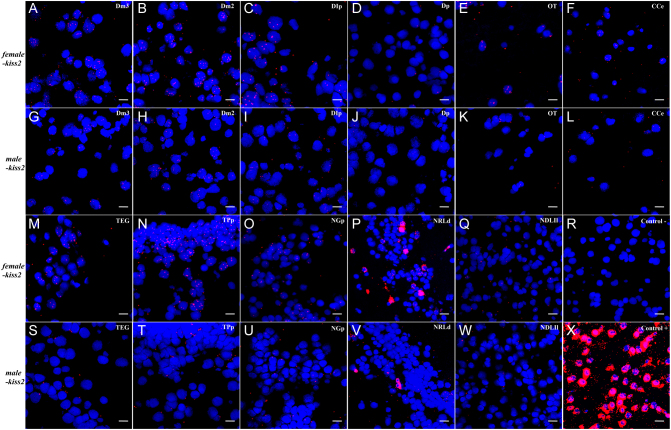
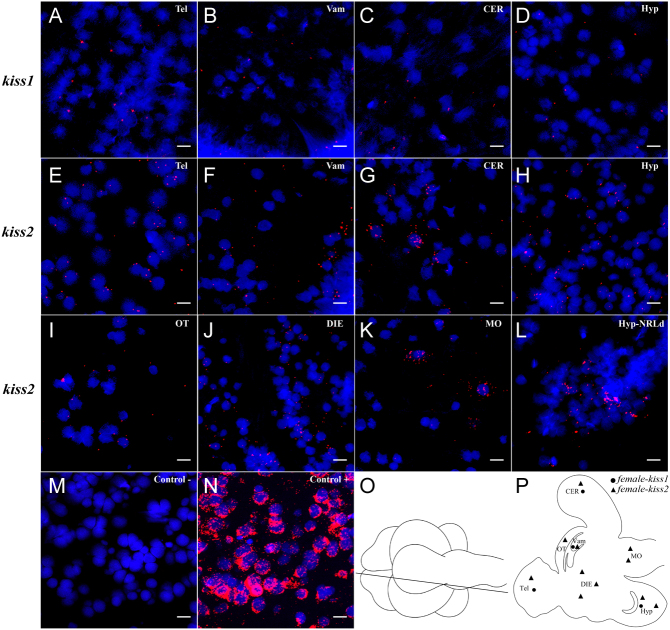
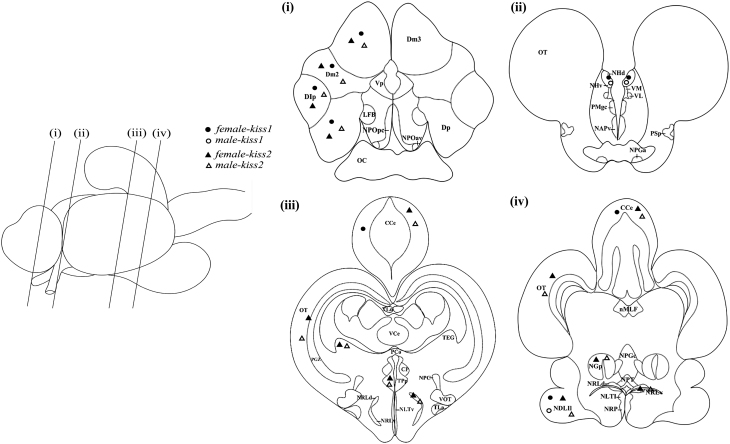
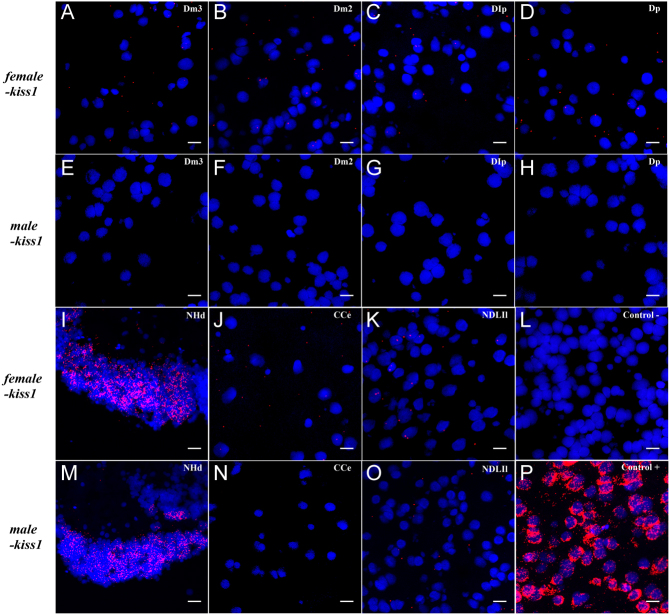
Kisspeptin system was shown to be a key factor in mediating social stress and reproduction. Yellowtail clownfish, Amphiprion clarkii, is a hermaphrodite fish, whose sex determination and gonadal development are affected by the social status of individuals. The yellowtail clownfish is a fantastic animal model to explore sex determination, but the social status and precise distribution of kiss mRNAs in the brain of this species are unknown. Hererin, a novel in situ hybridization technique, RNAscope, was used to investigate the distribution of kiss1 and kiss2 expressions in the brain of yellowtail clownfish. The coronal planes of brain showed that the kiss1 signal was mainly present in dorsal habenular nucleus (NHd) and kiss2 mRNA was widely expressed in telencephalon, midbrain, and hypothalamus, especially in dorsal part of the nucleus of the lateral recess (NRLd). Additionally, kiss1 and kiss2 signals have sexually dimorphic distribution. The kiss1 mRNA was distributed in NHd, the telencephalon, and lateral part of the diffuse nucleus of the inferior lobe (NDLIl) of females but in NHd and NDLIl of males. kiss2 signals were stronger in females than that in males. The distribution of kiss1 and kiss2 neurons in NHd of habenula and NRLd of hypothalamus may suggest that kiss genes associate environmental signaling and reproductive function in yellowtail clownfish.
亲吻素系统被证明是介导社会压力和繁殖的关键因素。黄尾小丑鱼(双带小丑鱼)是一种雌雄同体的鱼类,其性别决定和性腺发育受个体社会地位的影响。黄尾小丑鱼是探索性别决定的绝佳动物模型,但该物种大脑中亲吻素mRNA的社会地位和精确分布尚不清楚。在此,一种新的原位杂交技术——RNAscope,被用于研究黄尾小丑鱼大脑中亲吻素1(kiss1)和亲吻素2(kiss2)表达的分布。大脑冠状切面显示,kiss1信号主要存在于背侧缰核(NHd),而kiss2 mRNA在端脑、中脑和下丘脑广泛表达,尤其是在外侧隐窝核背侧部分(NRLd)。此外,kiss1和kiss2信号具有性二态分布。kiss1 mRNA在雌性的NHd、端脑和下叶弥散核外侧部分(NDLIl)分布,而在雄性的NHd和NDLIl分布。kiss2信号在雌性中比在雄性中更强。缰核的NHd和下丘脑的NRLd中kiss1和kiss2神经元的分布可能表明亲吻素基因在黄尾小丑鱼中将环境信号与生殖功能联系起来。