Wang Bin, Mechaly Alejandro S, Somoza Gustavo M
Key Laboratory of Sustainable Development of Marine Fisheries, Ministry of Agriculture and Rural Affairs, Yellow Sea Fisheries Research Institute, Chinese Academy of Fishery Sciences, Qingdao, China.
Laboratory for Marine Fisheries and Food Production Processes, Pilot National Laboratory for Marine Science and Technology (Qingdao), Qingdao, China.
Front Endocrinol (Lausanne). 2022 Mar 22;13:862614. doi: 10.3389/fendo.2022.862614. eCollection 2022.
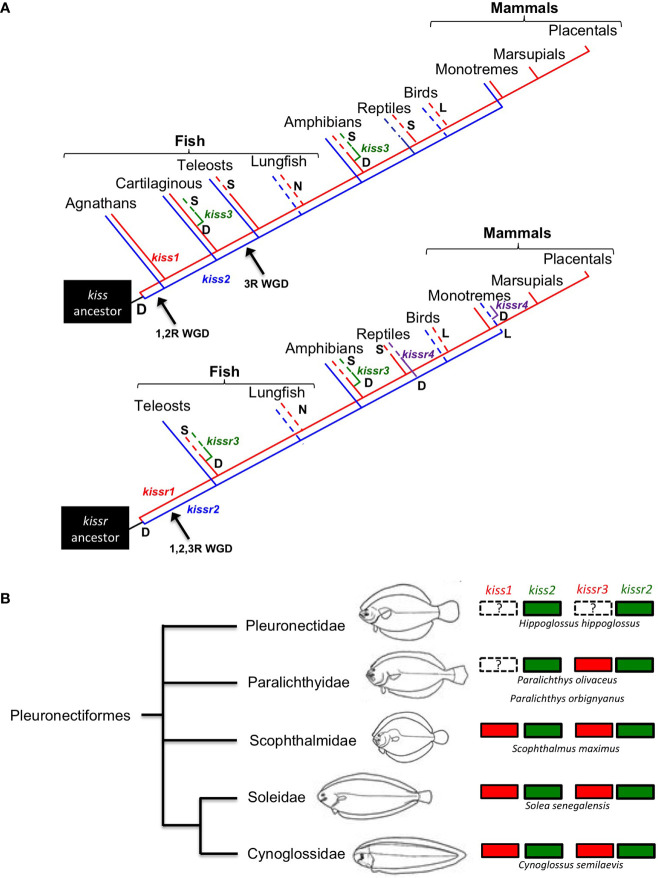
In the last two decades, kisspeptin (Kiss) has been identified as an important player in the regulation of reproduction and other physiological functions in vertebrates, including several fish species. To date, two ligands (Kiss1, Kiss2) and three kisspeptin receptors (Kissr1, Kissr2, Kissr3) have been identified in teleosts, likely due to whole-genome duplication and loss of genes that occurred early in teleost evolution. Recent results in zebrafish and medaka mutants have challenged the notion that the kisspeptin system is essential for reproduction in fish, in marked contrast to the situation in mammals. In this context, this review focuses on the role of kisspeptins at three levels of the reproductive, brain-pituitary-gonadal (BPG) axis in fish. In addition, this review compiled information on factors controlling the Kiss/Kissr system, such as photoperiod, temperature, nutritional status, sex steroids, neuropeptides, and others. In this article, we summarize the available information on the molecular diversity and evolution, tissue expression and neuroanatomical distribution, functional significance, signaling pathways, and gene regulation of Kiss and Kissr in teleost fishes. Of particular note are recent advances in understanding flatfish kisspeptin systems, which require further study to reveal their structural and functional diversity.
在过去二十年中,亲吻素(Kiss)已被确定为脊椎动物(包括几种鱼类)生殖和其他生理功能调节中的重要参与者。迄今为止,硬骨鱼中已鉴定出两种配体(Kiss1、Kiss2)和三种亲吻素受体(Kissr1、Kissr2、Kissr3),这可能是由于硬骨鱼早期进化过程中发生的全基因组复制和基因丢失所致。斑马鱼和青鳉突变体的最新研究结果对亲吻素系统对鱼类繁殖至关重要这一观点提出了挑战,这与哺乳动物的情况形成鲜明对比。在此背景下,本综述重点关注亲吻素在鱼类生殖、脑-垂体-性腺(BPG)轴三个层面上的作用。此外,本综述汇编了有关控制亲吻素/亲吻素受体(Kiss/Kissr)系统的因素的信息,如光周期、温度、营养状况、性类固醇、神经肽等。在本文中,我们总结了硬骨鱼中亲吻素和亲吻素受体在分子多样性与进化、组织表达与神经解剖分布、功能意义、信号通路以及基因调控等方面的现有信息。特别值得注意的是在了解比目鱼亲吻素系统方面的最新进展,这需要进一步研究以揭示其结构和功能多样性。