School of Science and Technology, University of Camerino, ChIP Building, Via Madonna delle Carceri, 62032, Camerino, Italy.
Elantas Europe S.R.L., Altana Group DE, Zona Ind.le Campolungo 35, 63100, Ascoli Piceno, Italy.
Sci Rep. 2022 Jul 29;12(1):12993. doi: 10.1038/s41598-022-17316-7.
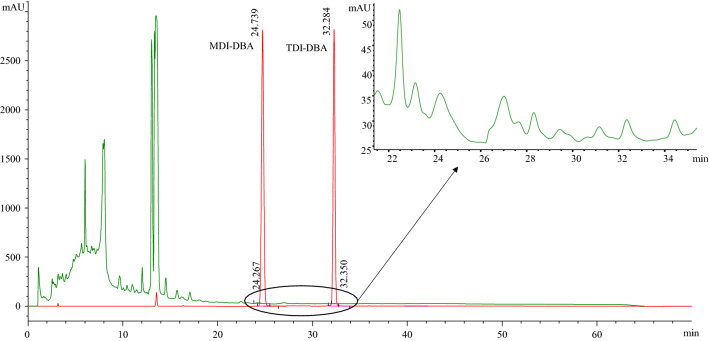
In the scientific context, the environmental and healthy impact of polymers is more related to the residual monomer content rather than their macromolecular structure, due to the monomer capability to interact with membrane cells. For this a novel method to stabilize and quantify residual monomeric isocyanates in high thermal resistance polyamide resins (PAs) has been developed. This new analytical method resulted in an improvement concerning the quantification of residual aromatic diisocyanates in viscous polymeric matrices by using a simple and cheap technique like HPLC-VWD. Diisocyanate monomers were derivatized with dibutylamine, resulting in stable urea derivatives that were simultaneously analysed and quantified. The method was applied to solvent-based polyamide resins, used as primary electrical insulation, for avoiding additional step of solvent removing before the analysis. The quantification of residual monomers answers to the provisions imposed by European Regulation N. 1907/2006 (REACH) for polymer registration, and the necessity of an early evaluation of the occupational risk associated with the use of diisocyanates, due to their toxicity and high reactivity towards moisture.
在科学领域,聚合物的环境和健康影响与其高分子结构更相关,因为单体能够与膜细胞相互作用。因此,开发了一种新的方法来稳定和定量高耐热性聚酰胺树脂(PA)中的残留单体异氰酸酯。这种新的分析方法通过使用简单廉价的 HPLC-VWD 技术,对粘性聚合物基质中的残留芳香族二异氰酸酯进行了定量改进。异氰酸酯单体与二丁胺衍生化,得到稳定的脲衍生物,同时进行分析和定量。该方法应用于溶剂型聚酰胺树脂,用作主要电绝缘材料,避免了在分析前去除溶剂的额外步骤。残留单体的定量符合欧洲法规 N. 1907/2006(REACH)对聚合物注册的规定,以及早期评估与使用二异氰酸酯相关的职业风险的必要性,因为它们具有毒性和对水分的高反应性。