Department of Environmental Health and Behavioral Sciences, School of Public Health, Mekelle University, Mekelle, Ethiopia.
Department of Preventive Medicine, School of Public Health, Addis Ababa University, Addis Ababa, Ethiopia.
BMC Womens Health. 2022 Jul 29;22(1):317. doi: 10.1186/s12905-022-01904-w.
Breast cancer is the most frequently diagnosed reproductive organ cancer among women in Ethiopia. Even though breast self-examination (BSE) is shown to be the least expensive, less time-consuming, and non-invasive screening method, the practice of breast self-examination in Ethiopia is poor. Therefore this study aimed to assess breast self-examination practice and predictors among female secondary school teachers using the Health Belief Model.
An institution-based, cross-sectional study was conducted among 589 female secondary school teachers in Addis Ababa, Ethiopia. A self-administered questionnaire containing socio-demographic characteristics, sources of information, knowledge, perception on breast self-examination, and BSE practice was prepared based on the Champion's revised Health Belief Model and used as a data collection instrument. Multi-variable binary logistic regression was employed to identify the predictors of breast self-examination practice with significance set at p < 0.05 by controlling possible confounders.
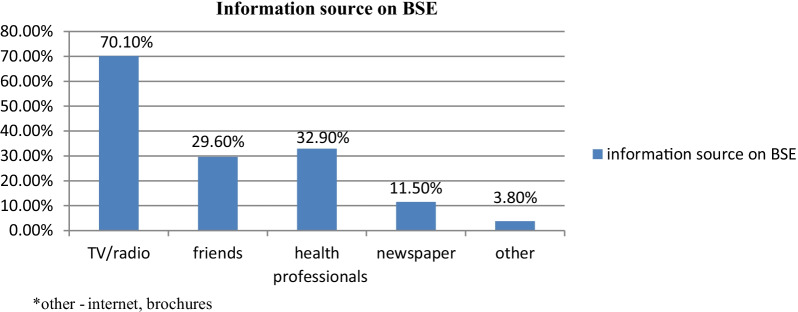
Breast self-examination was practiced by 43.6% of female secondary school teachers. Television and radio were the commonest sources of information about breast cancer and breast self-examination. Personal history of breast problem (AOR 3.27, 95% CI 1.13-9.45), teaching experience (AOR 2.46, 95% CI 1.33-4.56), knowledge (AOR 1.06, 95% CI 1.01-1.12) and perceived self-efficacy (AOR 1.07, 95% CI 1.01-1.12) were significantly associated with BSE practice.
The practice of breast self-examination was found to be low. Perceived self-efficacy, personal history of breast problems, and the knowledge level of female teachers were factors associated with the practice of BSE. This suggests the need for educational programs to enhance knowledge regarding breast cancer and improve the practice of breast self-examination.
乳腺癌是埃塞俄比亚女性中最常见的生殖器官癌症。尽管乳房自我检查(BSE)被证明是最便宜、耗时最短且非侵入性的筛查方法,但埃塞俄比亚的乳房自我检查实践情况不佳。因此,本研究旨在使用健康信念模型评估女性中学教师的乳房自我检查实践情况及其预测因素。
在埃塞俄比亚亚的斯亚贝巴的 589 名女性中学教师中进行了一项基于机构的横断面研究。根据 Champion 修订的健康信念模型,编制了一份包含社会人口统计学特征、信息来源、知识、对乳房自我检查的认知以及 BSE 实践情况的自我管理问卷,并将其用作数据收集工具。采用多变量二项逻辑回归来确定乳房自我检查实践的预测因素,并通过控制可能的混杂因素,将显著性设置为 p<0.05。
43.6%的女性中学教师进行了乳房自我检查。电视和广播是关于乳腺癌和乳房自我检查的最常见信息来源。个人乳房问题史(AOR 3.27,95%CI 1.13-9.45)、教学经验(AOR 2.46,95%CI 1.33-4.56)、知识(AOR 1.06,95%CI 1.01-1.12)和感知自我效能(AOR 1.07,95%CI 1.01-1.12)与 BSE 实践显著相关。
乳房自我检查的实践情况发现很低。女性教师的感知自我效能、个人乳房问题史和知识水平是与 BSE 实践相关的因素。这表明需要开展教育计划,以提高有关乳腺癌的知识水平,并改善乳房自我检查的实践。