Hohberg Vivien, Fuchs Reinhard, Gerber Markus, Künzler David, Paganini Sarah, Faude Oliver
Department of Sports, Exercise and Health, University of Basel, Basel, Switzerland.
Department of Sport Psychology, Institute of Sports and Sport Science, University of Freiburg, Freiburg, Germany.
Sports Med Open. 2022 Jul 30;8(1):100. doi: 10.1186/s40798-022-00489-w.
Blended care interventions combine therapeutic guidance with digital care. Current research results show the promising role of the blended care approach in clinical care. This new way of delivering health care could have the potential to effectively promote physical activity in different public health settings.
The aim of the systematic review is to investigate the varieties of intervention characteristics of blended care interventions to promote physical activity in terms of structure, behavior change goals, behavior change techniques, and effectiveness of blended care interventions compared to a control group.
We searched for randomized controlled trials published from 2000 to March 2021 in MEDLINE, CINAHL, Cochrane Central Register of Controlled Trials, SPORTDiscus, PsycINFO, and Web of Science according to the PRISMA guidelines. Risk of bias was assessed using the Cochrane Collaboration tool. Study characteristics, intervention characteristics, and outcome data were extracted. Furthermore, the effect size on the outcome of physical activity was examined or calculated.
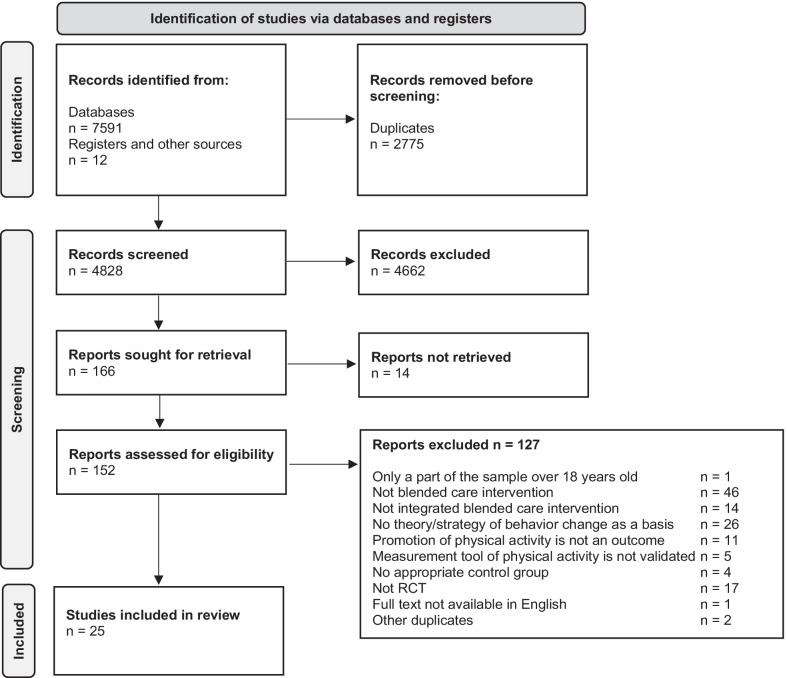
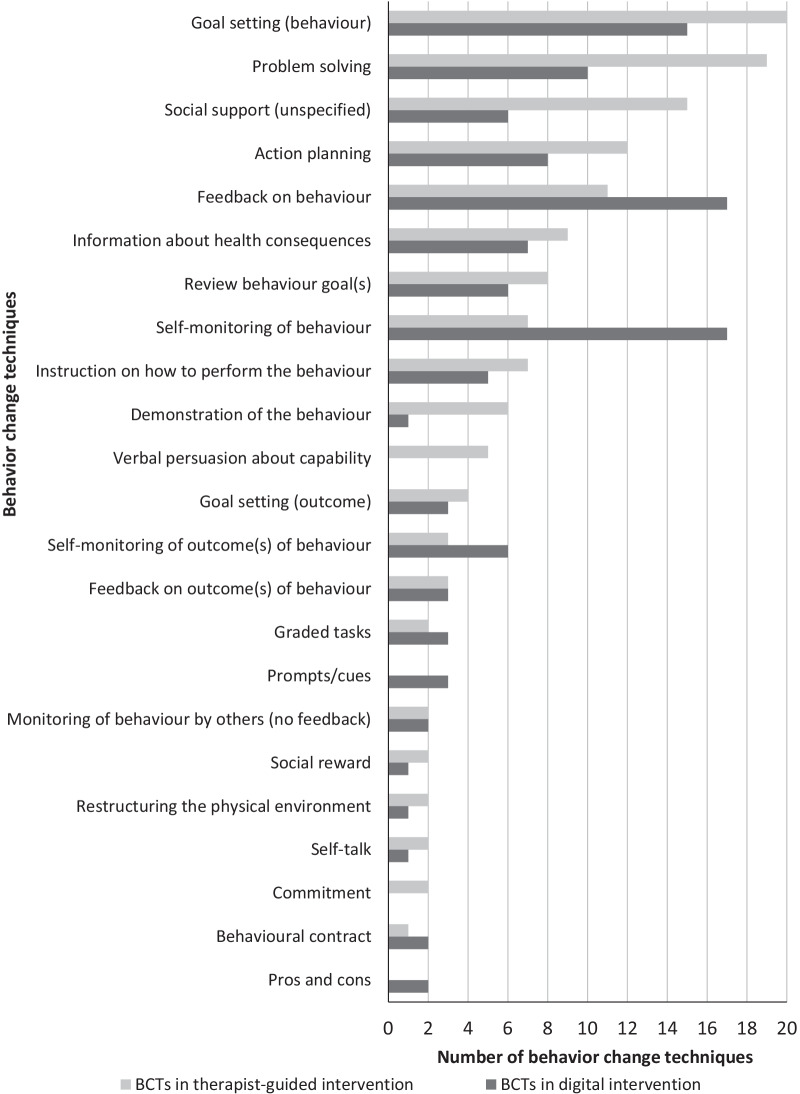
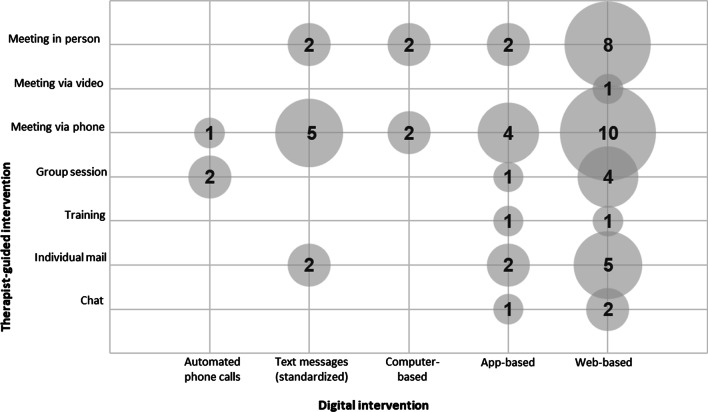
In total, the number of reports identified from the database searches was 4828. Of these, 25 studies were included in the review, with a total of 5923 study participants. Results indicated that the characteristics of blended care interventions showed a high heterogeneity. The combinations of therapist-guided interventions and digital interventions allowed the identification of specific subgroups, but they varied in length (range 8-52 weeks, SD 16.6), intensity, and the combination of the components. The most used combination of blended care interventions to promote physical activity was the combination of one-on-one meetings via telephone and Web-based interventions. Motivational models of behavior change were used most frequently as underlying theoretical foundations. Certain behavior change techniques were used consistently across the individual components, e.g., "problem solving" in the therapist-guided component and "feedback on behavior" in the digital component. Considering the effect size of blended care interventions compared with control groups, most studies showed a small effect.
It can be concluded that blended care interventions have potential to promote physical activity. In the future, further high-quality studies should investigate which type of blended care intervention is effective for which target group. Additionally, insights are required on which intervention characteristics are most effective, taking into account new evidence on behavior change. Registration This systematic literature review was registered in PROSPERO ( CRD42020188556 ).
混合式护理干预将治疗指导与数字护理相结合。目前的研究结果显示了混合式护理方法在临床护理中的潜在作用。这种提供医疗保健的新方式有可能在不同的公共卫生环境中有效促进身体活动。
本系统评价的目的是研究混合式护理干预在促进身体活动方面的干预特征种类,包括结构、行为改变目标、行为改变技术,以及与对照组相比混合式护理干预的效果。
我们根据PRISMA指南,在MEDLINE、CINAHL、Cochrane对照试验中央注册库、SPORTDiscus、PsycINFO和科学网中检索了2000年至2021年3月发表的随机对照试验。使用Cochrane协作工具评估偏倚风险。提取研究特征、干预特征和结局数据。此外,还检查或计算了身体活动结局的效应量。
从数据库检索中识别出的报告总数为4828份。其中,25项研究纳入本评价,共有5923名研究参与者。结果表明,混合式护理干预的特征显示出高度异质性。治疗师指导干预和数字干预的组合可以识别出特定亚组,但它们在时长(范围8 - 52周,标准差16.6)、强度和各组成部分的组合方面存在差异。促进身体活动最常用的混合式护理干预组合是通过电话进行一对一会议和基于网络的干预的组合。行为改变的动机模型最常被用作基础理论依据。某些行为改变技术在各个组成部分中一致使用,例如治疗师指导部分中的“解决问题”和数字部分中的“行为反馈”。考虑到混合式护理干预与对照组相比的效应量,大多数研究显示效果较小。
可以得出结论,混合式护理干预有促进身体活动的潜力。未来,应开展进一步的高质量研究,以调查哪种类型的混合式护理干预对哪个目标群体有效。此外,考虑到行为改变的新证据,还需要了解哪些干预特征最有效。注册情况:本系统文献综述已在PROSPERO(CRD42020188556)注册。