Department of Orthopaedic Surgery, McGovern Medical School, The University of Texas Health Science Center at Houston, Houston, TX, USA.
School of Pharmacy, University of Pittsburgh, Pittsburgh, PA, USA.
Stem Cell Res Ther. 2022 Jul 30;13(1):385. doi: 10.1186/s13287-022-03047-z.
Bone morphogenetic protein 4 (BMP4) promotes the osteogenic differentiation and the bone regenerative potential of muscle-derived stem cells (MDSCs). BMP4 also promotes the self-renewal of both embryonic and somatic stem cells; however, BMP4 signaling activity significantly decreases with age. Cyclin-dependent kinase inhibitors P16 (P16) and P18 (P18) induce early G1-phase cell cycle blockade by targeting cyclin-dependent kinase 4/6. It is still unclear if BMP4 affects the bone regenerative potential of old MDSCs through regulation of P16 and P18 expression.
Young and old MDSCs were isolated from 3 week (young) and 2-year-old (old) mice. In vitro cell proliferation and multipotent differentiation were performed for young and old MDSCs both before and after BMP4/GFP transduction. Cell cycle genes were analyzed using Q-PCR. The bone regenerative potential of young and old MDSCs transduced with BMP4/GFP were compared using Micro-CT and histological analysis. The bone regenerative potential of young and old MDSCs was also compared between single and double transduction (higher BMP4 levels expression). The cell proliferation, mitochondrial function and osteogenic differentiation was also compared in vitro between cells that have been transduced with BMP4GFP (single and double transduction). The correlation of bone regeneration capacity of young and old MDSCs with P16 and P18 expression was further evaluated at 10 days after cell transplantation using histology and western blot analysis.
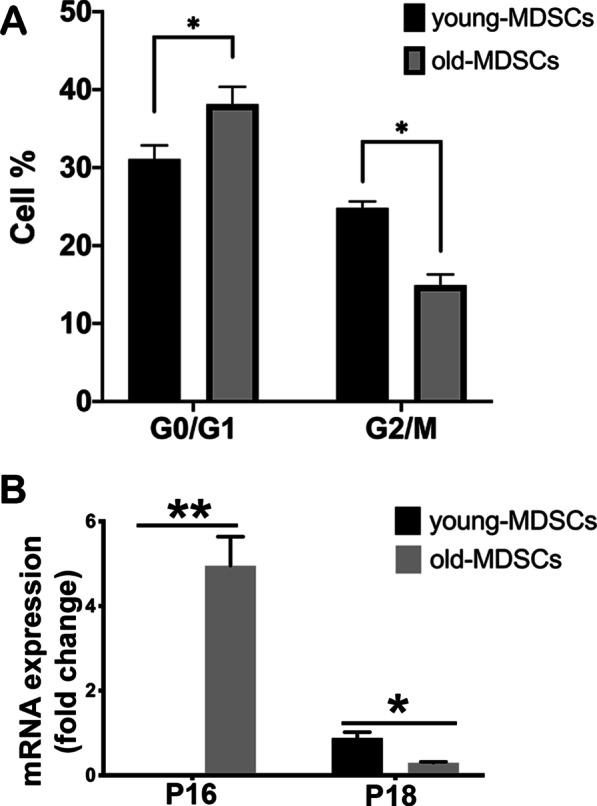
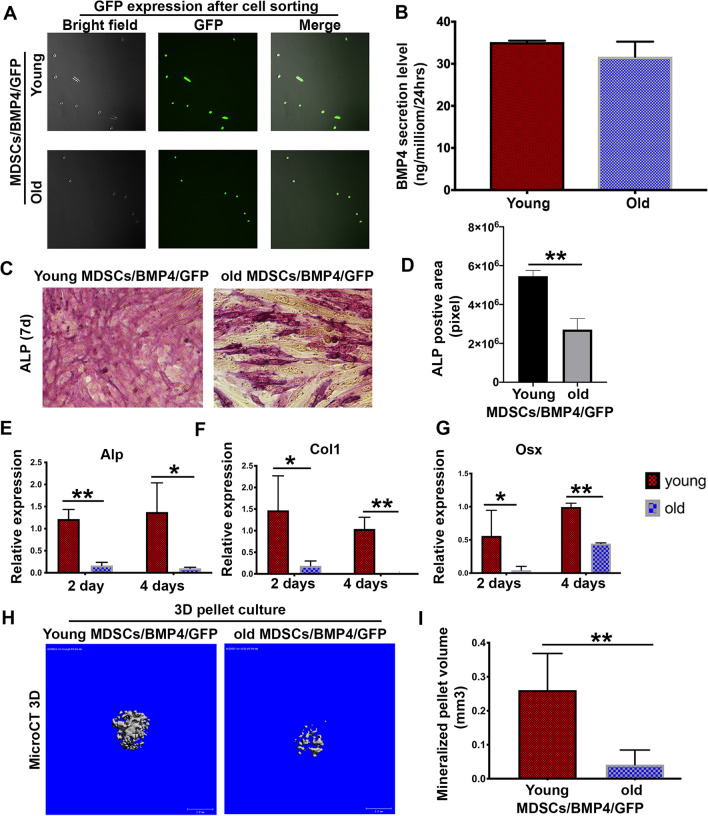
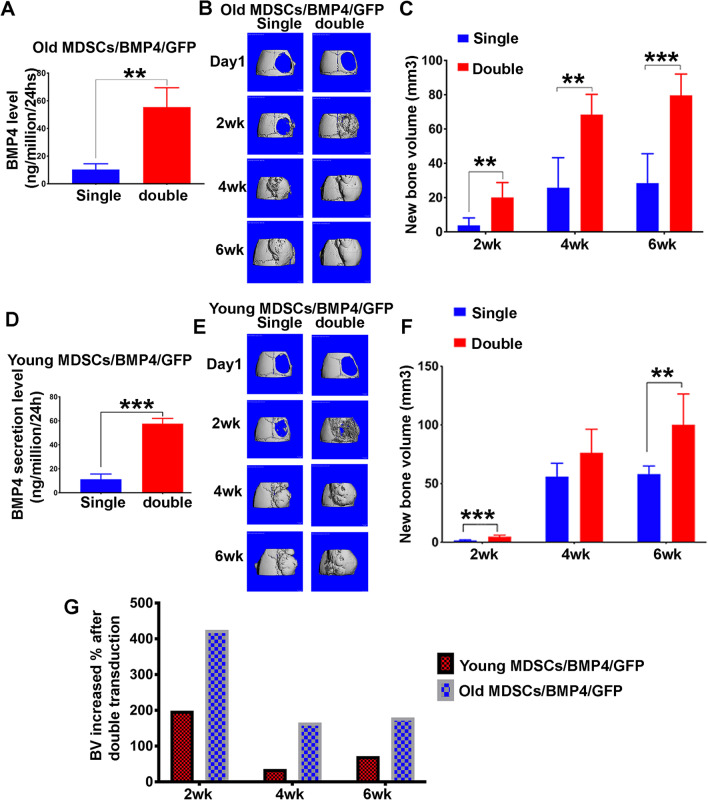
Old murine MDSCs (MDSCs) exhibit reduced proliferation and multi-lineage differentiation potential with or without BMP4 stimulation, when compared to young murine MDSCs. Old MDSCs express significantly higher P16 and lower P18, with more cells in the G0/1 phase and fewer cells in the G2/M phase, compared to young MDSCs. Old MDSCs retrovirally transduced to express BMP4 regenerated less bone in a critical size skull defect in CD-1 nude mice when compared to young retrovirally transduced MDSCs expressing similar BMP4 levels and contribute less to the new regenerated new bone. Importantly, both young and old MDSCs can regenerate more bone when BMP4 expression levels are increased by double-transduction with the retroviral-BMP4/GFP. However, the bone regeneration enhancement with elevated BMP4 was more profound in old MDSCs (400% at 2 weeks) compared to young MDSCs (200%). Accordingly, P18 is upregulated while P16 is downregulated after BMP4 transduction. Double transduction did not further increase cell proliferation nor mitochondrial function but did significantly increase Osx expression in both young and old MDSCs. Old MDSCs had even significant higher Osx levels as compared to young MDSCs following double transduction, while a similar Alp expression was observed between young and old MDSCs after double transduction. In addition, at 10 days after cell transplantation, old MDSCs having undergone double transduction regenerated bone more rapidly as showed by Alcian blue and Von Kossa staining. Western blot assays demonstrated that old MDSCs after retro-BMP4/GFP double transduction have significantly lower P18 expression levels when compared to young BMP4-transduced MDSCs. In addition, P18 expression was slightly increased in old MDSCs after double transduction when compared to single transduction. P16 expression was not detectable for both young and two old BMP4/GFP transduced MDSCs groups.
In summary, BMP4 can offset the adverse effect of aging on the osteogenic differentiation and the bone regenerative potential of old MDSCs via up-regulation of P18 and down-regulation P16 expression.
骨形态发生蛋白 4(BMP4)可促进肌肉源性干细胞(MDSCs)的成骨分化和骨再生潜能。BMP4 还可促进胚胎和体干细胞的自我更新;然而,BMP4 信号活性随年龄显著降低。细胞周期蛋白依赖性激酶抑制剂 P16(P16)和 P18(P18)通过靶向细胞周期蛋白依赖性激酶 4/6 诱导早期 G1 期细胞周期阻滞。目前尚不清楚 BMP4 是否通过调节 P16 和 P18 表达来影响老年 MDSC 的骨再生潜能。
从小鼠 3 周龄(年轻)和 2 岁(老年)中分离年轻和老年 MDSC。在 BMP4/GFP 转导前后,对年轻和老年 MDSC 进行体外细胞增殖和多能分化。使用 Q-PCR 分析细胞周期基因。使用 Micro-CT 和组织学分析比较转导 BMP4/GFP 的年轻和老年 MDSC 的骨再生潜能。还比较了年轻和老年 MDSC 在单次和双转导(更高的 BMP4 水平表达)之间的骨再生潜能。还比较了体外转导 BMP4GFP(单次和双转导)的细胞的细胞增殖、线粒体功能和成骨分化。在细胞移植后 10 天,使用组织学和 Western blot 分析进一步评估年轻和老年 MDSC 的骨再生能力与 P16 和 P18 表达的相关性。
与年轻的小鼠 MDSC 相比,老年的小鼠 MDSC(MDSC)在没有 BMP4 刺激的情况下表现出增殖和多谱系分化潜力降低。与年轻的 MDSC 相比,老年 MDSC 表达明显更高的 P16 和更低的 P18,G0/1 期的细胞更多,G2/M 期的细胞更少。与年轻的病毒转导 MDSC 相比,在 CD-1 裸鼠的临界大小颅骨缺损中,表达相似 BMP4 水平的转导的老年 MDSC 再生的骨量较少,对新再生的新骨的贡献较小。重要的是,当通过逆转录病毒 BMP4/GFP 的双转导增加 BMP4 表达水平时,年轻和老年 MDSC 都可以再生更多的骨。然而,与年轻 MDSC(2 周时为 200%)相比,老年 MDSC 的骨再生增强更为明显(2 周时为 400%)。相应地,BMP4 转导后 P18 上调,而 P16 下调。双转导不会进一步增加细胞增殖或线粒体功能,但会显著增加年轻和老年 MDSC 中的 Osx 表达。与年轻 MDSC 相比,老年 MDSC 甚至在双转导后具有更高的 Osx 水平,而在双转导后,年轻和老年 MDSC 之间观察到相似的 Alp 表达。此外,在细胞移植后 10 天,经细胞双转导的老年 MDSC 通过阿尔辛蓝和 Von Kossa 染色更快地再生骨。Western blot 检测表明,与年轻的 BMP4 转导的 MDSC 相比,经 Retro-BMP4/GFP 双转导的老年 MDSC 具有显著更低的 P18 表达水平。此外,与单次转导相比,老年 MDSC 双转导后 P18 表达略有增加。年轻和两个老年 BMP4/GFP 转导的 MDSC 组均未检测到 P16 表达。
总之,BMP4 通过上调 P18 和下调 P16 表达,可抵消衰老对老年 MDSC 的成骨分化和骨再生潜能的不利影响。