Department of Medicine and Surgery, University of Milano-Bicocca, Monza, Italy.
Dipartimento di Scienze Farmaceutiche, University of Milan, Milan, Italy.
J Cell Physiol. 2022 Oct;237(10):3834-3844. doi: 10.1002/jcp.30833. Epub 2022 Jul 31.
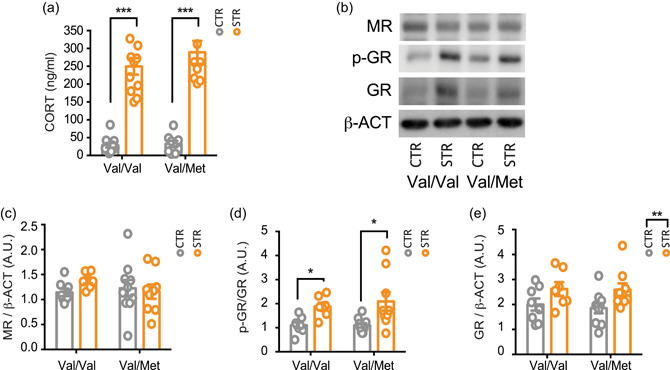
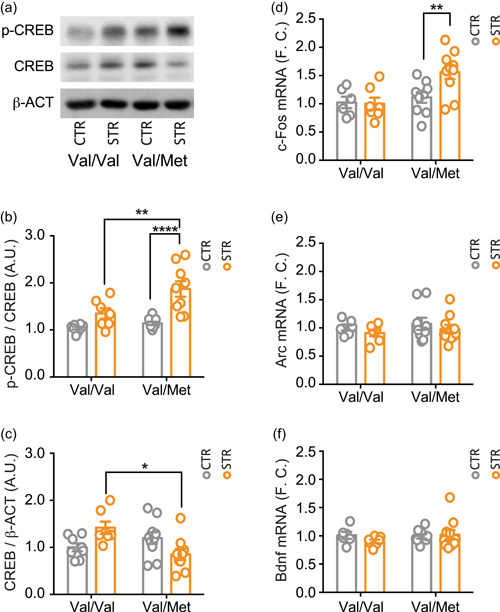
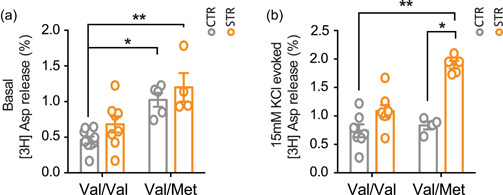
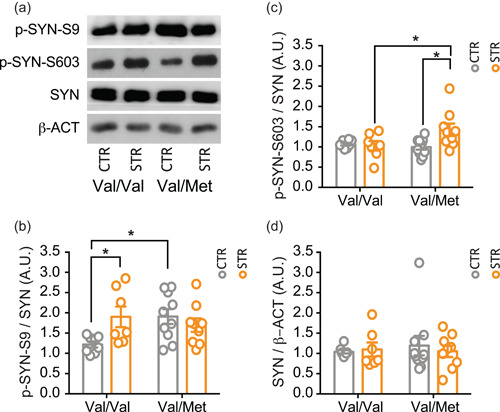
Stressful life events are considered major risk factors for the development of several psychiatric disorders, though people differentially cope with stress. The reasons for this are still largely unknown but could be accounted for by individual genetic variants, previous life events, or the kind of stressors. The human brain-derived neurotrophic factor (BDNF) Val66Met variant, which was found to impair intracellular trafficking and activity-dependent secretion of BDNF, has been associated with increased susceptibility to develop several neuropsychiatric disorders, although there is still some controversial evidence. On the other hand, acute stress has been consistently demonstrated to promote the release of glutamate in cortico-limbic regions and altered glutamatergic transmission has been reported in psychiatric disorders. However, it is not known if the BDNF Val66Met single-nucleotide polymorphism (SNP) affects the stress-induced presynaptic glutamate release. In this study, we exposed adult male BDNF and BDNF knock-in mice to 30 min of acute restraint stress. Plasma corticosterone levels, glutamate release, protein, and gene expression in the hippocampus were analyzed immediately after the end of the stress session. Acute restraint stress similarly increased plasma corticosterone levels and nuclear glucocorticoid receptor levels and phosphorylation in both BDNF and BDNF mice. However, acute restraint stress induced higher increases in hippocampal presynaptic release of glutamate, phosphorylation of cAMP-response element binding protein (CREB), and levels of the immediate early gene c-fos of BDNF compared to BFNF mice. Moreover, acute restraint stress selectively increased phosphorylation levels of synapsin I at Ser and at Ser in BDNF and BDNF mice, respectively. In conclusion, we report here that the BDNF Val66Met SNP knock-in mice display an altered response to acute restraint stress in terms of hippocampal glutamate release, CREB phosphorylation, and neuronal activation, compared to wild-type animals. Taken together, these results could partially explain the enhanced vulnerability to stressful events of Met carriers reported in both preclinical and clinical studies.
应激性生活事件被认为是几种精神疾病发展的主要风险因素,尽管人们对压力的应对方式不同。造成这种情况的原因在很大程度上尚不清楚,但可能与个体遗传变异、先前的生活事件或压力类型有关。人类脑源性神经营养因子 (BDNF) Val66Met 变体被发现会损害 BDNF 的细胞内运输和活性依赖性分泌,与增加易患几种神经精神疾病的易感性有关,尽管仍有一些有争议的证据。另一方面,急性应激一直被证明能促进皮质-边缘区域谷氨酸的释放,并且在精神疾病中报道了谷氨酸能传递的改变。然而,尚不清楚 BDNF Val66Met 单核苷酸多态性 (SNP) 是否影响应激诱导的突触前谷氨酸释放。在这项研究中,我们使成年雄性 BDNF 和 BDNF 基因敲入小鼠暴露于 30 分钟的急性束缚应激中。应激结束后立即分析海马中的血浆皮质酮水平、谷氨酸释放、蛋白质和基因表达。急性束缚应激同样增加了 BDNF 和 BDNF 小鼠的血浆皮质酮水平和核糖皮质激素受体水平以及磷酸化。然而,与 BDNF 小鼠相比,急性束缚应激诱导 BDNF 小鼠海马前突触谷氨酸释放、cAMP 反应元件结合蛋白 (CREB) 磷酸化和即刻早期基因 c-fos 的水平增加更高。此外,急性束缚应激分别选择性地增加了 BDNF 和 BDNF 小鼠突触蛋白 I 在 Ser 和 Ser 的磷酸化水平。总之,我们在这里报告,与野生型动物相比,BDNF Val66Met SNP 基因敲入小鼠在海马谷氨酸释放、CREB 磷酸化和神经元激活方面对急性束缚应激的反应发生改变。这些结果共同表明,与临床前和临床研究报告的 Met 携带者对压力事件的易感性增强部分相关。