Department of Management, Information and Production Engineering, University of Bergamo, via Salvecchio 19 - Bergamo, Italy.
Comput Methods Programs Biomed. 2022 Sep;224:107029. doi: 10.1016/j.cmpb.2022.107029. Epub 2022 Jul 16.
In Italy, the administration of COVID-19 vaccines began in late 2020. In the early stages, the number of available doses was limited. To maximize the effectiveness of the vaccine campaign, the national health agency assigned priority access to at-risk individuals, such as health care workers and the elderly. Current vaccination campaign strategies do not take full advantage of the latest mathematical models, which capture many subtle nuances, allowing different territorial situations to be analyzed aiming to make context-specific decisions.
The main objective is the definition of an agent-based model using open data and scientific literature to assess and optimize the impact of vaccine campaigns for an Italian region. Specifically, the aim is twofold: (i) estimate the reduction in the number of infections and deaths attributable to vaccines, and (ii) assess the performances of alternative vaccine allocation strategies.
The COVID-19 Agent-based simulator Covasim has been employed to build an agent-based model by considering the Lombardy region as case study. The model has been tailored by leveraging open data and knowledge from the scientific literature. Dynamic mobility restrictions and the presence of Variant of Concern have been explicitly represented. Free parameters have been calibrated using the grid search methodology.
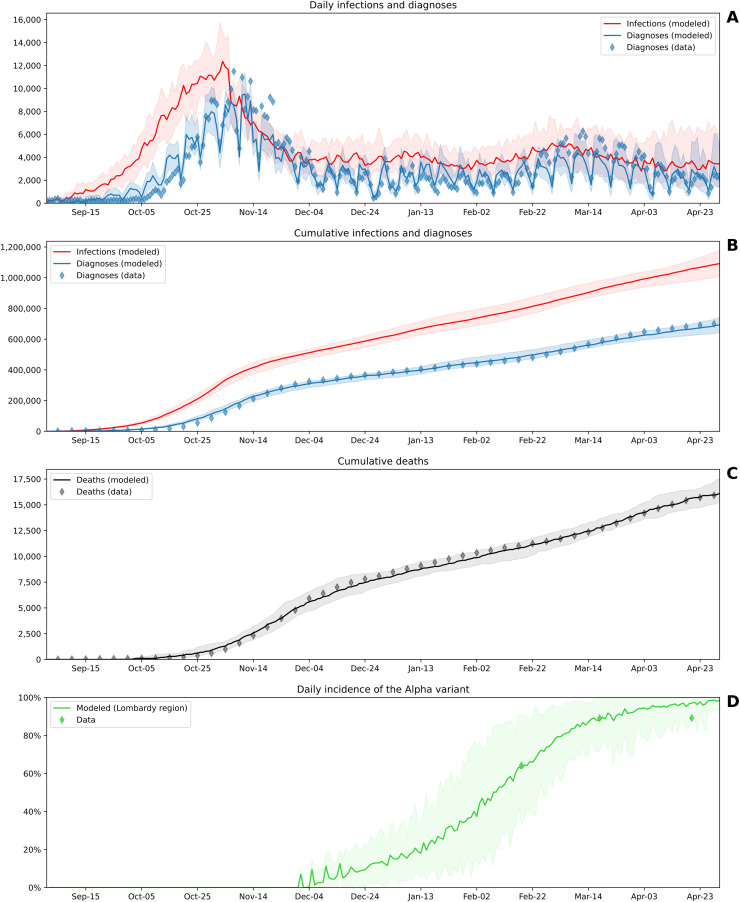
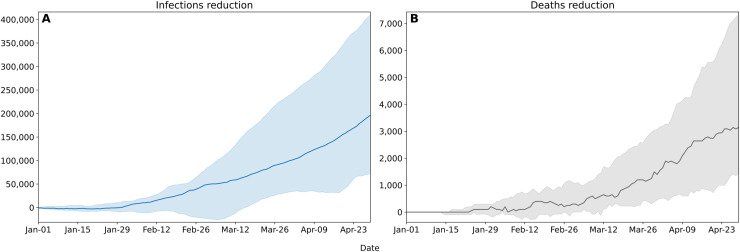
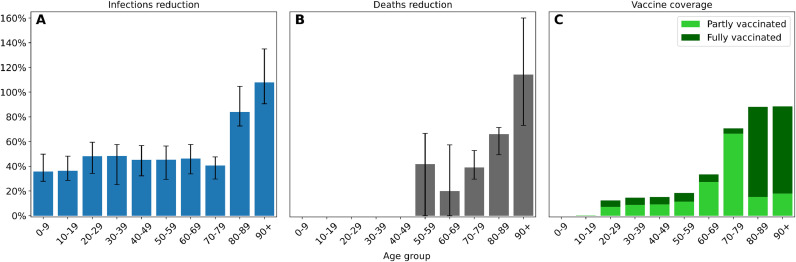
The model mimics the COVID-19 wave that hit Lombardy from September 2020 to April 2021. It suggests that 168,492 cumulative infections 2,990 cumulative deaths have been avoided due to the vaccination campaign in Lombardy from January 1 to April 30, 2021. Without vaccines, the number of deaths would have been 66% greater in the 80-89 age group and 114% greater for those over 90. The best vaccine allocation strategy depends on the goal. To minimize infections, the best policy is related to dose availability. If at least 1/3 of the population can be covered in 4 months, targeting at-risk individuals and the elderly first is recommended; otherwise, the youngest people should be vaccinated first. To minimize overall deaths, priority is best given to at-risk groups and the elderly in all scenarios.
This work proposes a methodological approach that leverages open data and scientific literature to build a model of COVID-19 capable of assessing and optimizing the impact of vaccine campaigns. This methodology can help national institutions to design regional mathematical models that can support pandemic-related decision-making processes.
意大利于 2020 年末开始接种 COVID-19 疫苗。在早期,可用疫苗数量有限。为了使疫苗接种运动发挥最大效果,国家卫生机构将优先接种权分配给高危人群,如医护人员和老年人。当前的疫苗接种运动策略并未充分利用最新的数学模型,这些模型捕捉到许多细微差别,可分析不同的地区情况,以便做出具体情况具体决策。
本研究旨在使用开放数据和科学文献定义一个基于代理的模型,以评估和优化意大利一个地区的疫苗接种运动效果。具体而言,主要目标有两个:(i)估计疫苗接种带来的感染和死亡人数的减少量;(ii)评估替代疫苗分配策略的效果。
采用 COVID-19 基于代理的模拟器 Covasim 构建基于代理的模型,以伦巴第大区为案例研究。该模型利用开放数据和科学文献知识进行了定制。明确表示了动态移动限制和关注变体的存在。使用网格搜索方法对自由参数进行了校准。
该模型模拟了 2020 年 9 月至 2021 年 4 月期间伦巴第大区的 COVID-19 疫情。结果表明,2021 年 1 月 1 日至 4 月 30 日期间,由于在伦巴第大区的疫苗接种运动,累计避免了 168492 例感染和 2990 例死亡。如果没有疫苗,80-89 岁年龄组的死亡人数将增加 66%,90 岁以上的死亡人数将增加 114%。最佳的疫苗分配策略取决于目标。如果在 4 个月内至少有 1/3 的人口可以接种疫苗,那么首先应针对高危人群和老年人;否则,应首先接种最年轻的人群。如果要将总死亡人数降到最低,在所有情况下,高危人群和老年人都应优先接种疫苗。
本研究提出了一种利用开放数据和科学文献构建 COVID-19 模型的方法,该模型能够评估和优化疫苗接种运动的效果。该方法可帮助国家机构设计可支持大流行相关决策过程的区域数学模型。