Kyoto University School of Public Health, Yoshidakonoe cho, Sakyo ku, Kyoto city 6068501, Japan; Graduate School of Medicine, Hokkaido University, Kita 15 Jo Nishi 7 Chome, Kita-ku, Sapporo-shi, Hokkaido 060-8638, Japan.
Kyoto University School of Public Health, Yoshidakonoe cho, Sakyo ku, Kyoto city 6068501, Japan.
Epidemics. 2022 Sep;40:100618. doi: 10.1016/j.epidem.2022.100618. Epub 2022 Jul 27.
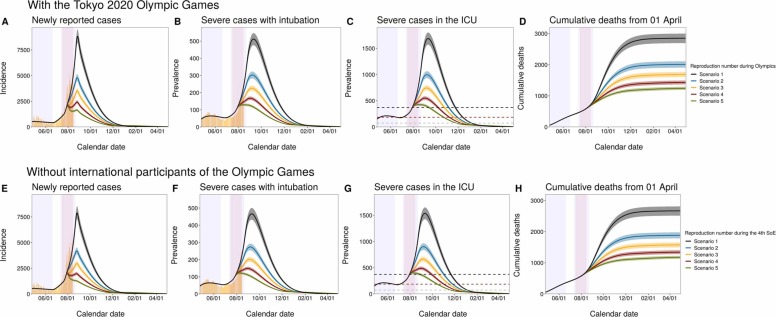
The number of coronavirus disease 2019 (COVID-19) cases was expected to increase during the Tokyo Olympic Games because of the increased physical contact within and between the domestic population and international participants of the Games. The rapid rise of the Delta variant (B.1.617) in Japan meant that hosting the Olympic Games without any restrictions was likely to lead to an increase in cases. We aimed to quantitatively assess possible COVID-19 response strategies for the Olympic Games, comparing the prevalence of severe cases and the cumulative number of COVID-19 deaths via scenario analysis.
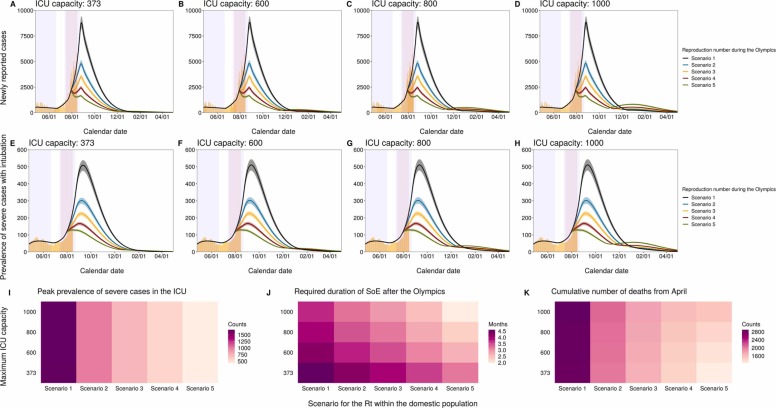
We used a discrete-time deterministic compartmental model structured by age group. Parameters were calibrated using the age-stratified COVID-19 incidence data in Osaka. Numerical simulations incorporated the planned Olympics Games and nationwide COVID-19 vaccination into the proposed model, alongside various subjects and types of countermeasures.
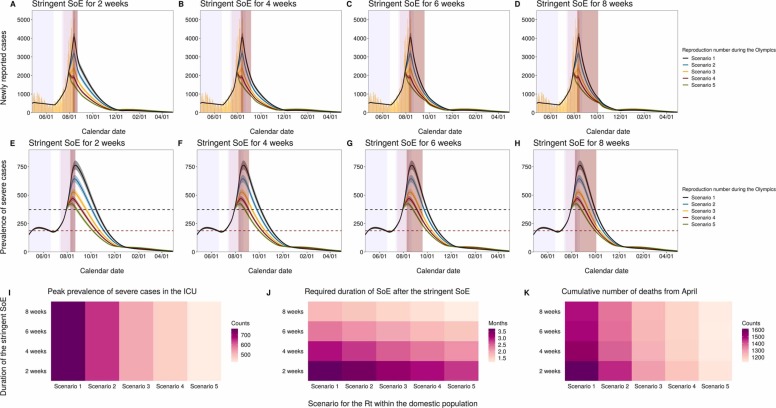
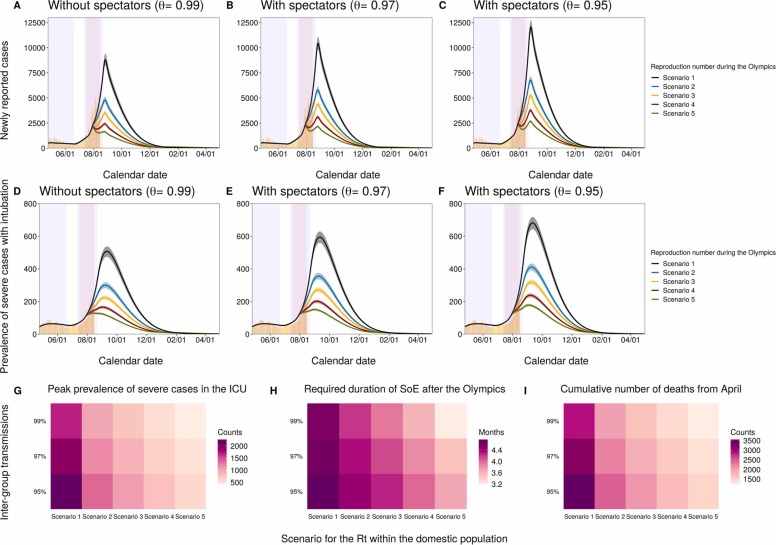
Our model-informed approach suggested that having spectators at the Tokyo Olympic Games could lead to a surge in both cases and hospitalization. Projections for the scenario that explicitly incorporated the spread of the Delta variant (i.e., time-dependent increase in the relative transmissibility) showed that imposing stringent social distancing measures (R=0.7) for more than 8 weeks from the end of the Olympic Games might be required to suppress the prevalence of severe cases of COVID-19 to avoid overwhelming the intensive care unit capacity in Tokyo.
Our modeling analyses guided an optimal choice of COVID-19 response during and after the Tokyo Olympic Games, allowing the epidemic to be brought under control despite such a large mass gathering.
由于奥运会期间国内人口和国际参与者之间的身体接触增加,预计 2019 年冠状病毒病(COVID-19)病例数将会增加。日本 Delta 变异株(B.1.617)的迅速上升意味着在没有任何限制的情况下举办奥运会可能会导致病例增加。我们旨在通过情景分析定量评估奥运会可能的 COVID-19 应对策略,比较严重病例的患病率和 COVID-19 死亡人数的累计数。
我们使用按年龄组结构的离散时间确定性房室模型。使用大阪的年龄分层 COVID-19 发病率数据对参数进行校准。数值模拟将计划中的奥运会和全国范围的 COVID-19 疫苗接种纳入到所提出的模型中,同时还考虑了各种主题和类型的对策。
我们的模型指导方法表明,在东京奥运会上有观众可能会导致病例和住院人数激增。对于明确纳入 Delta 变异株传播情况的情景(即相对传染性的时间依赖性增加)的预测表明,可能需要从奥运会结束后严格实施社交距离措施(R=0.7)超过 8 周,以抑制 COVID-19 严重病例的患病率,避免东京的重症监护病房容量不堪重负。
我们的建模分析为东京奥运会期间和之后的 COVID-19 应对提供了最佳选择,尽管有如此大规模的集会,但仍能控制疫情。