Department of Intelligent Systems Engineering, Indiana University, Bloomington, IN, 47405, USA.
Center for Stem Cell and Organoid Medicine (CuSTOM), Division of Pulmonary Biology, Division of Developmental Biology, Cincinnati Children's Hospital Medical Center, Cincinnati, OH, 45229, USA.
Adv Sci (Weinh). 2022 Sep;9(27):e2200475. doi: 10.1002/advs.202200475. Epub 2022 Jul 31.
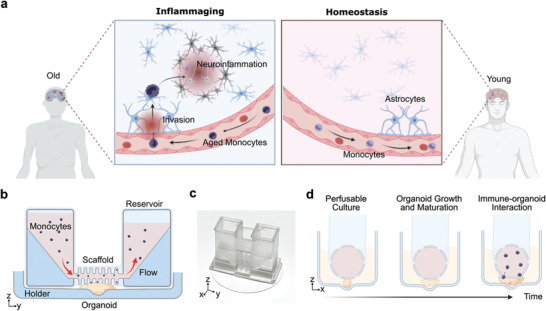
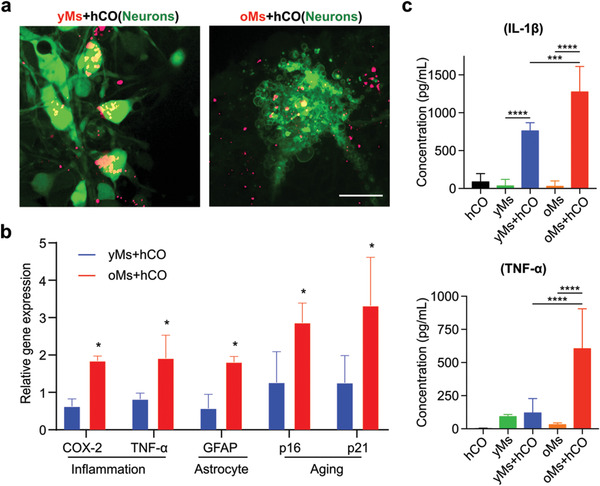
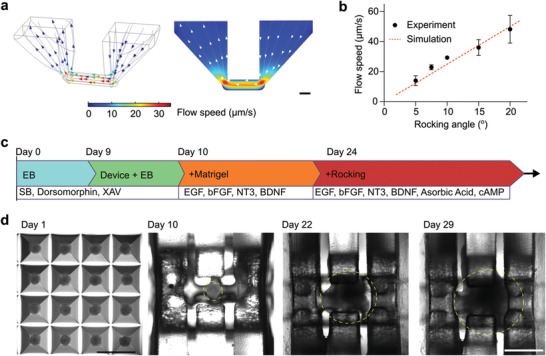
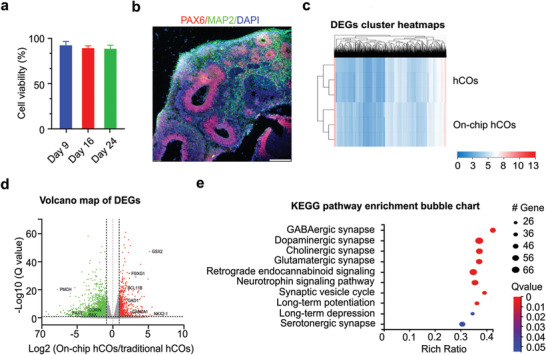
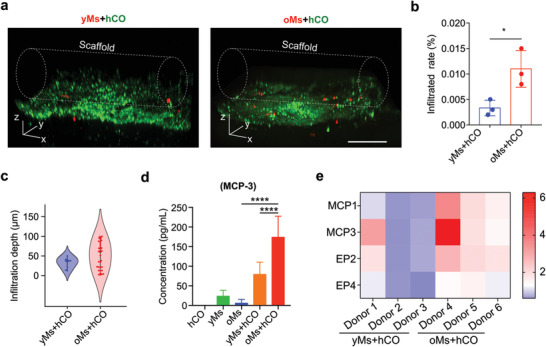
The aging of the immune system drives systemic aging and the pathogenesis of age-related diseases. However, a significant knowledge gap remains in understanding immune-driven aging, especially in brain aging, due to the limited current in vitro models of neuroimmune interaction. Here, the authors report the development of a human brain organoid microphysiological analysis platform (MAP) to discover the dynamic process of immune-driven brain aging. The organoid MAP is created by 3D printing that confines organoid growth and facilitates cell and nutrition perfusion, promoting organoid maturation and their committment to forebrain identity. Dynamic rocking flow is incorporated into the platform that allows to perfuse primary monocytes from young (20 to 30-year-old) and aged (>60-year-old) donors and culture human cortical organoids to model neuroimmune interaction. The authors find that the aged monocytes increase infiltration and promote the expression of aging-related markers (e.g., higher expression of p16) within the human cortical organoids, indicating that aged monocytes may drive brain aging. The authors believe that the organoid MAP may provide promising solutions for basic research and translational applications in aging, neural immunological diseases, autoimmune disorders, and cancer.
免疫系统的衰老导致全身性衰老和与年龄相关疾病的发病机制。然而,由于目前对神经免疫相互作用的体外模型有限,因此在理解免疫驱动的衰老方面仍然存在很大的知识差距,尤其是在大脑衰老方面。在这里,作者报告了一种人类大脑类器官微生理分析平台 (MAP) 的开发,以发现免疫驱动的大脑衰老的动态过程。该类器官 MAP 通过 3D 打印创建,该技术可限制类器官的生长并促进细胞和营养灌注,从而促进类器官成熟及其向前脑身份的转变。该平台还纳入了动态摇动流,以允许从小龄(20 至 30 岁)和老年(>60 岁)供体中灌注原代单核细胞,并培养人类皮质类器官以模拟神经免疫相互作用。作者发现,老年单核细胞增加了渗透,并促进了人类皮质类器官中与衰老相关的标志物(例如,p16 表达更高)的表达,这表明老年单核细胞可能会导致大脑衰老。作者认为,类器官 MAP 可能为衰老、神经免疫疾病、自身免疫性疾病和癌症的基础研究和转化应用提供有前景的解决方案。