Leeds Institute of Medical Research at St James's, St James's University Hospital, University of Leeds, Leeds, UK.
Leeds Institute of Health Sciences, Faculty of Medicine and Health, University of Leeds, Leeds, UK.
Neuro Oncol. 2023 Feb 14;25(2):351-364. doi: 10.1093/neuonc/noac185.
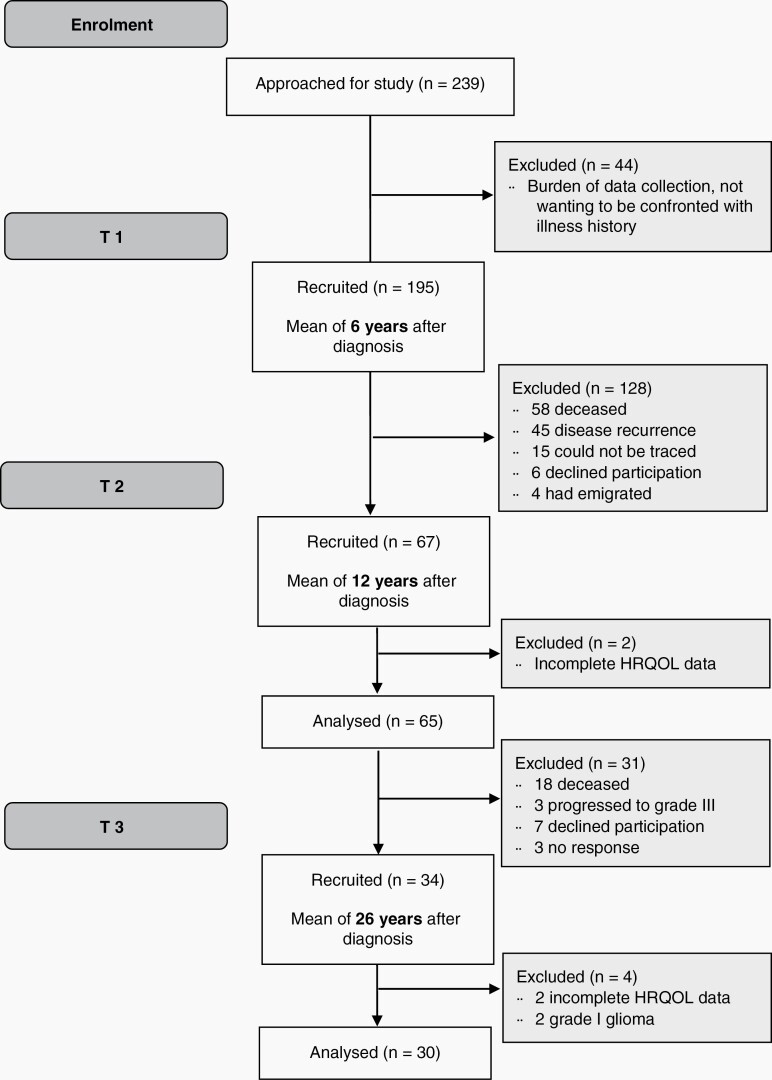
While patients with diffuse low-grade glioma (LGG) often survive for years, there is a risk of tumor progression which may impact patients' long-term health-related quality of life (HRQOL) and neurocognitive functioning (NCF). We present a follow-up of LGG patients and their informal caregivers (T3) who took part in our previous HRQOL investigations (T1, M = 7 and T2 M = 13 years after diagnosis).
Participants completed HRQOL (short form-36 health survey [SF-36]; EORTC-BN20), fatigue (Checklist Individual Strength [CIS]), and depression (Center for Epidemiological Studies-Depression [CES-D]) questionnaires and underwent NCF assessments. T3 scores were compared with matched controls. Changes over time (T1-T2-T3) on group and participant level were assessed. Where available, histology of the initial tumor was revised and immunohistochemical staining for IDH1 R132H mutant protein was performed.
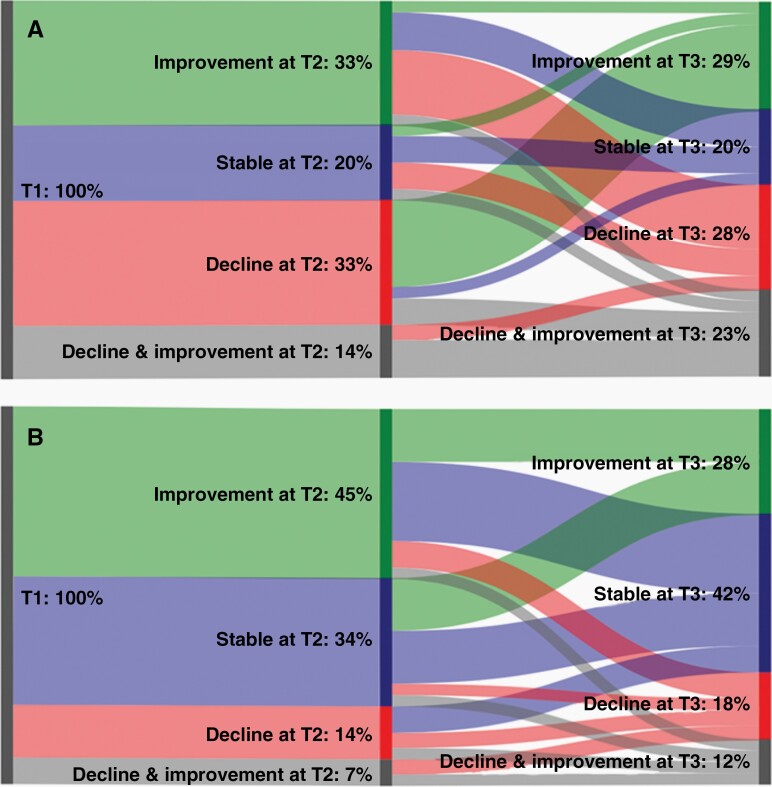
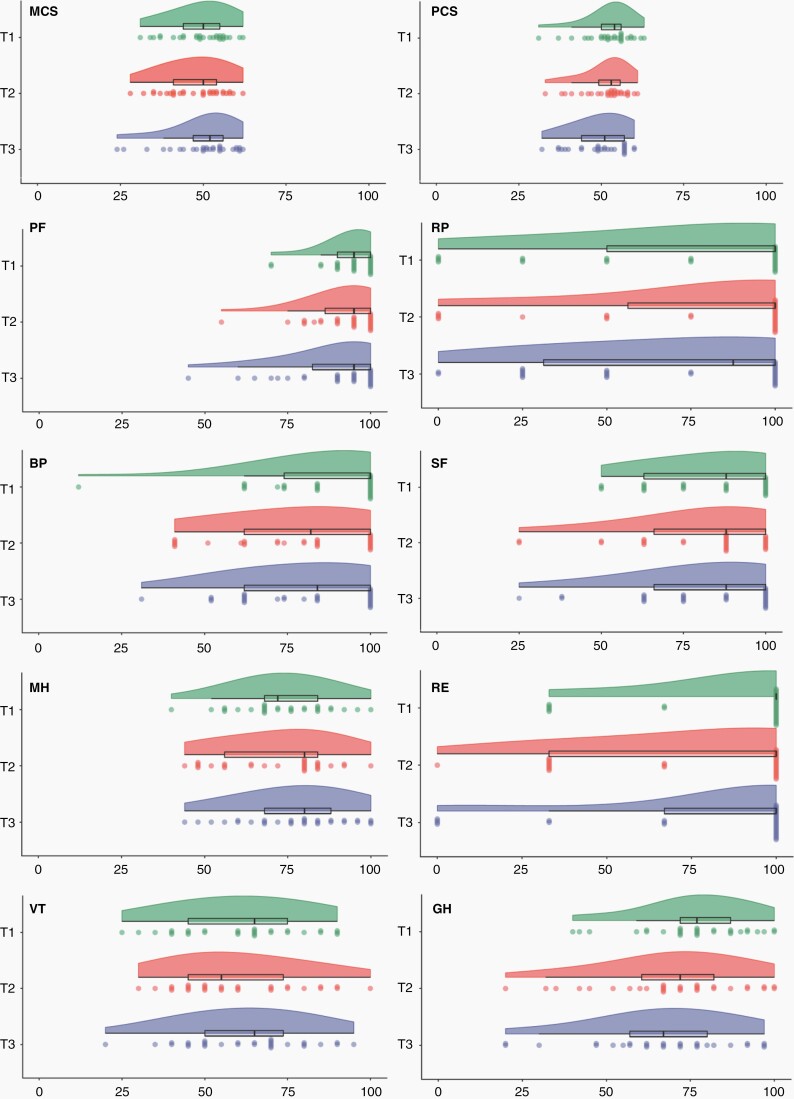
Thirty patients and nineteen caregivers participated. Of N = 11 with tissue available, 3 patients had confirmed diffuse LGG. At T3, patients (M = 26 years after diagnosis) had HRQOL and NCF similar to, or better than controls, yet 23.3% and 53.3% scored above the cut-off for depression (≥16 CES-D) and fatigue (≥35 CIS), respectively. Caregivers' HRQOL was similar to controls but reported high rates of fatigue (63.2%). Over time, patients' mental health improved (P < .05). Minimal detectable change in HRQOL over time was observed in individual patients (30% improvement; 23.3% decline; 20% both improvement and decline) with 23.3% remaining stable. NCF remained stable or improved in 82.8% of patients.
While HRQOL and NCF do not appear greatly impacted during long-term survivorship in LGG, depressive symptoms and fatigue are persistent.
弥漫性低级别胶质瘤(LGG)患者的生存期通常可达数年,但仍存在肿瘤进展的风险,这可能会影响患者的长期健康相关生活质量(HRQOL)和神经认知功能(NCF)。我们对曾参与我们之前 HRQOL 调查(T1,诊断后 7 年和 T2,诊断后 13 年)的 LGG 患者及其非正式照顾者(T3)进行了随访。
参与者完成了 HRQOL(36 项简短健康调查 [SF-36];EORTC-BN20)、疲劳(个体力量检查表 [CIS])和抑郁(流行病学研究中心抑郁量表 [CES-D])问卷,并进行了 NCF 评估。T3 评分与匹配的对照组进行了比较。在组和参与者水平上评估了随时间的变化(T1-T2-T3)。在有组织样本的情况下,对初始肿瘤的组织学进行了修订,并进行了 IDH1 R132H 突变蛋白的免疫组织化学染色。
共有 30 名患者和 19 名照顾者参与了本研究。在有组织样本的 N = 11 名患者中,3 名患者的诊断为弥漫性 LGG。在 T3 时,患者(诊断后 26 年)的 HRQOL 和 NCF 与对照组相似或更好,但仍有 23.3%和 53.3%的患者抑郁(≥16 CES-D)和疲劳(≥35 CIS)评分超过临界值。照顾者的 HRQOL 与对照组相似,但报告疲劳率较高(63.2%)。随着时间的推移,患者的心理健康状况有所改善(P<.05)。个别患者的 HRQOL 随时间变化的最小可检测变化为(30%改善;23.3%下降;20%改善和下降),其中 23.3%保持稳定。82.8%的患者的 NCF 保持稳定或改善。
尽管在 LGG 的长期生存中,HRQOL 和 NCF 似乎没有受到很大影响,但抑郁症状和疲劳仍然存在。