Department of Neurosciences, Lerner Research Institute, Cleveland Clinic, Cleveland, Ohio, USA.
Department of Biological, Geological, and Environmental Sciences, Cleveland State University, Cleveland, Ohio, USA.
Immunol Rev. 2022 Oct;311(1):39-49. doi: 10.1111/imr.13121. Epub 2022 Jul 31.
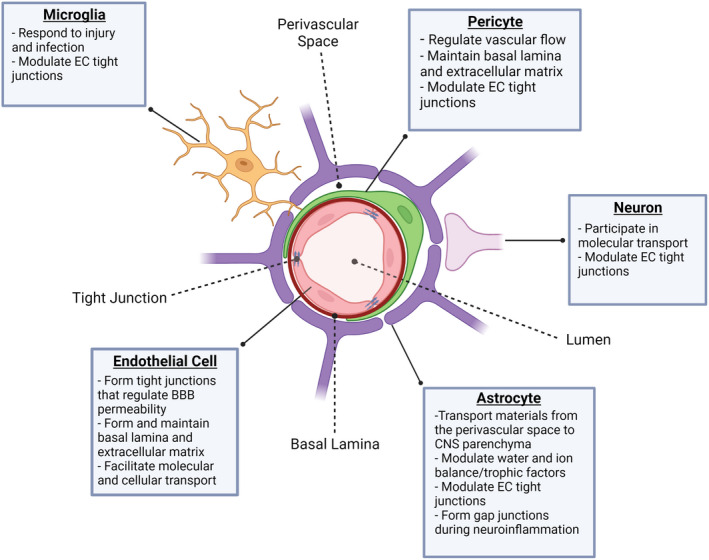
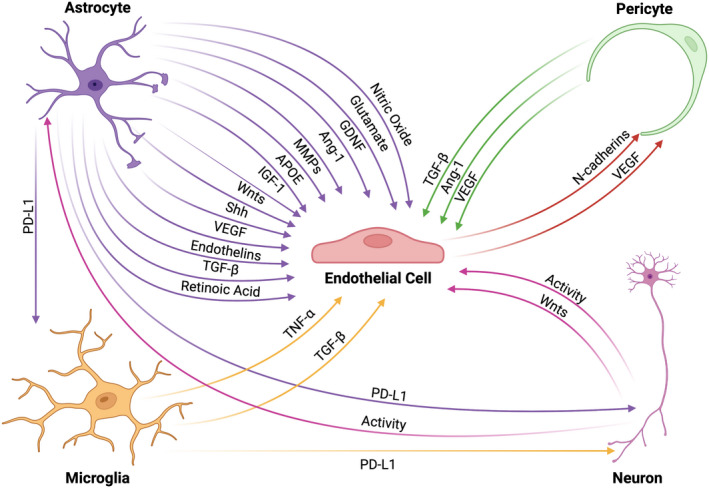
The blood-brain barrier (BBB) is a selectively permeable barrier separating the periphery from the central nervous system (CNS). The BBB restricts the flow of most material into and out of the CNS, including many drugs that could be used as potent therapies. BBB permeability is modulated by several cells that are collectively called the neurovascular unit (NVU). The NVU consists of specialized CNS endothelial cells (ECs), pericytes, astrocytes, microglia, and neurons. CNS ECs maintain a complex "seal" via tight junctions, forming the BBB; breakdown of these tight junctions leads to BBB disruption. Pericytes control the vascular flow within capillaries and help maintain the basal lamina. Astrocytes control much of the flow of material that has moved beyond the CNS EC layer and can form a secondary barrier under inflammatory conditions. Microglia survey the border of the NVU for noxious material. Neuronal activity also plays a role in the maintenance of the BBB. Since astrocytes, pericytes, microglia, and neurons are all able to modulate the permeability of the BBB, understating the complex contributions of each member of the NVU will potentially uncover novel and effective methods for delivery of neurotherapies to the CNS.
血脑屏障(BBB)是一种选择性渗透屏障,将外周与中枢神经系统(CNS)分隔开。BBB 限制了大多数物质进出 CNS 的流动,包括许多可作为有效治疗药物的物质。BBB 的通透性由几种被统称为神经血管单元(NVU)的细胞调节。NVU 由专门的中枢神经系统内皮细胞(EC)、周细胞、星形胶质细胞、小胶质细胞和神经元组成。中枢神经系统 EC 通过紧密连接维持复杂的“密封”,形成 BBB;这些紧密连接的破坏会导致 BBB 破裂。周细胞控制毛细血管内的血管流量,并有助于维持基膜。星形胶质细胞控制已超出 CNS EC 层的物质的大部分流动,并在炎症条件下形成次级屏障。小胶质细胞在 NVU 的边界处检测有害物质。神经元活动也在 BBB 的维持中发挥作用。由于星形胶质细胞、周细胞、小胶质细胞和神经元都能够调节 BBB 的通透性,因此了解 NVU 每个成员的复杂贡献,可能会为向 CNS 输送神经疗法提供新的、有效的方法。