Magar Lil Budha, Rayamajhee Binod, Khadka Sujan, Karki Gaurab, Thapa Alina, Yasir Muhammad, Thapa Sandeep, Panta Om Prakash, Sharma Suprina, Poudel Pramod
Department of Microbiology, National College, Tribhuvan University, Kathmandu, Nepal.
School of Optometry and Vision Science, Faculty of Medicine and Health, UNSW, Sydney, Australia.
Scientifica (Cairo). 2022 Jul 19;2022:9675041. doi: 10.1155/2022/9675041. eCollection 2022.
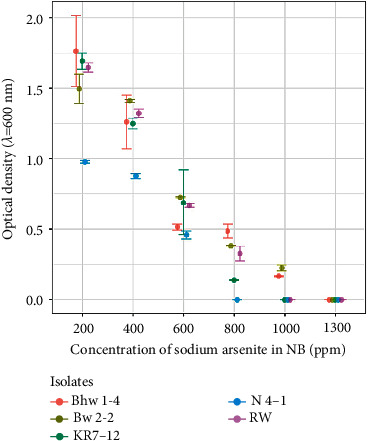
Arsenic contamination in soil and water is one of the major environmental problems in multiple countries including Nepal imposing a serious threat to the ecosystem and public health. Many soil bacteria can detoxify arsenic, including genus . With an objective to gauge the plant growth-promoting activities of arsenic-resistant species, 36 samples (soil, rice, cauliflower, and beans) were collected from the region of Nepal. For selective isolation of s species, each sample was heated at 80°C for 15 min before the inoculation into nutrient agar (NA). Following the standard protocol, arsenic-resistant species were screened using NA supplemented with 100 ppm sodium arsenate and sodium arsenite. Among 158 randomly selected isolates, only five isolates were able to tolerate sodium arsenite concentration up to 600 ppm. Notably, all five isolates were able to produce indole acetic acid (IAA), a plant hormone, and solubilize phosphate. Based on biochemical analysis and rRNA gene sequencing, isolates N4-1, RW, KR7-12, Bhw1-4, and BW2-2 were identified as subsp. , , and , respectively. To the best of our knowledge, this is the first study showing the presence of arsenic-resistant in Nepalese soil with plant growth-promoting traits. Possible utilization of these strains could facilitate the novel bioremediation pathway to reduce the toxic effect of arsenic from the soil and water in the region of Nepal.
土壤和水中的砷污染是包括尼泊尔在内的多个国家面临的主要环境问题之一,对生态系统和公众健康构成严重威胁。许多土壤细菌能够使砷解毒,包括[细菌属名称未给出]属。为了评估抗砷[细菌属名称未给出]物种促进植物生长的活性,从尼泊尔的[地区名称未给出]地区采集了36个样本(土壤、水稻、花椰菜和豆类)。为了选择性分离[细菌属名称未给出]物种,每个样本在接种到营养琼脂(NA)之前于80°C加热15分钟。按照标准方案,使用添加了100 ppm砷酸钠和亚砷酸钠的NA筛选抗砷[细菌属名称未给出]物种。在158个随机选择的分离株中,只有5个分离株能够耐受高达600 ppm的亚砷酸钠浓度。值得注意的是,所有5个分离株都能够产生植物激素吲哚乙酸(IAA)并溶解磷酸盐。基于生化分析和[16S rRNA基因未给出]基因测序,分离株N4 - 1、RW、KR7 - 12、Bhw1 - 4和BW2 - 2分别被鉴定为[细菌种名未给出]亚种、[细菌种名未给出]、[细菌种名未给出]和[细菌种名未给出]。据我们所知,这是第一项显示尼泊尔土壤中存在具有促进植物生长特性的抗砷[细菌属名称未给出]的研究。这些[细菌属名称未给出]菌株的可能利用可以促进新的生物修复途径,以降低尼泊尔[地区名称未给出]地区土壤和水中砷的毒性作用。