Higa Nayuta, Akahane Toshiaki, Yokoyama Seiya, Yonezawa Hajime, Uchida Hiroyuki, Takajo Tomoko, Otsuji Ryosuke, Hamada Taiji, Matsuo Kei, Kirishima Mari, Hata Nobuhiro, Hanaya Ryosuke, Tanimoto Akihide, Yoshimoto Koji
Department of Neurosurgery, Graduate School of Medical and Dental Sciences, Kagoshima University, Kagoshima-City, Kagoshima, Japan.
Department of Pathology, Graduate School of Medical and Dental Sciences, Kagoshima University, Kagoshima-City, Kagoshima, Japan.
Neurooncol Adv. 2022 Jun 21;4(1):vdac097. doi: 10.1093/noajnl/vdac097. eCollection 2022 Jan-Dec.
Platelet-derived growth factor receptor alpha () is the second most frequently mutated tyrosine kinase receptor in glioblastoma (GBM). However, the prognostic impact of amplification on GBM patients remains unclear. Herein, we evaluated this impact by retrospectively analyzing outcomes of patients with wild-type GBM.
Using a custom-made oncopanel, we evaluated gain/amplification in 107 GBM samples harboring wild-type , along with promoter () methylation status.
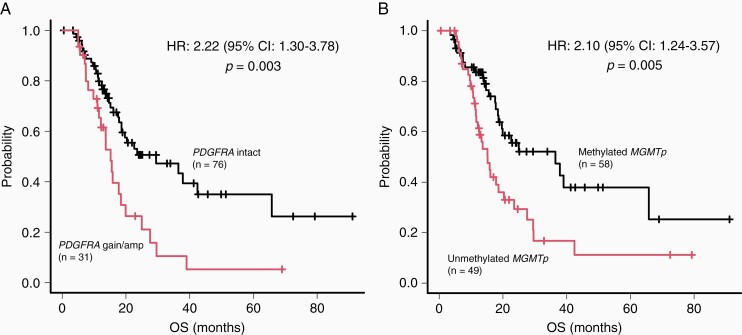
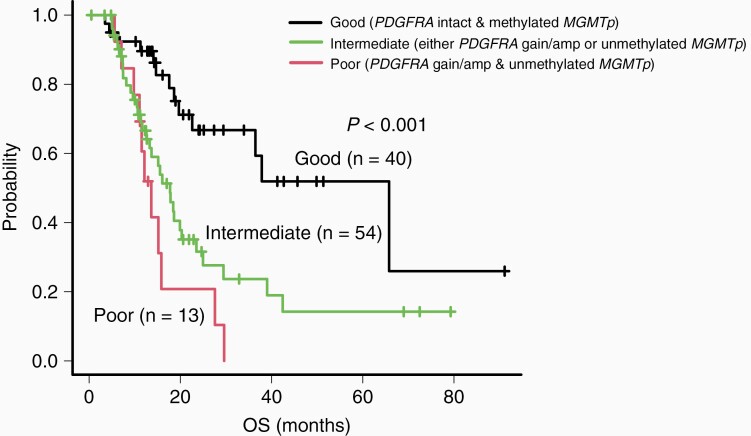
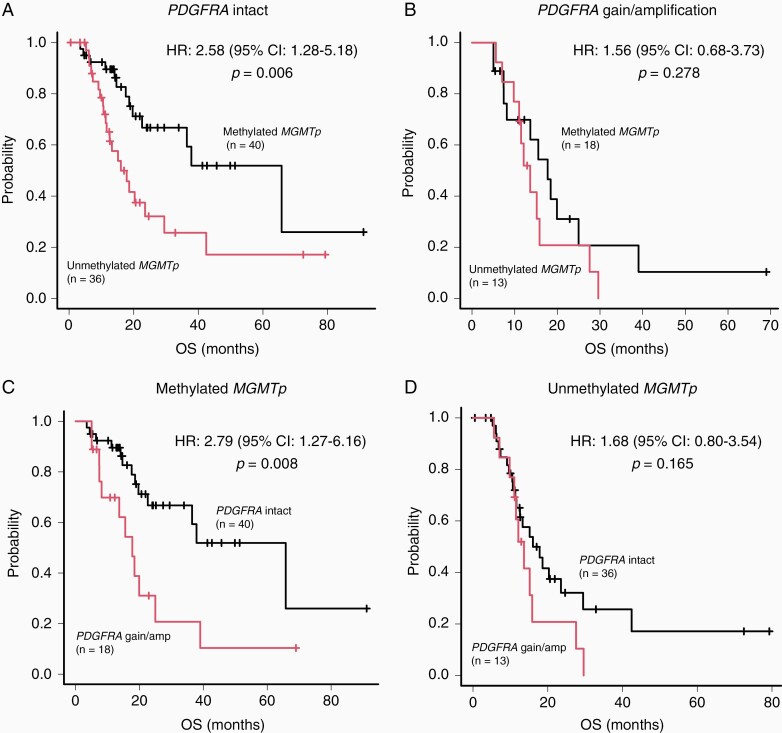
We detected gain/amplification in 31 samples (29.0%). gain/amplification predicted poor prognosis ( = .003). Compared to unamplified , gain/amplification in GBM was associated with higher patient age ( = .031), higher Ki-67 score ( = .019), and lower extent of surgical resection ( = .033). Unmethylated also predicted poor prognosis ( = .005). As gain/amplification and unmethylated were independent factors for poor prognosis in multivariate analyses, we grouped GBM cases based on and status: poor ( gain/amplification and unmethylated ), intermediate ( gain/amplification or unmethylated ), and good ( intact and methylated ) prognosis. The Kaplan-Meier survival analysis indicated that these groups significantly correlated with the OS of GBM patients ( < .001).
Here we report that gain/amplification is a predictor of poor prognosis in wild-type GBM. Combining gain/amplification with methylation status improves individual prognosis prediction in patients with wild-type GBM.
血小板衍生生长因子受体α()是胶质母细胞瘤(GBM)中第二常见的突变酪氨酸激酶受体。然而,扩增对GBM患者的预后影响仍不清楚。在此,我们通过回顾性分析野生型GBM患者的结局来评估这种影响。
使用定制的肿瘤基因检测板,我们评估了107例野生型的GBM样本中的增益/扩增情况,以及启动子()甲基化状态。
我们在31个样本(29.0%)中检测到增益/扩增。增益/扩增预示着预后不良( = 0.003)。与未扩增的相比,GBM中的增益/扩增与患者年龄较大( = 0.031)、Ki-67评分较高( = 0.019)以及手术切除范围较小( = 0.033)相关。未甲基化的也预示着预后不良( = 0.005)。由于在多变量分析中增益/扩增和未甲基化的是预后不良的独立因素,我们根据和状态对GBM病例进行分组:预后差(增益/扩增且未甲基化)、中等(增益/扩增或未甲基化)和预后良好(完整且甲基化)。Kaplan-Meier生存分析表明,这些组与GBM患者的总生存期显著相关( < 0.001)。
在此我们报告,增益/扩增是野生型GBM预后不良的一个预测指标。将增益/扩增与甲基化状态相结合可改善野生型GBM患者的个体预后预测。