Immunology Section, Lund University, Lund, Sweden.
Department of Health Technology, Technical University of Denmark, Lyngby, Denmark.
Front Immunol. 2022 Jul 13;13:932388. doi: 10.3389/fimmu.2022.932388. eCollection 2022.
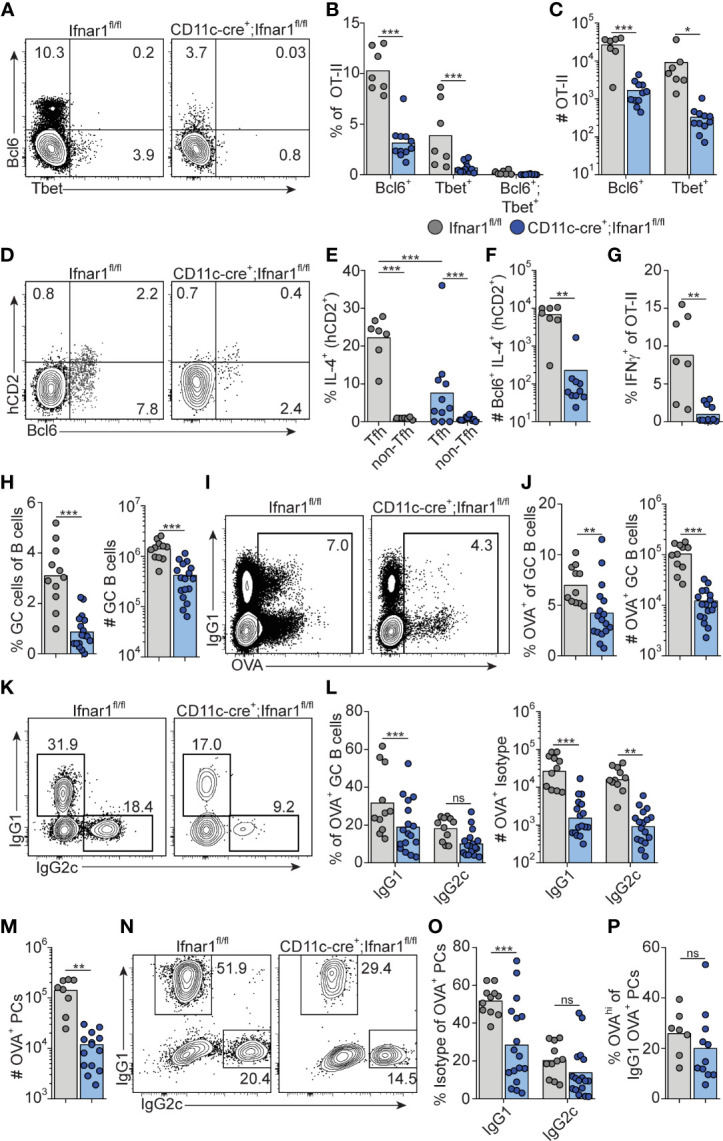
Type I interferons (IFNs) are essential for antiviral immunity, appear to represent a key component of mRNA vaccine-adjuvanticity, and correlate with severity of systemic autoimmune disease. Relevant to all, type I IFNs can enhance germinal center (GC) B cell responses but underlying signaling pathways are incompletely understood. Here, we demonstrate that a succinct type I IFN response promotes GC formation and associated IgG subclass distribution primarily through signaling in cDCs and B cells. Type I IFN signaling in cDCs, distinct from cDC1, stimulates development of separable Tfh and Th1 cell subsets. However, Th cell-derived IFN-γ induces T-bet expression and IgG2c isotype switching in B cells prior to this bifurcation and has no evident effects once GCs and Tfh cells developed. This pathway acts in synergy with early B cell-intrinsic type I IFN signaling, which reinforces T-bet expression in B cells and leads to a selective amplification of the IgG2c GC B cell response. Despite the strong Th1 polarizing effect of type I IFNs, the Tfh cell subset develops into IL-4 producing cells that control the overall magnitude of the GCs and promote generation of IgG1 GC B cells. Thus, type I IFNs act on B cells and cDCs to drive GC formation and to coordinate IgG subclass distribution through divergent Th1 and Tfh cell-dependent pathways.
I 型干扰素 (IFNs) 是抗病毒免疫的必要条件,似乎代表了 mRNA 疫苗佐剂的关键组成部分,并且与系统性自身免疫性疾病的严重程度相关。与所有人相关的是,I 型 IFNs 可以增强生发中心 (GC) B 细胞反应,但潜在的信号通路尚未完全了解。在这里,我们证明简洁的 I 型 IFN 反应主要通过 cDCs 和 B 细胞中的信号转导来促进 GC 形成和相关 IgG 亚类分布。cDC 中的 I 型 IFN 信号转导与 cDC1 不同,可刺激可分离的 Tfh 和 Th1 细胞亚群的发育。然而,Th 细胞衍生的 IFN-γ 在这种分支之前诱导 B 细胞中的 T-bet 表达和 IgG2c 同种型转换,并且一旦 GC 和 Tfh 细胞发育,就没有明显的影响。该途径与早期 B 细胞内在的 I 型 IFN 信号协同作用,该信号增强 B 细胞中的 T-bet 表达,并导致 IgG2c GC B 细胞反应的选择性扩增。尽管 I 型 IFNs 具有强烈的 Th1 极化作用,但 Tfh 细胞亚群发育成产生 IL-4 的细胞,控制 GC 的总体幅度并促进 IgG1 GC B 细胞的产生。因此,I 型 IFNs 作用于 B 细胞和 cDC 以驱动 GC 形成,并通过不同的 Th1 和 Tfh 细胞依赖的途径协调 IgG 亚类分布。